
Voters in California are preparing to choose a new governor to replace Gavin Newsom. The state’s “jungle primary”—the system adopted in 2011 in which all candidates run against one another and the two with the highest support move on to the general election—was thrown into some turmoil when former Rep. Eric Swalwell dropped out following multiple allegations of sexual assault.
A recent debate among several remaining contenders, including former California attorney general and Biden cabinet secretary Xavier Becerra, hedge fund founder Tom Steyer, and former Rep. Katie Porter failed to produce a clear frontrunner. As Democrats struggle to unite, Republican Steve Hilton, endorsed by President Donald Trump, is polling strongly. Riverside County Sheriff Chad Bianco has consistently polled in third place.
Voters in California are preparing to choose a new governor to replace Gavin Newsom. The state’s “jungle primary”—the system adopted in 2011 in which all candidates run against one another and the two with the highest support move on to the general election—was thrown into some turmoil when former Rep. Eric Swalwell dropped out following multiple allegations of sexual assault.
A recent debate among several remaining contenders, including former California attorney general and Biden cabinet secretary Xavier Becerra, hedge fund founder Tom Steyer, and former Rep. Katie Porter failed to produce a clear frontrunner. As Democrats struggle to unite, Republican Steve Hilton, endorsed by President Donald Trump, is polling strongly. Riverside County Sheriff Chad Bianco has consistently polled in third place.
Election results in California often carry national implications. Given the state’s size and diversity, as well as its sizable number of votes in the Electoral College (54), it can serve as a powerful platform for shaping the direction of the party nationwide and even for emerging as a national leader.
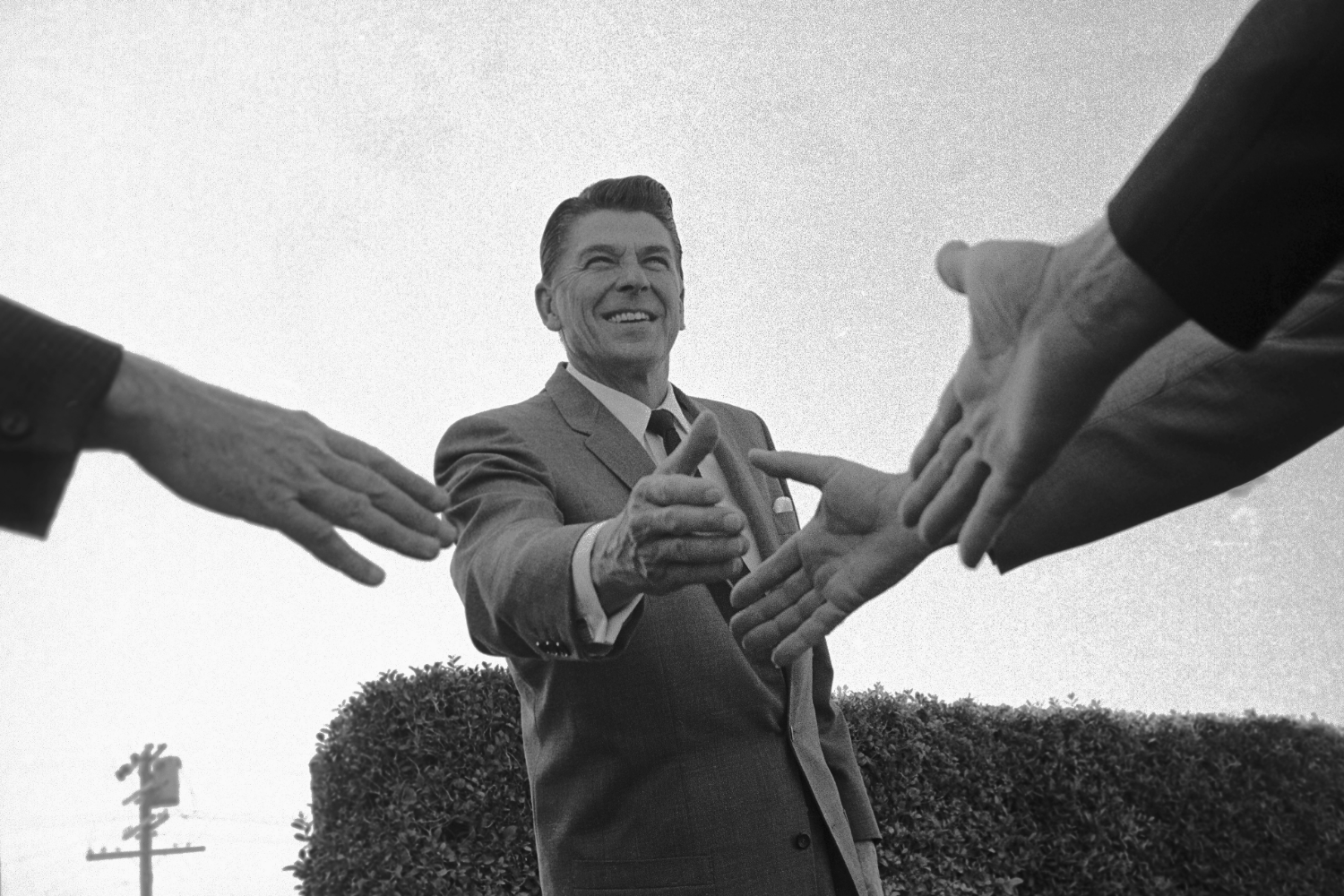
The nation has seen this before, in 1966, when the Republican primary produced Ronald Reagan, a victory that would go on to reshape the GOP and national politics for decades.
The Republican Party was deeply divided in the 1960s. The Northeastern wing of the GOP, led by figures such as New York Gov. Nelson Rockefeller and Sen. Jacob Javits, pulled the party toward the center, reflecting relatively liberal positions on issues like civil rights and government health care. By contrast, Republicans from the Midwest and Sun Belt pushed debates in a different direction, emphasizing opposition to government spending, high taxes, and economic regulation. As a result, moderation generally remained the preferred approach in selecting candidates for most offices.
This conventional wisdom was tested during the 1964 presidential election. When Arizona Sen. Barry Goldwater, a leading right-wing conservative, secured the Republican nomination, the party establishment was horrified. At the Republican National Convention at the Cow Palace in California, Rockefeller was booed from the floor when he urged colleagues to remember the virtues of moderation. By contrast, delegates cheered when Goldwater declared that “extremism in the defense of liberty is no vice.” U.S. politics, however, was not ready for a President Goldwater. President Lyndon Johnson, who had succeeded John F. Kennedy after his tragic assassination in Dallas, trounced the senator in one of the largest landslides in U.S. history, ushering massive Democratic majorities into Congress.
The one shining star of the Republican campaign had been Ronald Reagan. Reagan, a former Democratic Hollywood actor turned conservative spokesman for General Electric, was starting to emerge as one of the most exciting voices on the right. He appeared in a campaign spot for Goldwater on Oct. 27, 1964, called “A Time for Choosing,” a televised speech that captivated the party. “This is the issue of this election,” Reagan said in the ad. “Whether we believe in our capacity for self-government or whether we abandon the American revolution and confess that a little intellectual elite in a far-distant capitol can plan our lives for us better than we can plan them ourselves.” Although Republicans were disillusioned that Goldwater had suffered such a stinging defeat, they looked to Reagan with admiration.
Two years later, despite the 1964 election seemingly having discredited genuine conservatism, Reagan entered the primary for the California gubernatorial race. During the primary, he faced George Christopher, the former mayor of San Francisco (1956 to 1964), a handsome 58-year-old who embodied the party’s mid-century moderation. As mayor, Christopher was credited with revitalizing the city’s financial district, leading a housing boom, and luring the New York Giants to San Francisco.
The California Republican League, representing the state’s Republican moderates, backed Christopher as the candidate most likely to win the 1966 primary and the one whose experience best suited him for governing. Christopher accused Reagan of running the “dirtiest and most scurrilous smear campaign I have ever witnessed.” Even some of Reagan’s allies worried he might not be able to prevail. One of his strongest supporters, Caspar Weinberger, feared that Reagan’s unwillingness to distance himself from the extremist John Birch Society would doom his chances.
While Christopher attacked the 55-year old Reagan as a dirty campaigner and a right-wing zealot who would doom the party, Reagan countered by denouncing “welfare bums” and the student anti-war protesters at the University of California, Berkeley. Reagan warned one audience that the young demonstrators were “not just lewd, but mentally sick.” In a speech at Cow Palace on May 12, the site of the historic 1964 convention, Reagan criticized what he called the “morality and decency gap” at the university. He also played to growing anger among white voters about the urban unrest that shook Watts in August 1965. He vowed to mount a “moral crusade” to end the “arrogance” of the Democratic regime governing the state. While offering a bright optimistic vision for California, he painted a dark picture of the state reeling from misguided liberal policies: “Our city streets are jungle paths after dark, with more crimes of violence than New York, Pennsylvania, and Massachusetts combined.” He called over and over for law and order.
Reagan’s campaign was run by Stuart Spencer and Bill Roberts, who helped craft a television-friendly public image of their candidate that maintained his ideological appeal while undercutting claims of extremism. Their firm had been recommended by Goldwater, who had been impressed by what they did against him when representing Rockefeller in 1964. Democratic Gov. Pat Brown’s attempt to sabotage the Republicans by spreading smears about Christopher—assuming Reagan could be more easily defeated—ultimately backfired. Finally, Reagan drew strong support from Hollywood, where he had spent a good deal of his career. A number of prominent celebrities—including John Wayne and Jimmy Stewart—backed him.
Reagan stunned the nation by defeating Christopher, as well as several other candidates, with 65 percent of the vote. Everyone seemed to be watching. Shortly after winning the primary, The Austin Statesman reported about conversations taking place to draft Reagan to run in the 1968 presidential election. Former President Dwight Eisenhower met with the California Republican and backed his candidacy—even though the state’s senior party member, Sen. Thomas Kuchel, remained ambivalent about throwing his support behind someone whose record was so far to the right. Though nobody had any doubt that he was aligned with Goldwater’s vision of the party, having been the star of the campaign’s most famous ads, Reagan’s team had managed to soften his image by keeping the focus on the “intellectual clique in Sacramento” that threatened working- and middle-class Californians.
Seeing these developments from a more pessimistic point of view, the baseball star Jackie Robinson, a Black Republican who had broken with his party as a result of Goldwater’s radical extremism, including on race, warned that Reagan was just like Goldwater—only that his Hollywood charisma made him appear less threatening.
During the general election, Reagan continued with the same themes that he used to defeat Christopher.
Reagan, according to historian Matthew Dallek in The Right Moment: Ronald Reagan’s First Victory and the Decisive Turning Point in American Politics, “successfully linked the liberal social programs of the ‘60s with disorder in the streets … The Reagan revolution would prove so lasting because the formulas developed in the heat of the moment—pro-social order, pro-individual liberty, anti-government meddling—had a lasting appeal.” In a state where Democrats outnumbered Republican voters by three to two, Reagan defeated Brown on Nov. 8 with nearly 58 percent of the vote.
It was a good year for Republicans, who gained 47 seats in the U.S. House of Representatives. They helped roll back Democrats’ gains in the 1964 election, which had created the political foundation of President Johnson’s Great Society.
While serving two terms in the statehouse in Sacramento, even as he compromised with the Democratic-controlled legislature on issues such as abortion, taxation, and government funding, Reagan would continue to fine-tune many of his core rhetorical themes from the campaign. He then challenged Republican President Gerald Ford in the 1976 primaries, nearly unseating the incumbent, and won the presidency in 1980 in a historic victory over President Jimmy Carter.
Reagan’s years as California governor had given him a national platform, elevating his brand of right-wing conservatism and demonstrating that a candidate who did not valorize the political center could win and hold power. Those years positioned him well to capture the White House and to push national politics sharply to the right.
It is not clear whether any of the candidates currently running in the California race have the same potential as Reagan. For Democrats, that would mean an elected official who can help to define what the next generation of their party politics might look like, and for Republicans, what the GOP might become once Trump is no longer in power.
But as the state has shown with Reagan, it has the capacity to produce figures with national impact. Often, the candidate capable of doing big things does not become apparent until that person is in office and begins using the tools the state provides to make national statements. For this reason, most political experts keep a close eye on the Golden State, knowing it has a long history of generating political shifts that reach far beyond its borders.



