
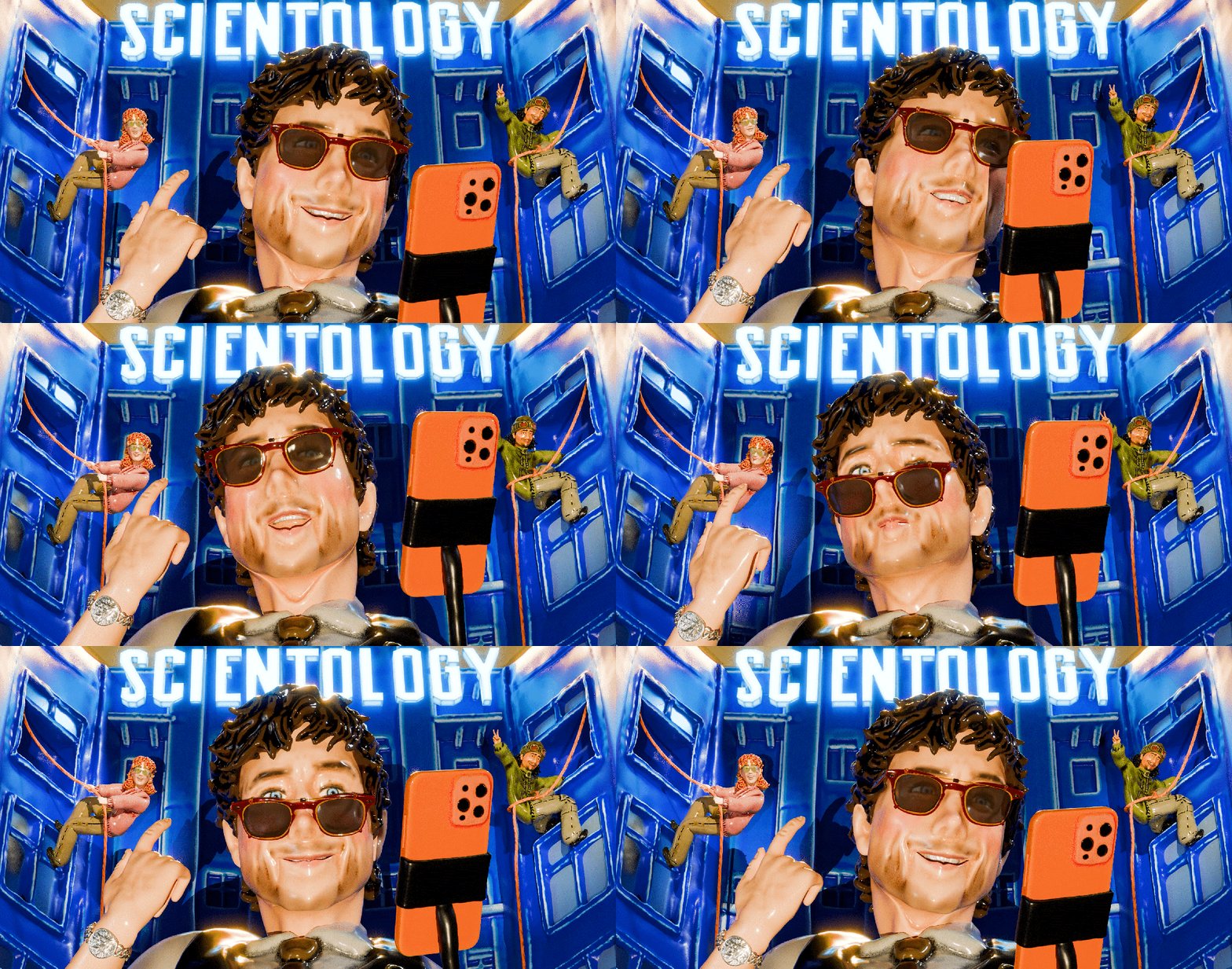
If you go on TikTok looking for information about Scientology, you’ll likely encounter a young man named Gunnar Scharf, leading impassioned tours of church buildings and holding holy texts aloft. Scharf has blue eyes, spiky dirty blonde hair, a trim black vest, and an abiding passion for telling the youth just how cool, normal, and approachable his faith really is.
“Inside Scientology,” one video begins, with Scharf leaning against a set of swinging doors, “what do we have that benefits all religions? Come with me.” He hikes a thumb over his shoulder and leads viewers in.
Scharf is the online face of Scientology’s Twin Cities church, and since the beginning of 2025 he has starred in dozens of videos on its TikTok and Instagram pages, inviting curious outsiders to check out what the church has to offer. He shows off personality tests and e-meters—the tools that Scientology uses to “audit” the curious and faithful alike—and answers common questions, like “Do Scientologists pray?” (The answer is no, unless, in addition to Scientology, they also belong to a religion where prayer is practiced.)
The account has over 10,000 followers and generates a lot of discussion—much of it either focused on Scharf’s looks (“I could fix him,” one Redditor declared) or witheringly critical (“So do I cut ties with my friends and family before or after joining?” one commenter asked on a recent video).
Scharf is just one of the young people at dozens of Scientology centers around the world who have begun making videos online, often using popular songs and trending audio, presenting a more approachable, amiable, and youthful face for the church. Many of these Instagram and TikTok accounts became especially active starting in early 2025 and have kept up an intense pace since.
A TikTok account for Scientology’s San Francisco chapter shows a younger male staffer leading tours. A less-active account called “Life Improvement Centre” shares TikToks from a Scientology mission in London, where youthful staff members brandish copies of the core Scientology text Dianetics to camera or answer questions about the church while standing near informational displays. In Las Vegas, an account presents two beaming women with long hair doing synchronized dances as onscreen text lists the “top three books to read in Scientology.” And the Los Feliz mission has been especially busy; there, a group of young female Scientologists star in a series of pop psychology-flavored videos about how Dianetics can support readers through self-discovery, mental health challenges, and even breakups.
“Stop stressing, you silly little goose,” one Los Feliz post declares, over a video of three female Scientologists jumping up and down in a kitchen. “You have a good heart, you’re not your intrusive thoughts, and Scientology exists. The universe is on your side… You’re going to be just fine.”
According to Tony Ortega, a veteran journalist and former Village Voice editor in chief who has covered Scientology for decades, the videos are part of an evolving social media strategy. “They’ve been attempting to project a different impression for the past few years,” he says. “Now we have this online presence on TikTok and Instagram.”
A public relations pivot was arguably necessary, and even overdue, Ortega says, as Scientology is in need of new members. “They’re desperate right now,” he says. “It’s gotten really difficult for them. It’s so hard to recruit for Scientology.”
The videos come after years of bad press. The commenter who joked about cutting ties, for instance, was referring to just one controversial Scientology practice that became public through journalists and ex-members. They range from that concept, “disconnection,” where people in the religion are said to be pressured to sever contact with those who leave, to the financial and physical abuse former Scientologists say they experienced. High-profile defectors like actor Leah Remini and investigative projects like the book and documentary Going Clear have presented narratives of control and physical abuse that people allege having suffered during their time with the church.
Scientology has denied all reports of abuse, and accuses critics of harboring anti-religious bias, or worse. The STAND League, a Scientology-backed organization that says it fights discrimination against Scientologists and other religions, has, for instance, called Going Clear a “bigoted propaganda video,” and maintains webpages devoted to denouncing its critics, including Ortega, who they label as “an anti-religious hate blogger.”
In December 2025, however, the new, more lighthearted social media strategy was on full display in a Christmas-season TikTok. Scientology staffers from several different cities and countries were edited together in a video depicting them throwing a copy of Dianetics to each other. The last to catch the book is Scotland’s Amir Essalhi, a young man shown beaming in a red sweatshirt.
Essalhi, who is no longer in the church, first got interested in Scientology when he was an 18 year old film student with a love of Tom Cruise and dreams of acting. He heard Scientology had a library. “I like learning about philosophy and theology and life in general,” he told me recently. “They had mental health books and books claiming to have the answer about life. They sell themselves an applied philosophy. It’s not like you’re joining a religion.”
Essalhi was soon tapped to work without pay managing money for the Edinburgh Scientology center. Essalhi, who lived at home with his parents, says he dropped out of school and took on gigs helping fellow Scientologists with their various businesses: “Ads, social media, party businesses, cleaning, admin,” he says. (The church has for years faced, and denied, allegations it exploits members for money and forced labor.) It was challenging, he adds. “You don’t sleep.” Essalhi ultimately became the Edinburgh center’s public contact secretary, another unpaid executive role tasked with “getting new people through the front door and creating as many new Scientologists as possible.”
“We’re all in a WhatsApp group—or I was—called Social Media Warriors,” says Essalhi, who is now 21 years old. “Its purpose is to get Scientology out there on as many social media platforms as possible.”
“You basically get given full creative control,” he says.
Late last year, Essalhi decided to use his perceived autonomy in an unusual way by agreeing to appear on a podcast with Alex Barnes-Ross, a UK-based ex-Scientologist and prominent critic of the church’s alleged abuses.
“Any young person nowadays who walks past Scientology and gets handed a leaflet, they’re going to Google .”
Essalhi first encountered Barnes-Ross as he protested outside a 2025 Scientology conference in East Grinstead, where the church keeps its UK headquarters. His curiosity was piqued, and after a few weeks of cautious communication, the two agreed to speak on Barnes-Ross’ show. Essalhi hoped not only to defend Scientology, but to demonstrate the church’s commitment to free speech.
During the January recording, Barnes-Ross predicted their conversation would have negative repercussions for Essalhi. Essalhi disagreed: “I thought I was free to speak to this guy.”
“It was a great conversation,” Essalhi now says, a little ruefully, “that opened up Pandora’s box. The next two weeks after that I was subjected to all sorts of punishment.”
According to Essalhi, he spent that time being interrogated by senior Scientology officials before being ordered to do what he describes as “hard manual labor” renovating a new Scientology building. “And for what reason?” he asks. “For talking to somebody? For talking to a critic of the organization? For encouraging open dialogue and free speech?”
After one day of construction, Essalhi decided he was done: “I grabbed a grocery store bag, I grabbed all my awards, everything I was commended for, all my belongings. I went out the emergency exit, and I never returned.” (A Scientology spokesperson acknowledged a request for comment for this story, but did not provide any on the record response, including to questions about Essalhi’s account.)
Barnes-Ross says he joined the church at 15, and by 2014 was director of public sales for its London branch, charged with hawking copies of Dianetics and paid courses based on the tenets of its author, L. Ron Hubbard, the science fiction writer who founded Scientology. Today, Barnes-Ross tells me that his podcast is part of his efforts to give former Scientologists “a platform to share their stories and campaign for legislative changes in the UK to hold Scientology accountable for their abusive practices.” He maintains a YouTube page, Apostate Alex, with over 10,000 followers.
Before leaving in 2016, Barnes-Ross had a similar role in London as Essalhi did in Edinburgh. He recalls pushing his supervisor in roughly 2011 to “start using social media, set up a page on Twitter and Facebook and show people what Scientology really is, because there’s all these people talking rubbish about it online.” Barnes-Ross says that while Scientology’s central offices then had bare Facebook and Twitter pages, they mostly just offered links to the main Scientology website and basic videos. Barnes-Ross recalls no city-specific social media accounts—and nothing on social media that he thought did justice to what he then saw as the benefits of Scientology texts like Dianetics.
According to Barnes-Ross, his supervisor said that if they asked for permission from Scientology’s American headquarters, they’d likely be told no; instead, they should just launch some London accounts and see if they worked.
“’Do it,’” Barnes-Ross remembers the supervisor telling him, “‘but make sure you get results. If you do it and you don’t sell books, we’ll be in a lot of trouble.’”
“Trouble,” Barnes-Ross says, could have meant being subjected to “interrogations on the e-meter in the form of what’s called a ‘sec check’, a security check” or potentially being “put on hard manual labor and forced to confess my ‘crimes.’ The stakes were very high.”
The London accounts began “pumping out content like I’ve never seen before. It was like a post every single hour,” Barnes-Ross said, leading a few potential recruits to come in for introductory stress tests. With the rise in that closely tracked metric, he says “we were able to justify” the posting as a so-called “successful action” which, according to church doctrine, cannot be stopped.
The posts were a forerunner of videos that were later produced by another Barnes-Ross supervisor, a fellow London Scientologist named Charlie Wakley. According to Barnes-Ross, Wakley’s video content showing “how cool” it was to be a young Scientologist in the city made him a global figurehead, and “ultimately led to the social media campaigns we’re seeing today.” Wakley’s social media pages have been inactive since 2021 and he did not respond to a request for comment.

While Scientology has had an online presence since the earliest days of the internet, the web has always been a bit of an unfriendly neighborhood. Its most boisterous opponent has been Anonymous, the decentralized activist group, which in 2008 launched Project Chanology, which sought to raise awareness about Scientology’s practices, troll the organization, and banish it from online spaces.
“Your organization should be destroyed for the good of your followers, for the good of mankind, and for our own enjoyment,” declared a video Anonymous posted announcing the campaign. “We shall proceed to expel you from the Internet and systematically dismantle the Church of Scientology in its present form.”
“The internet is something L. Ron Hubbard didn’t predict.”
The church has also been an object of online mockery and pranks. Today, groups of young people on TikTok are filming themselves “speed-running” Scientology buildings—seeing how deep inside they can get before being thrown out. The creator of the first speedrun video, targeting a Los Angeles church, told the Hollywood Reporter that it racked up more than 90 million views. Several of the most viral such videos have since been deleted, although it’s not clear if they were taken down by TikTok or by their creators. The church, meanwhile, told the Los Angeles Times that this behavior is a “hate crime.”
On a more practical level, the web has been a challenge for Scientology as critics have used it to create transparency around matters the church would prefer to keep private, and the organization’s leaders and lawyers have struggled to keep negative information about it from spreading online. Those critics have often been past members. In 1997, for instance, the church sued a former Scientologist from Virginia for copyright infringement after he posted a few dozen pages of doctrinal materials online. A court ruled in the church’s favor. Scientology was also successful in a similar lawsuit against the Fight Against Coercive Tactics Network, an anti-cult group founded by a former Scientologist. In that case, the church was ultimately allowed to repossess some 2000 pages of documents it claimed had been illegally copied.
But over time, this strategy proved fruitless and probably served, Streisand-effect-like, to only raise on- and offline awareness of anti-Scientology materials. Fundamentally, Ross-Barnes explains, “the internet is something L. Ron Hubbard didn’t predict,” and one the organization’s lawyers and legal threats cannot overcome. “This is a huge platform and space for free speech. People can put whatever they want on the internet. That’s something Scientology isn’t equipped for. It thinks it can control the narrative, silence critics, and avoid accountability. Perhaps this was easier in the 60s and 70s.”
“We’re all in a WhatsApp group… Its purpose is to get Scientology out there.”
Social media has given ex-Scientologists another space and platform to criticize the church. The most prominent is Jenna Miscavige, the niece of David Miscavige, Scientology’s ecclesiastical leader, who has built a large following on TikTok and YouTube talking about the neglect, isolation, and manual labor she said she suffered growing up in the Sea Org, the church’s tightly-controlled workforce.
In April, Alex Barnes-Ross was given a copy of a digital flyer circulated by the church to a Scientologist-only online community seeking recruits for a “Master dissemination group” that works to “get new people into orgs through social media.” Underneath an image of a team of people seated on a couch looking at laptops, tablets, and phones, the flyer’s authors’ claimed credit for having “introduced” “tens of thousands” to L. Ron Hubbard, while recruiting “hundreds of new people onto the Bridge,” Scientology’s graduated path of spiritual progress.
The flyer reflects the Scientology PR apparatus’ growing interest in harnessing church members not only to recruit members on social media, but to engineer a positive image that will drown out more critical voices.
“Scientology’s strategy is to try to control the dissent online and flood Facebook and Instagram and TikTok with their propaganda so it overrules the survivor stories,” Barnes-Ross explains.
The TikTok and Instagram pages being run by individual Scientology missions are likely being carefully monitored, he adds, with how they are authorized to respond to critical comments closely coordinated with the Office of Special Affairs (OSA), which oversees church public relations.
“OSA will basically send down orders and say, ‘In the future, reply like this’ or “Don’t do this,’” he says. “There’ll be very strict guidelines on what to say or not say and how to say it.”
Essalhi confirms that OSA would instruct the social media teams on how to answer negative comments. “Anyone that has to deal with the public,” he explains, would “get practiced on it routinely.”
The church’s new Instagram and TikTok presences—and, Essalhi says, an emerging emphasis on YouTube—are efforts to present a gentler and more approachable face to these platforms’ relatively young, unformed, audience, which is naturally an attractive population for Scientology. While Scientology claims a membership of millions, the figure seems to include anyone who’s ever taken one of the Church’s courses. Independent surveys have put it at fewer than 100,000 in America. A 2001 City University of New York survey estimated only about 55,000 US adults identified as Scientologists. Today, Tony Ortega pegs active membership at 20,000 to perhaps 50,000 at highest.
Scientology, Ortega says, “has an aging population. The vast majority of members…are second or third generation. They’ve been raised in Scientology rather than joining. They’re in a crisis in terms of membership. If they can get you while you’re young, you’re going to be a longstanding donor for years.”
In 2020, Mike Rinder, a former senior church official turned critic, described Scientology as “steadily shrinking” in a blog post: “The vast majority of scientologists today are… 65 to 75 years old. They are going to die off. Despite their claims to the contrary, scientology cannot prevent illness and disease.” Rinder himself died in 2025. Today, Scientology says 44% of members are between the ages of 31 and 40, and that only 3% are over 61 years old.
Whatever the current numbers, Essalhi says the social media recruitment effort “is not working at all.” While the videos he once helped make may be “doing a good job popping up on people’s For You page” on TikTok, Essalhi says they’re falling short of their actual goal: “If you want to talk about actually getting people in, getting products sold, selling books—which is the ultimate reason why you’d do it—it’s not working. I know, because I was in this group chat.”
“Any young person nowadays who walks past Scientology and gets handed a leaflet, they’re going to Google or go on TikTok,” explains Barnes-Ross. “They’re going to find the truth and they’re not going to go into the building.”
Barnes-Ross also says the new, TikTok-heavy approach is, as he puts it, “doomed for failure,” because with the internet, “the truth is out there—and it’s easy for people to engage and spread.”



