
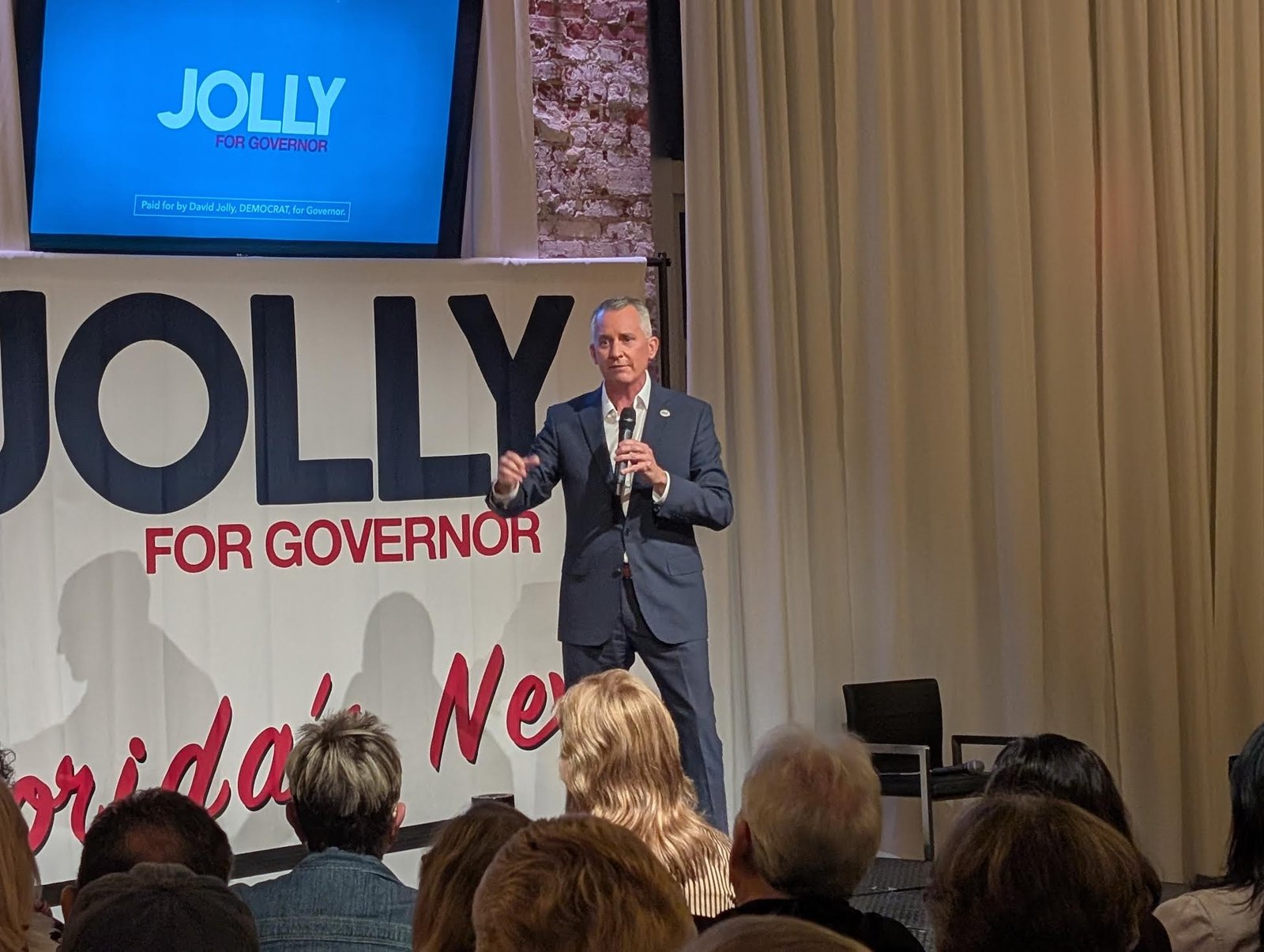
Democratic gubernatorial candidate David Jolly says that if he’s elected in November, he would establish an Office of Civil Rights within the Governor’s Office.
Speaking in Fort Myers Sunday during a gathering hosted by the Florida Democratic Hispanic Caucus, the former U.S. representative from Pinellas County reflected on the recent U.S. Supreme Court ruling weakening Section 2 of the 1965 U.S. Voting Rights Act, which has permitted southern states to redraw congressional maps to eliminate Democratic districts and dilute the influence of Black voters.
“I don’t think that the disparate impact of prejudicial and racist policies of the last 100 years has now expired and now we’re a moment of great equality and equity, I don’t,” he said. “I think the disparate impact is still real today.”
To contend with that, he says Florida “deserves an Office of Civil Rights.”
He said it would look at voting rights, access to healthcare, and ensure everyone is getting a “high quality education” as outlined in the Florida Constitution, among other aims.
His comments came as the Ron DeSantis administration has applied a sledgehammer to vestiges of diversity, equity, and inclusion (DEI) programs in the state. Those efforts began in 2023, when the state passed legislation banning the state’s public colleges and universities from spending any money on DEI programs.
That was followed last month with the governor signing legislation (SB 1134) that bans local governments from funding or promoting DEI initiatives, with local officials who are found to have violated the law subject to removal from office. It takes affect on Jan. 1, 2027.
There’s also the case of Florida Attorney General James Uthmeier, who issued an advisory legal opinion on the Martin Luther King Jr. federal holiday in January declaring that any state actions recognizing racial disparities are “presumptively unconstitutional” under both federal and state law.
His opinion included an appendix listing more than 80 state laws referencing minority preferences, race-based state action, and affirmative action in state hiring and contracting that he said his office would no longer defend or enforce.
On the same day, Texas Attorney General Ken Paxton issued an advisory opinion asserting that “decades’ worth of DEI frameworks” embedded in Texas law are unconstitutional.
Florida Republican lawmakers filed legislation that would have codified Uthmeier’s opinion into state law, but those proposals didn’t move in the regular 2026 Florida legislative session.
“I think David is absolutely right in creating this office, especially in a state that is actively rolling back many of those very civil rights,” said Miami Gardens Democratic state Sen. Shevrin Jones, who endorsed Jolly for governor in March. “So, yes, not only is it needed, it’s necessary.”
Human rights
Nearly every state in the nation manages its own state-level civil rights or human-rights commission to protect residents from discrimination in sectors such as unemployment, housing, and public accommodations. In the case of Florida, the Legislature created the Florida Commission on Human Relations in 1969 to enforce the Florida Civil Rights Act to address discrimination.
“If Florida’s Commission on Human Relations is fully meeting this moment, most Floridians certainly cannot tell,” said Jones.
Several other specialized civil rights offices operate within state government, with an Office of Civil Rights in the Attorney General’s office, the Department of Children’s and Families, and Department of Economic Opportunity.
Jolly said Sunday that he’s ready to respond to those who “recoil” at his idea.
“I will tell you this. If we don’t have any problems, then you’ve got nothing to worry about. But I think we need an Office of Civil Rights in the office of the governor to investigate where the problems are and figure out how we move ahead.”
Independent Journalism for All
As a nonprofit newsroom, our articles are free for everyone to access. Readers like you make that possible. Can you help sustain our watchdog reporting today?



