
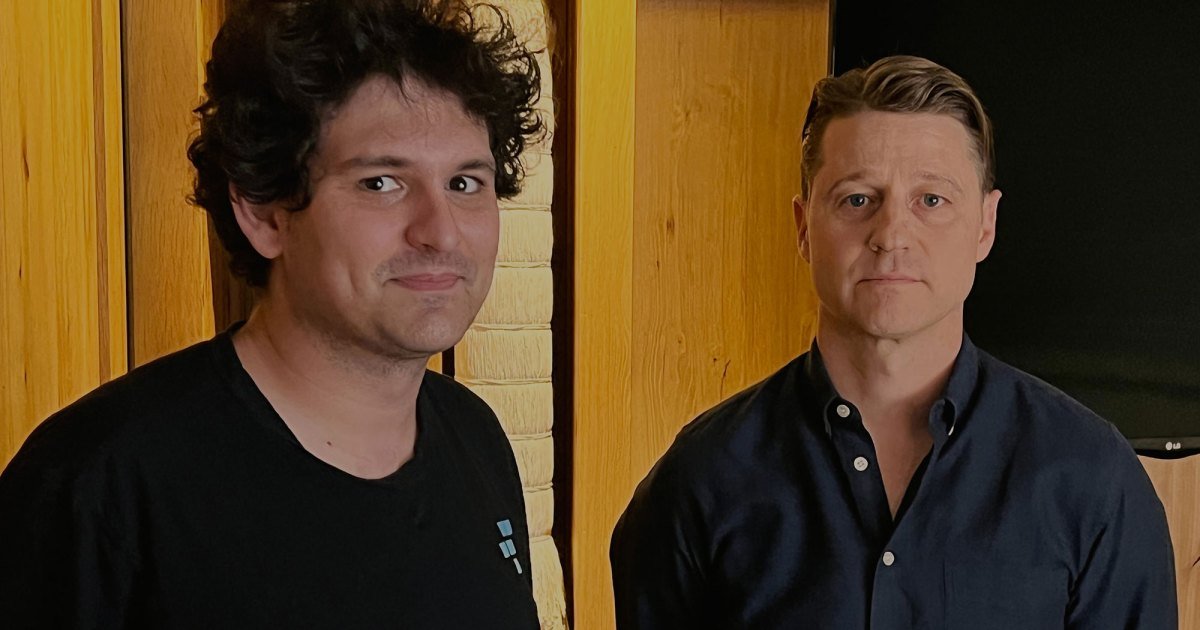
Sam Bankman-Fried and Ben McKenzie Neil Brandvold/Easy Money Productions, Inc.
A version of the below article first appeared in David Corn’s newsletter, Our Land. The newsletter comes out twice a week (most of the time) and provides behind-the-scenes stories and articles about politics, media, and culture. Subscribing costs just $5 a month—but you can sign up for a free 30-day trial.
Not too sure what to make of cryptocurrency? Don’t really understand it but kind of think it’s a scam? That was Ben McKenzie’s attitude when an old buddy during the Covid pandemic suggested he invest in Bitcoin. His pal had given him a bum investment tip years earlier, so McKenzie was wary. But since he was shut in, with time on his hands, he decided to use that stretch to dig deep into crypto—real deep—and came to the realization: It’s a con. Thus, he was launched on a second career as a crypto critic.
McKenzie’s first career was a pretty good one. He’s a Hollywood star. He played Ryan Atwood, the bad boy with a good heart, on The O.C., the popular teen drama of the 2000s. He was also police detective Jim Gordon in Gotham, the dark and moody Batman prequel. But now he took on a much different role. Armed only with his undergraduate economics degree from University of Virginia and a sense of skepticism, he fired up his laptop and mounted a one-man investigation of crypto that resulted in the 2023 book (co-written with journalist Jacob Silverman), Easy Money: Cryptocurrency, Casino Capitalism, and the Golden Age of Fraud. The title is a giveaway for where his inquiry landed.
McKenzie began his crypto journey with a simple principle: You should not invest in something you don’t understand.
Last month, the 47-year-old McKenzie released a documentary, Everyone Is Lying to You for Money, which, appropriately for a denizen of a superhero world, is an origin story. It chronicles how this former teen heartthrob became one of the leading antagonists of the crypto industry. It also serves up a 90-minute-long entertaining primer on crypto, explaining its rise, its scamminess, and the threat it poses to the financial sector—and you and me. It’s not quite the same as watching Margot Robbie in a bubble bath explain subprime loans, but McKenzie has deftly crafted an enjoyable but troubling ride through the murky world of digital currency.
McKenzie began his crypto journey with a simple principle: You should not invest in something you don’t understand. After the financial crash of 2007, people were right to be pissed off at Big Finance, a system rigged by Wall Street predators for the wealthy. The promise that cryptocurrency could decentralize and democratize finance was appealing. But the specific promise of Bitcoin sounded like a “free lunch” to him. Especially given how Matt Damon and other celebs, paid by the industry, were promoting crypto as an adventure for the bold and exploiting FOMO. “What does Matt Damon know about crypto?” McKenzie asks in the film. “Nothing.”
In London, McKenzie chatted with Dan Davies, an economist and author of Lying for Money, and asked him, “All of crypto can’t be a scam, right?” Davies replied, “I don’t like that word ‘can’t.’”
McKenzie trekked to crypto conventions and talked to crypto disciples (including one cryptocurrency founder who ended up in prison for fraud). He traveled to El Salvador, where the nation’s authoritarian leader embraced crypto and promised to build a “Bitcoin City” powered by geothermal energy from a volcano. (Spoiler alert: There’s no such city yet.) In July 2022, he interviewed Sam Bankman-Fried, who fast became a billionaire by creating the FTX cryptocurrency exchange, and who had a hard time explaining to McKenzie what crypto was good for besides speculation and criminal operations. “There needs to be more oversight,” SBF told him. (Four months later FTX would collapse and Bankman-Fried would be arrested for fraud and money-laundering.)
In London, McKenzie chatted with Dan Davies, an economist and author of Lying for Money, and asked him, “All of crypto can’t be a scam, right?” Davies replied, “I don’t like that word ‘can’t.’” McKenzie testified before Congress and called the crypto industry “the largest Ponzi scheme in history,” warning it could infect the entire financial system if not regulated properly. In perhaps the most disturbing scene, he talked to everyday folks who still believed in the power and dream of crypto—even after being fleeced in a crypto scheme that crashed.
The film has been playing in several theaters nationwide, often with McKenzie doing Q&As. He hopes it will be on a streaming service soon. We recently talked about the movie and the current state of crypto.
Let’s start with the end of the documentary. You’re talking with your wife, and you say that you didn’t think that your anti-crypto efforts up to that point had much impact—your congressional testimony, your advocacy, your book. Have you seen more impact from the film?
I have. I go to screenings as often as I can and do a Q&A afterwards. I can see the audience really responding to the film. They have a lot of questions, a lot of anger—directed at not just crypto, but also prediction markets and AI. I’ve had incredible conversations with strangers, and personally that makes me feel good. Like I’m not crazy. And maybe this is part of the start of a change in the way we view all these things. A lot of folks have concerns similar to those with crypto about AI data centers and their effect on local communities. And who’s in charge of it? I feel inspired by that. And more people are going to see a 90-minute comedy that they can watch at home than are ever going to read a 300-page book on economics. I get that. I made the movie to be entertaining. So hopefully it is.
You don’t address AI in the film. But my guess is that in many people’s mind crypto and AI merge together as part of the whole issue with Big Tech and the dislocation it is causing.
There’s a number of areas of overlap. There’s disruption to communities and the costs that come from having these data centers and crypto mining operations in these places. They use an enormous amount of electricity, which can cause people’s prices to go up. They are incredibly loud, some of them very disruptive. And are you familiar with the term “the grift shift”? That’s the idea that grifters shift from one grift to another. So there’s a grift shift between the last crypto crash and the current AI boom. Companies that were mining Bitcoin suddenly decided they were going to be data centers. That’s somewhat telling. The difference, of course, is that AI is a real technology, whereas blockchain used for crypto is quite old and isn’t used for much of anything outside of cryptocurrency.
I think the concern that I and many other people have is, who’s in control of the technology and what are their motives?
I think the concern that I and many other people have is, who’s in control of the technology and what are their motives? I read the profile of Sam Altman, the OpenAI head, in The New Yorker, and I saw this quote from an unnamed Microsoft executive who said, “I think there’s a small but real chance he’s eventually remembered as a Bernie Madoff- or Sam Bankman-Fried-level scammer.”
I’m not nearly qualified to make grandiose statements, but it does feel like we’re running into problems that the current version of capitalism we’re practicing doesn’t solve. In fact, it only reinforces some of the negative dynamics. We’re talking about the accrual of extraordinary wealth in the hands of few and the costs to the broader public—and the sense that the system is rigged. These things seem to be getting worse—obviously embodied by our con-man-in-chief president. How do we address it? Democracy is not working. There’s a bad crypto bill going through Congress, the Digital Asset Market Clarity Act [which would set up a regulatory regimen with less stringent rules for crypto]. We know why Republicans are voting for it, but the reason that some Democratic members may vote for it is that they’re afraid of the crypto lobby, which has a lot of money.
In the movie, you show that when you came became a public crypto critic, you got a lot of hate mail and harassment online from crypto fans who claimed you didn’t know what you’re talking about. Has that happened with this film as well?
Not that I’m aware of. I’m sure I have. But I’m not on X anymore. After Elon Musk took it over, my account got hacked, and I couldn’t recover it because there was no customer service at X anymore. I haven’t been able to access my X account for years. I’m blissfully unaware of what’s happening on that platform, and I’m sure I’m getting some hatred over there. In person, at the screenings, it’s been either completely lovely or some very, quite frankly, reasonable questions from a guy in the audience who’s pushing back politely and trying to have a reasonable conversation.
It’s harder to be an asshole in real life than it is online.
Absolutely. Online it’s almost like the algorithm is telling you to be an asshole so that you get the clicks and the engagement. The cliché is the internet is not real life, but crypto exists exclusively on the internet. There is no there there. And most of these crypto “communities” aren’t really communities. They are people trying to sell you this or that type of thing, people hiding behind a pseudonym. In the real world, 80-plus percent of the country has never bought cryptocurrency. And when I ask them what they think of it, they almost always say some version of this: It seems complicated, but also scammy, and maybe I’m just not smart enough to understand it.
If this thing is really based on no underlying asset, you’re basically putting money in because you hope that someone else will buy it from you.
I made the movie to say, “No, you are. You know it sounds too good to be true. It is.” I don’t think I can convince the 5 to 6 percent of the population that’s really into crypto. They’re sort of members of a cult. And then there’s maybe 10 percent that are playing around with it. It’s really wild that 5 to 6 percent of the population can dictate policy on Capitol Hill, isn’t it? Talk about a minority view and overrunning the democratic processes.
When you were making the movie, you noted that Bitcoin was worth about $44,000. Today it’s $80,960. Why is it still holding so much value?
In the fall of 2021, it was $60,000. So it’s a little bit above that. It’s recovered from 2022 when all these companies went bust, and several people went to jail. The market was really in the tank. Now it’s very simple: Donald Trump is most of the answer. The market was slowly recovering, but not in any spectacular way. Then in summer of 2024 Trump suddenly embraced Bitcoin. After calling Bitcoin a scam as recently as 2021, he suddenly saw an angle. Perhaps as a way to make money, perhaps as a way to appeal to a certain constituency of young men.
People rationally made a calculation. If this thing is really based on no underlying asset, you’re basically putting money in because you hope that someone else will buy it from you. For econ guys like me, that’s the greater fool theory. But if you think that other people are going to buy it because Trump has a 50-50 shot at being president and he can do a lot to push the price higher, then it’s rational to bet on it. So the price started going up then. Sure enough, he was elected. And the price kept going up. And by the time he got in office, it was $100,000 a coin.
He and his administration have done an incredible amount to take apart what safeguards and accountability there was—not just by pardoning Changpeng Zhao (a.k.a. “CZ”), the founder of Binance, but also ripping apart the Justice Department cryptocurrency task force, and passing this bad bill called the Genius Act, which allows corporations to issue their own form of crypto. It was absurd any Democrat voted for it, but 100 Democrats did. So Donald Trump and people associated with him, including Howard Lutnick, Marc Andreessen, and Elon Musk, have been incredibly effective in getting crypto into our system and taking apart the rules, regulations, and law enforcement apparatuses that were trying to keep it in check.
With Trump now in the crypto business—albeit in a major conflict of interest and in a corrupt manner—do you think that’s given crypto a political status?
Definitely. To have the most powerful person in the world go all in is an incredible advantage. It’s deeply ironic, though. Crypto was supposed to be this reaction to the excesses of tyrannical government. This was supposed to be money that exists outside the government. And now you have the president of the United States issuing his own versions of these “currencies.” And he’s now being accused of fraud by one of his top investors. This certainly lays bare the lie that crypto is the decentralized, democratized future of money—when you’re talking about regulatory capture and corruption, and all the things that Trump embodies.
When you interviewed Sam Bankman-Fried for the film—just a few months before he was arrested—did you have a sense that he was blowing smoke up your ass about crypto?
Yeah. He clearly had trouble answering some basic questions. The simple question was, what good does crypto do? Give me one example. And he mentioned remittances—the payments workers here send to relatives in their home countries. But I had just come from El Salvador, where I saw crypto was not being used for this, and I politely said bullshit. Here’s supposedly the head of the industry, and he can’t tell me one good thing that this trillion-dollar industry actually does.
I had this sinking feeling that if this is the guy in charge, something bad was going to happen. And sure enough, it did.
The most alarming moment in our interview is when I asked him about the donations he made to politicians, and he has a hard time answering. He can’t look me in the eye. He can’t tell me how much money he was giving to them, which I thought at the time was quite strange because he was so openly supportive of the Democrats. You could have looked this up. It was public. He gave $40 million or whatever to the Democrats. Why is he lying to me or having a hard time with this question. We learned later he was allegedly running a $100 million straw-donors game. He was giving to the Democrats publicly, but he was secretly giving to the Republicans via cutouts.
I felt good about the interview from a journalistic standpoint. But on a personal level, I had this sinking feeling that if this is the guy in charge, something bad was going to happen. And sure enough, it did.
One of the more poignant parts of the movie is when you’re talking to everyday, retail investors who lost money in a big crypto bust-up and they say they still believe in crypto.
That was pretty powerful. Even I was a little surprised by it. This is how I make sense of it. We’re talking about the dynamics of the cult. We are way outside of what would be a “rational investment” where if you lose money, you’d be like either “That sucks” and/or “I got scammed.” These guys are twisting themselves in knots to say, “Well, I got scammed here in this one crypto thing. But the bigger idea still works, even if I’ve still lost money in it.” That requires a lot of rationalizations. It’s almost the more you lose, the more you have to believe. To acknowledge that you were duped and this is all a scam would be very painful.
I also can’t help but reflect on the gender dynamic, which I think is really sort of fascinating. It’s quite sad to say—as a man and as a father of boys—that men are better marks. They have a harder time talking about their feelings, admitting that they’ve been duped. They have a lot of pride. And the crypto industry’s sort of genius is getting them to blame themselves for it.
There’s this whole culture in crypto of DYOR—do your own research—meaning, if you lose the money, it’s your fault. That benefits the fraudsters and the insiders who are making money, but also keeps the big population of outsiders, the regular guys, in the game. They think they have to keep going. HODL—hold on for dear life. You can’t sell your Bitcoin, no matter what.
There’s a chilling moment in the film when you ask Dan Davies, the economist and fraud expert, whether all of crypto is a scam, and he does not challenge that idea. It that your bottom-line belief? It’s just a con and eventually there will be a reckoning?
Crypto is only good for two things: gambling—is the price going to go up or down?—and crime. The amount of crime that crypto facilitates is staggering. There’s a crypto company, Chainanalysis, that estimated $154 billion of criminal activity was facilitated via crypto last year alone. There’s the bubble idea that the price could, over time, keep going up, as new people flock to crypto as the story continues to spread. And then crime gives it a use case, a reason to be valuable.
In my congressional testimony, I described as a Ponzi scheme. What is Trump’s thing, if not a Ponzi scheme, right? His meme coin is down 96 percent. It’s all a penny stock, a pump-and-dump, a Ponzi scheme—pick your metaphor. It’s not a legitimate investment. That’s 99 percent of it. Then there’s crime on top of it. And what’s most troubling is that if crypto gets further into our regulated system, as it’s threatening to do this with the Genius Act that passed and the proposed Clarity Act, then the repercussions could be huge. Because if it does crash again—and I will remind people that crypto has crashed many times in its brief but sordid history—it could contribute to the next version of a subprime crisis. That would be incredibly ironic, given the crypto was supposedly a reaction to that crisis.
Have you heard from Matt Damon, whom you roast in the film for being a pitchman for crypto?
I try to keep my head down in our weekly celebrity meetings when we all get together and chat about the industry. No, I don’t know Matt. I actually don’t know anyone personally who has sold crypto. I don’t think I’ll be getting a Matt Damon movie anytime soon.
Watch the Everyone Is Lying to You for Money trailer here.



