
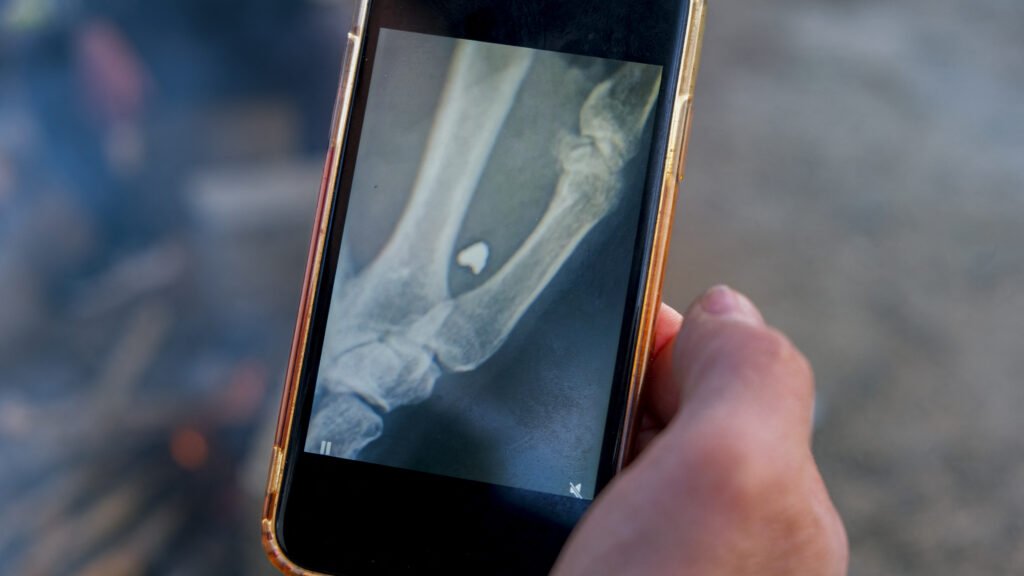
Oronde McClain was only 10 when he was shot in the head while caught in the gunfire of a drive-by shooting. He had to learn how to walk and talk again after an eight-week coma and the removal of one-third of his brain.
Twenty-five years later, McClain still lives with the health consequences of this incident. He has seizures, and his right side is partially paralyzed. He also lives with the physical remnants of what happened that day — specifically 36 retained bullet fragments that are lodged inside his brain and skull.
Every year, about 115,000 firearm injuries occur in the United States. A study estimates that about 75% of survivors of firearm injuries live with retained bullet fragments — pieces of metallic ammunition that remain in the body after a non-fatal gunshot wound. Changes in firearm and ammunition design, such as the increased use of hollow-tip bullets, have increased this risk. These bullets are designed to create more tissue destruction and are less likely to exit. Depending on where the fragment(s) are located, they are often not removed. Survivors of gun violence often live with retained bullet fragments inside the body for the rest of their lives.
It is well known that survivors of gun violence face long-term health consequences. Less publicized are the physical and psychological impacts that they can face specifically when bullet fragments remain inside.
Retained bullet fragments can lead to chronic pain, issues with mobility, and, if they migrate in the body, organ damage. Some case reports have also linked retained bullet fragments to soft tissue cancers in the brain, lungs, and skin.
Because most modern-day bullets are made out of a lead or lead alloy core, they may also cause heavy metal toxicity from lead poisoning. Commonly associated with paint in old houses, lead poisoning from retained bullet fragments is an often overlooked and underdiagnosed consequence of firearm injuries.
“If someone is shot and they are living with a metal fragment inside of their body, it may serve as a source for metals to leach out,” Jamaji Nwanaji-Enwerem, emergency medicine physician and professor of environmental health, told me.
Lead toxicity from retained bullet fragments has even been shown in some studies. Though it is quite rare, it is nonetheless important for people to know about.
In adults, a blood lead level (BLL) of more than 5 µg/dL is considered elevated. A report from the CDC looking at 150,000 people with an elevated BLL found that about 500 people with a BLL of 10 or more had retained bullet fragments, amounting to less than 1% of cases. However, retained bullet fragments were overrepresented in the most severe cases. About 5% of all cases with a BLL of 80 or more had retained bullet fragments. The highest reported reading among this population was above 306, a level that can be fatal.
One case study discussed a 23-year-old with retained fragments in his brain who was found to have lead poisoning. His symptoms of abdominal cramping, mood lability, and tingling in his extremities improved after the fragments were removed and his blood lead levels went down.
According to Nwanaji-Enwerem, the risk of lead toxicity may be higher if the fragments are located in certain areas of the body, such as near a joint. “Some hypothesize that joint fluid can accelerate metal degradation, making them more readily absorbed into the bloodstream,” he said.
Signs and symptoms of lead poisoning can be inconspicuous, leading to diagnoses many years later. People may experience nerve damage, mood disturbances, headaches, elevated blood pressure, and anemia.
Routine testing of blood lead levels in those with retained bullet fragments is not currently the standard of care, though some advocate that it should be.
Despite this growing body of research, most people with retained bullet fragments are completely unaware of these health risks, McClain included.
“They told me that they can’t take it out because if they take it out [from my head], I might die or have more deficits. They did not tell me anything about lead or anything like that,” he told me.
Patients are not the only ones in the dark about these potential consequences — many clinicians are, too.
As an emergency medicine resident physician, I have seen a fair share of patients with retained fragments either in the trauma bay or when they come to the emergency department to seek care after their firearm injury. In my experience, conversations surrounding the health impacts of retained fragments are not commonplace in the physician community. The first time I learned about the potential link between lead poisoning and retained fragments was actually in a non-clinical setting. Because I work at a Level 1 trauma center in a city with high rates of gun violence, I knew that it was important to research and educate myself on the impacts of retained fragments so that I could better support the patients I serve.
Through my research, I also found that, apart from the physical health risks, retained bullet fragments are associated with higher rates of depression.
During her surgical training in Philadelphia, Randi Smith, associate professor of surgery and trauma surgeon at Emory University, saw many people who had retained bullet fragments, prompting her to study the impacts on mental health. According to one of her studies, people with retained bullet fragments were found to have higher depression scores.
“For some people, the bullet is a constant reminder of the trauma that they’ve endured,” Smith said.
She told me about a young mother who had a retained fragment in her shoulder. “She never wanted to hold her child on that side because of the pain of the retained bullet being rubbed on. She also didn’t want to transfer that negative energy to her child,” Smith said.
McClain experienced this, too, telling me, “I was always scared, like, ‘Oh my God, if I wake up, the [fragments] are going to come out of my ear.’”
Now a gun violence survivor media advocate through his role as the director of the Philadelphia Center for Gun Violence Reporting’s Survivor Connection , McClain recounts that the majority of the survivors he works with have retained fragments. Many of them experience some sort of associated emotional distress — especially if they can feel or see it under the skin.
“They feel [the fragments] in their chest all the time, they’re nervous. They can see it every time they wake up. It reminds them of what happened, it reminds them of the scene. It’s not like you are looking at a scar, you are looking at a bullet. That’s frightening,” McClain said.
However, not everyone feels this way. According to Smith, some people view it symbolically, expressing, “I made it through a tough time, and the bullet reminds me of how far I’ve come.”
With firearm violence on the rise nationally, there is an urgent need for the medical community to standardize methods in its approach to those with retained fragments. For example, medical societies should decide whether lead levels should be routinely monitored in patients with retained fragments, instead of only when they are symptomatic.
Physicians across various specialties should also be more educated on the physical and psychological impacts of retained fragments. I had the opportunity to focus my grand rounds presentation on this as a small step toward increasing awareness among my residency community.
Patient transparency and education are also critical. “Some people are not even told that they have a retained bullet fragment, so how could they even look for information about it if they don’t even know they have one,” Smith said.
Due to her body of research, Smith’s institution in Atlanta has made strides in this regard. This has looked like including standardized education on retained fragments in discharge paperwork and increasing the amount of elective fragment removals if it is deemed medically safe. That may help those for whom retained bullet fragments are traumatic.
The reality of living with retained bullet fragments still weighs heavily on many.
“We are in this club that we didn’t sign up for. We feel like we could die at any moment because we have a foreign object in our body,” McClain said.
Adeiyewunmi (Ade) Osinubi, M.D., is an emergency medicine resident physician. Her documentary film “Black Motherhood Through the Lens” examines Black women’s experiences with infertility, childbirth, and postpartum mental health issues.



