
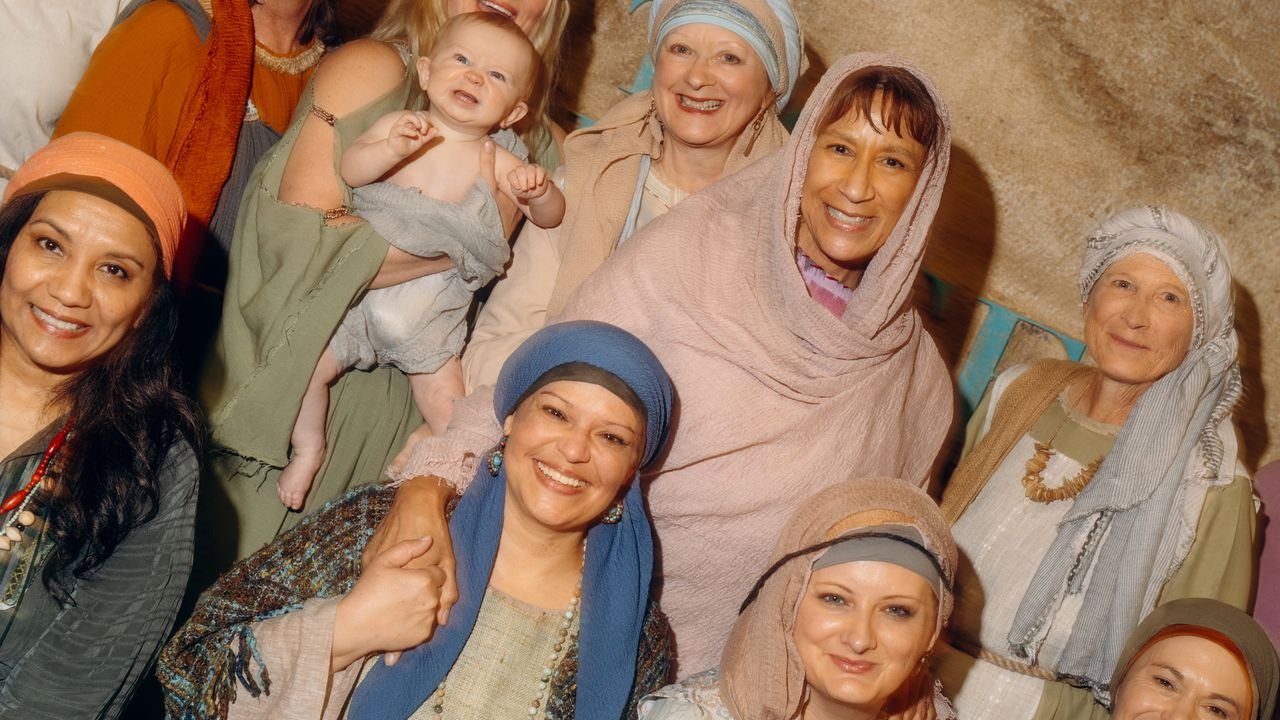
“The Chosen” is more nuanced and less aggressively didactic than many Christian films of recent vintage. The divinity of Christ is part of the ground truth of its world, rather than something that needs to be asserted or justified. It does not require a fluency in Biblical stories to understand; indeed, the show’s press team claims that a quarter of its viewership is not Christian. Yet I did not find the show as bingeable as its core audience does. Some crucial element of the experience—perhaps a feeling that what I was watching was providential and urgent and true—was inaccessible to me as a nonbeliever. Instead, I was left with the sense that this was a narrative that had stakes but little suspense, since it is never in question how this story is going to turn out.
When Jenkins was in eighth grade, his father, Jerry, decided that his son was mature enough to be initiated into the world of mainstream entertainment. It was the late eighties, and the Jenkinses, a family of five, lived in suburban Illinois, where Jerry was a prolific writer of as-told-to biographies of athletes and religious figures. The family was middle class, and fundamentalist Baptist “in a pretty hard-core way,” Jenkins told me. He and his younger brothers went to church twice a week, attended Christian schools, competed in Bible-memorization contests, and consumed largely faith-based media. Among their evangelical cohort, secular films and television programs were “something to be avoided or shunned,” he said. But Jerry was a storyteller at heart, with a soft spot for Hollywood classics. That summer, father and son watched a new movie nearly every night: “The Godfather,” “Bonnie and Clyde,” “One Flew Over the Cuckoo’s Nest.” Jenkins was troubled. Most cinematic depictions of Jesus felt like eating vegetables—why were these movies so delicious?
Jenkins has taken on the task of accustoming his audience to such directorial flourishes as nonlinear storytelling. “The core audience of ‘The Chosen,’ the early adopters, they tend not to watch as much film and television, and they’re not as familiar with some of the more challenging or nuanced storytelling techniques. And I’m not saying this in any kind of negative way,” Jenkins told me. “I do think, Let’s push them, let’s challenge them. And if they become a little bit more—I’m trying to avoid using the word ‘sophisticated,’ because it sounds condescending—but if they’re watching maybe with a little more nuance, a little more care, that’s going to increase the depth of the experience they have with the show.”
Jenkins went on to study media at a Christian college in Minnesota. While he was there, Jerry published his hundred-and-twenty-fifth book, “Left Behind: A Novel of the Earth’s Last Days,” the first in a series of eschatological novels inspired by the Book of Revelation, co-written with Tim LaHaye. The book was an unexpected hit; the “Left Behind” series has since sold more than seventy million copies. In midlife, Jerry became an evangelical celebrity, a status he accepted with humility, according to his son. “I don’t claim to be C. S. Lewis. The literary-type writers, I admire them,” Jerry once told an interviewer. “I wish I was smart enough to write a book that’s hard to read, you know?”
In 2000, “Left Behind” was adapted into a film that this magazine described, somewhat grudgingly, as “strikingly professional.” It was released directly to video, but, after sales outperformed expectations, the filmmakers pushed for a theatrical release. They recruited church groups who sponsored screenings, drumming up publicity in exchange for discounted tickets. In keeping with the series’ militant tone, these promoter-fans were called “commandos.” Ticket sales were middling. Three years later, however, a similar mobilization of congregations helped to earn “The Passion of the Christ”—a violent, R-rated, subtitled Christian movie with dialogue in Latin, Hebrew, and Aramaic—a worldwide gross of more than six hundred million dollars.



