
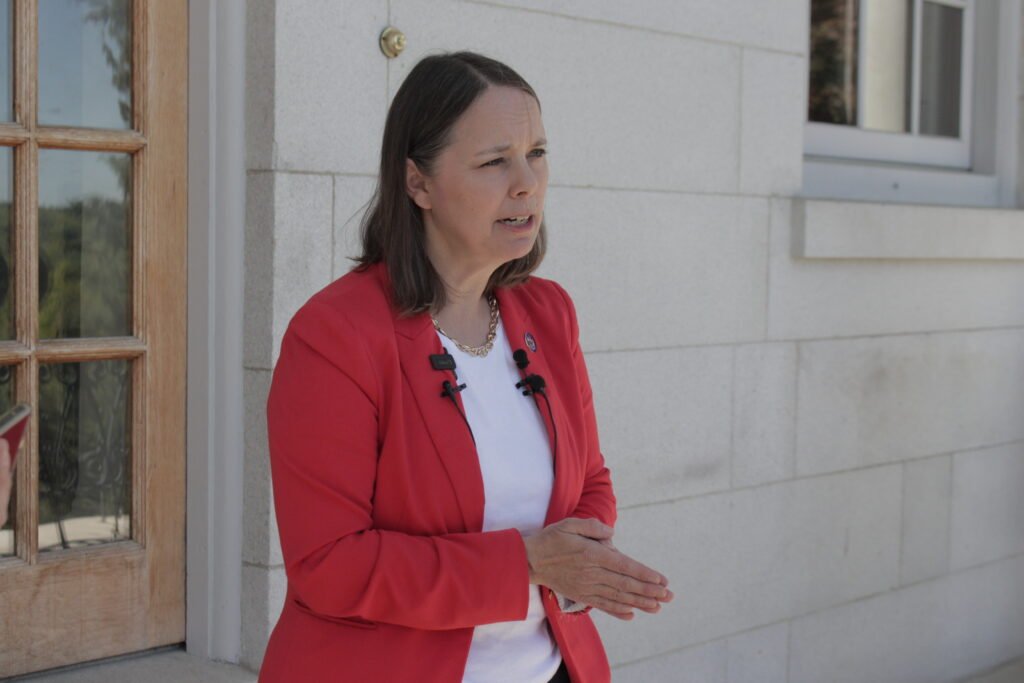
Secretary of State Shenna Bellows invalidated a citizen-led ballot initiative aiming to restrict transgender students’ access to school bathrooms, locker rooms and team sports that align with their gender identity. That’s because the group leading the effort did not collect enough valid signatures to qualify for a ballot referendum, she said at a Tuesday press conference in Augusta.
Bellows’ decision follows a recommendation from Chief Deputy Secretary of State Katherine McBrien after she presided over a hearing earlier this month regarding signature validity and found that more than 12,000 had been collected improperly.
“Citizen initiatives are direct democracy. Just as we take voting security seriously, we take petition integrity seriously,” Bellows said in a statement. “Unfortunately, some out-of-state circulators failed to meet certain legal requirements for petitions, resulting in this initiative failing to qualify for the ballot after legal review.”
The ballot campaign seeks to require sports teams and school facilities to be separated by biological sex as opposed to gender identity, at odds with the Maine Human Rights Act. It follows several failed legislative attempts to pass similar laws, while Maine is being sued by the federal government over its transgender inclusion policy.
The signature invalidation process
The secretary of state in March first confirmed that the question would be on the November ballot, after determining that the “Protect Girls Sports” campaign had collected enough signatures. The campaign’s petition practices were cast into doubt soon after when three challengers claimed in Superior Court that 7,900 signatures previously deemed valid should be disqualified. On April 24, Justice Deborah Cashman remanded the challenge to the Secretary of State’s Office for a final determination. On May 12, McBrien and Assistant Attorney General Jon Bolton held an hourslong hearing during which both sides presented their arguments.
Over the course of the hearing, a pattern of negligence within the campaign emerged, with signature collectors admitting to leaving petition forms unattended, among other infractions.
Bellows told media on Tuesday that her staff did an initial review of the signatures and found the petition to be valid, but unlike the hearing, “affidavits and photographic evidence are not part of the initial process that the Secretary of State uses to review petitions.”
“Unfortunately, in this case, at least two out-of-state circulators failed to follow Maine law, and that is why their petitions have been invalidated,” she added.
Out-of-state circulators are not allowed to gather signatures or be paid for circulation under the Maine Constitution, but they are allowed to do so under the U.S. Constitution. Litigation around the initiative process has resulted in courts ruling that out-of-state circulators may gather signatures, and that they may be paid per signature, Bellows explained, even though “many legislators and many members of the public think out-of-staters shouldn’t be permitted to gather signatures.”
Out-of-state signature collectors
All the signature collectors that appeared at the May 12 hearing were out-of-state residents, paid per signature by the “Protect Girls Sports” campaign. Some of them left petitions unattended while voters signed them, others were accused of filling petitions out themselves. Bellows said election staff had “sat down for multiple hours with those spearheading this particular initiative to walk them through the law and the requirements in detail.”
“Out-of-state circulators either did not adhere to training provided by those leading the initiative or those leading the initiative failed to train their out-of-state circulators sufficiently to avoid the legal problems that have resulted in validating the petition,” she said.
Tim Woodcock, an attorney with Eaton Peabody representing the petition campaign, said last week that they filed objections to the recommended decision. The campaign now has 10 days to appeal Bellows’ decision. Given the possibility of the appeal, the Secretary of State will still announce the final wording of the question should it appear on the November ballot on Thursday, Bellows’ office said.
Woodcock did not respond to additional requests for comment Tuesday.
If the campaign does challenge Bellows’ decision, the Superior Court can do three things: uphold her decision, remand the case back to the secretary’s office for further review or place the petition on the ballot, rejecting the decision.
This story was originally produced by Maine Morning Star, which is part of States Newsroom, a nonprofit news network which includes Florida Phoenix, and is supported by grants and a coalition of donors as a 501c(3) public charity.



