
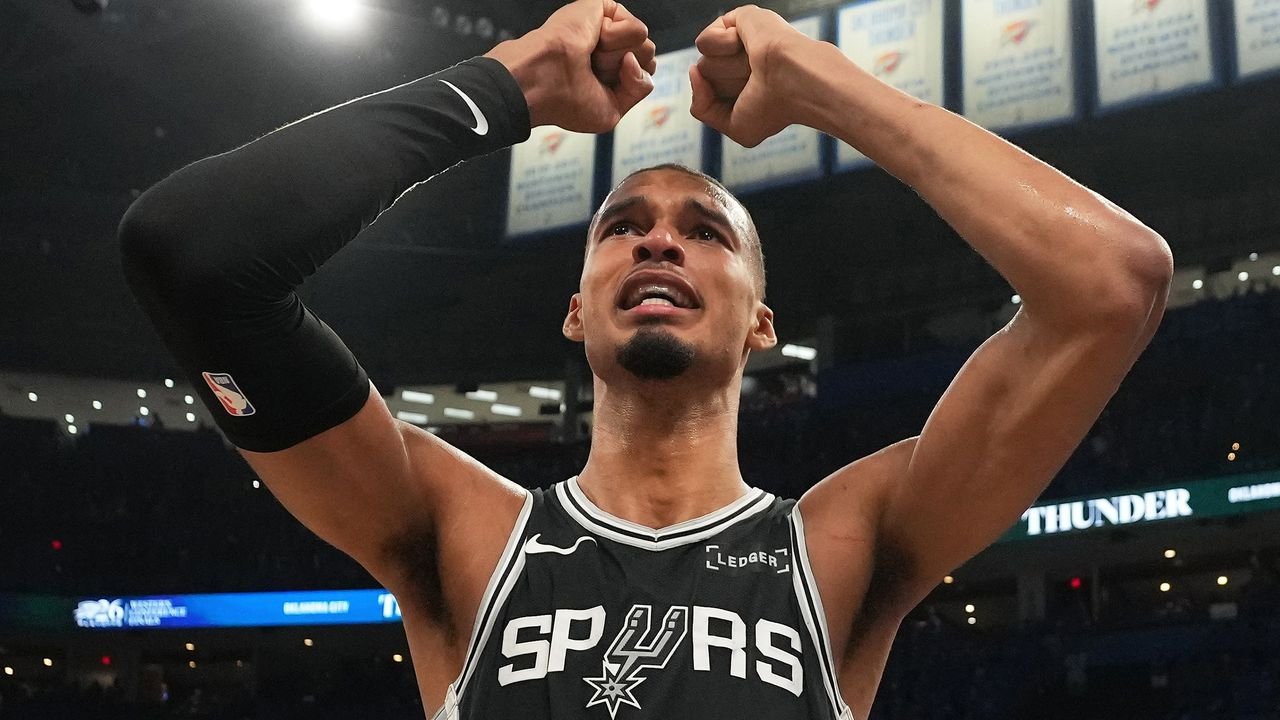
So outlandish are Wembanyama’s skills, and so anomalous his physiology, that people commonly refer to him as an alien. It fits. But what comes through when you watch him is his humanity. So much of his game exists not only in psychological dimensions but also in spiritual ones. He meditates before free throws. He cries, he listens closely, he becomes indignant. To ready himself for the demands of the season, he spent ten days training with monks at a Shaolin temple in China.
As much as any physical gift, what has made Wembanyama tower over his opponents, and now, it seems, over the sport, is his ability to rise to the moment. In this series, he understood the stakes and didn’t flinch. “This game is so hard, this team”—the Thunder—“is so good, that you gotta use every single emotion you got in you in order to win,” Wembanyama said on NBC’s postgame show. Sometimes he is driven by passion, he said, sometimes by love, sometimes by anger. “Sometimes it might even be jealousy,” he went on. “But I don’t wanna weigh myself down with any of these energies. I use them on the court.” He is twenty-two years old.
This Thunder team was impeccably constructed by its general manager, Sam Presti, who made trades that netted valuable draft picks, scoured the league for undervalued talent, found a future M.V.P. in a trade, and built a rotation of thirteen guys who elsewhere would have been starters—all of whom fit the team’s stringent, detail-oriented culture, which Presti had learned, in the early two-thousands, in San Antonio, where he spent the first several years of his career.
It is tempting, then, to view the rivalry between the Thunder and the Spurs, now fully realized, as a battle between a team and an individual, the swarm and the superstar. But the most surprising thing about the Spurs right now might be the performance of Wembanyama’s teammates. In Game Seven, the Spurs outplayed the Thunder throughout the first half, and yet victory was still within reach for the defending champs. Then a guy named Julian Champagnie, who’d gone undrafted four years ago and been cut by the Philadelphia 76ers three years ago, and, at that point, considered his career done, came into the game, and started drilling threes. The veteran point guard De’Aaron Fox flew around the court despite a high ankle sprain and delivered any number of winning plays. The rookie Dylan Harper—age twenty!—played with remarkable poise.
And when Wembanyama went to the bench in the fourth quarter with five fouls, and Gilgeous-Alexander began finding the space that he thrives in, and the excitement swelled in the partisan Oklahoma City crowd, with plenty of time still on the clock, Luke Kornet checked in. Kornet is an élite comedian, a competent backup, even a good writer! But he is not, let’s face it, on the level of the other players who were on the floor, playing some of the best basketball we’ve ever seen. And suddenly, with six minutes left and the Spurs up by six, he found himself racing after Isaiah Hartenstein, who had just stolen the ball and had an open lane to the basket. Kornet chased him down and cleanly blocked his shot, leading to a Spurs basket on the other end. It was a four-point swing and, in retrospect, the beginning of the end for the Thunder.
The block was one thing. The reaction on the bench was another. Wembanyama—usually the one to make that kind of play—clenched his fist and bit it. Kornet’s teammates embraced him. There was a palpable sense of inspiration flowing from player to player. Presti brought San Antonio’s team-oriented culture to Oklahoma City, but Wembanyama has brought a culture, too, and, by the force of his example and his will, he has remade the image of his team.



