
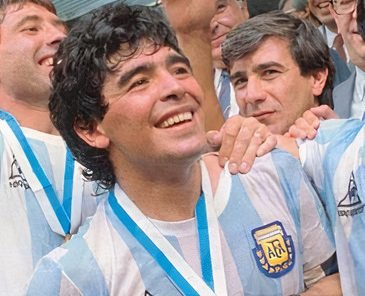
I was watching a fascinating documentary on one of the most interesting soccer players of all time – Diego Maradona – and in the spirit of the upcoming FIFA World Cup, I figured it was timely to share this story with you. We start with some political context.
I remember serving as an aide to then Mayor and State Assemblyman John V. Kelly. In the 80’s and 90’s he was the most popular figure in Essex County. At this time, John ran the local Nutley Savings, and he contributed to an astonishing array of local charities and was an extraordinary public servant. John would win local elections by landslides and after one particularly impressive victory he turned to me and said, “don’t believe all the hype, they love you until they want to kill you.” John went on to say, “the crowd will carry you on their shoulders one day and parade you around as the conquering hero and suddenly chase you out with torches and a blow gun the next.” Message received and on to our column.
Diego Maradona, an Argentinian born soccer phenomenon, had a very complicated love affair with the city of Naples in Italy. Naples was a place viewed as an embarrassment to the country, and they needed a revival and a savior.
To understand Maradona, you first need to understand Naples. It is not Milan, with its polished sophistication, or Rome, with its grandeur and self-importance. Naples has always been rough around the edges, proud, emotional, defiant, poor, and viewed as a city with a chip on its shoulder. (One of my dearest friends, Gregorio, was born and raised right outside of Naples, and I spent many nights with him discussing this peculiar place in Italy.
Along came Diego Maradona.
Diego joined the soccer team S.S.C. Napoli in 1984. At the time, he wasn’t just a soccer player; he was a street kid from Argentina who made magic happen on the soccer field. Diego had this magnetism and charm that followed him. Men and women openly flirted with him and the world fell in love with him. I think that Naples saw itself in Diego. Imperfect. Disrespected. Talented. Dangerous. Mountains of potential and promise.
And Diego delivered.
He singlehandedly dragged Napoli from irrelevance to glory, winning league title after league title, something many thought impossible. In Naples, he soon became far larger than an athlete. Murals were painted with his image. Shrines were erected in his honor. Children were named after him. In a city where faith runs deep, Maradona became part saint, part savior, and part folk hero.
But as we have learned, there is always a danger when people stop admiring someone and start worshipping them. Because when you become an idol, people will no longer allow you to be human.
The reality was that Maradona was human and his demons were well documented—drugs, excess, running around, bad decisions, toxic influences, and a crushing pressure to carry an entire city’s hopes on his back.
After his many successes in Naples, he decided it was time to move on as the pressure and vices of Naples were destroying him.
Well, soon enough, the public that once celebrated his winning rebelliousness and trophy-attaining manic style suddenly turned on him and wanted his total annihilation and elimination. The very same newspapers that lionized him and made him near mythical suddenly began writing stories about his long-time addiction to cocaine and his many dalliances with women of the night. Soon after, he found himself on law enforcement wiretaps and was soon prosecuted and pleaded guilty. The screw turns –girare la vite.
And the crowd of Naples turned on their hero. The streets, once filled with adoring fans of all ages, were now empty except when they paraded him in a perp walk, and he was jeered by the masses.
There is a lesson in that for politics and life itself. The public loves winners, but it loves mythology even more. We all want to remember the time when things were different, the people were nicer, the air was cleaner, the bread fresher, and the heroes never got it wrong. We are guilty of building people into giants and acting shocked when they falter.
In politics, we see it nearly every day. A mayor, a governor, a legislator becomes larger than life. The supporters convince themselves that the person can do no wrong. Then comes the stumble, the failure to act, or the scandal, and suddenly the same people who once fiercely and blindly defended every action act as if they were betrayed personally.
The truth is usually less dramatic and more human.
Maradona was neither a saint nor a devil. He was a profoundly gifted man who carried extraordinary burdens and ungodly expectations. He handled some of these poorly. He brought joy and hope to millions while simultaneously self-sabotaging parts of his life. The contradiction is confusing, as we like our heroes on pedestals. We want it clean and simple.
But as we know, life isn’t always easy and isn’t always clean and simple.
As the story goes, years later after the very public and very damaging divorce, the city of Naples found forgiveness for Diego and soon embraced him again.
Time can do that sometimes, soothe the ragged rawness of emotions and allow the anger to chip away. Today, Maradona’s image is again on towers and on public buildings. The people of Naples haven’t forgotten his wonderfulness or his flaws. They remember him for what he meant to the city when it was at its lowest and he brought them pride and dignity when the rest of Italy and the world denied them any respect.
Final lesson on Diego Maradona.
Be careful about worshipping human beings. If you put them on a pedestal, they will always disappoint you eventually. Humans are imperfect and their imperfections make them relatable. And to the elected officials and corporate leaders, be mindful that the public is fickle and as John Kelly reminds us, they will cheer you one day and stone you and your image the next.
FIFA World Cup time.



