
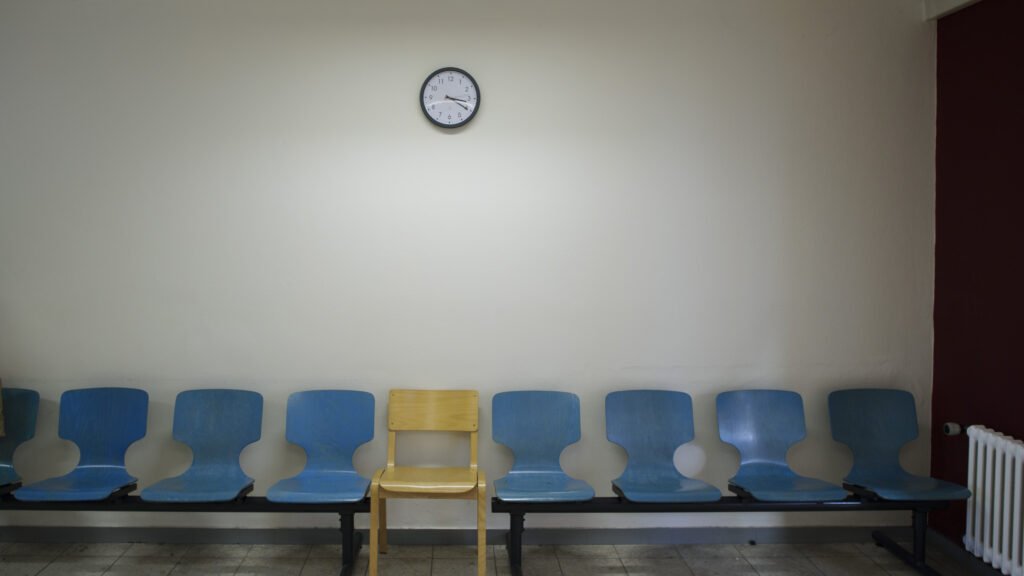
The word patient comes from the Latin patiens — an adjective meaning enduring, suffering. In medicine, that endurance has long meant waiting: waiting to be seen, to be diagnosed, to be treated. Over the past two decades of practicing emergency medicine, my shifts have begun the same way — walking past a room full of people waiting for care.
That room is not called a lobby or a reception area. It is called a waiting room, because the expectation of waiting is built into the architecture and culture of medicine. Triage — the systematic process of prioritizing patients by the severity of their condition — determines the length of the delay. The sickest are seen first; everyone else bears both their illness and the constraints of the system they have turned to for help.
Then the Covid-19 pandemic changed something fundamental. In response to the crisis, health policy and regulatory barriers that had long limited telemedicine fell away almost overnight. What followed was an unprecedented expansion of virtual care — and with it a new question at the door to medicine: Who can safely receive care without ever entering a hospital building?
Telemedicine visits increased more than sevenfold in the early months of the pandemic, and by 2020 roughly 1 in 5 medical encounters in the United States occurred virtually. Although telemedicine use declined after its pandemic peak, it has shown staying power. In 2022, 30.1% of U.S. adults reported using telemedicine in the previous 12 months.
At Emory, where I work, we built a nurse call line that directs lower-acuity patients to same-day virtual visits. During periods of surge — like the viral illness season we recently navigated — that line becomes a fast track. Imagine bumper-to-bumper traffic with the sudden option of a speedy HOV lane.
Even when the system is imperfect — when a patient routed to virtual care ultimately needs labs, imaging, or an in-person visit — they have still bypassed part of the traditional process. In many emergency departments, patients rarely see a physician immediately. First they meet a registrar who collects their information, then an administrator who verifies insurance, then a nurse who performs triage, perhaps a technician who draws labs ordered through protocols. Only later do they meet the doctor they came to see.
For generations, this delay has been viewed as inevitable. Virtual care now allows us to ask whether it must be.
There are, of course, good reasons for medicine’s queues: scarcity of clinicians and resources, unpredictable surges of illness, and the need to prioritize the sickest patients. But the tools available to us are changing. Telemedicine, asynchronous messaging, remote monitoring, and emerging AI tools raise a new question: If we can redesign how patients enter the system, what kind of system should we build?
I recently read Will Guidara’s “Unreasonable Hospitality,” a book about the pursuit of excellence in fine dining. It appeared on the reading list for a leadership program at my institution focused on virtual care innovation.
At first, a book about restaurants did not seem obviously relevant to health care. But Guidara describes how hospitality can be intentionally embedded into every element of the dining experience — from the greeting at the door to the pacing of a meal.
One example stood out. Most restaurants greet guests at a podium near the entrance. Guidara asked a simple question: What would happen if the podium disappeared? What if, instead, you were met at the door by the very person who took your reservation — greeting you by name, recalling why you were there, and welcoming you in as if into their home?
Medicine has rarely asked similar questions about its own rituals. Waiting rooms, like host stands, have simply been accepted as part of the process.
But the tools now exist to design systems that minimize delay rather than assume it. Telemedicine and virtual care platforms give us the opportunity not only to do what we already do more efficiently, but to do it differently — to rethink and redesign how patients enter the health care system altogether.
What would this look like in practice? The visit doesn’t begin in a waiting room. It begins at home. A patient describes their symptoms, connects with a clinician at a scheduled time, and is seen — not after a delay, but when they were told they would be. Many needs are resolved there.
When they are not, care escalates. The patient arrives not as a new problem to be processed, but as someone already known — expected, understood, and prepared for. They are met and guided forward, not sent back to start again.
In this model, the waiting room begins to die, not necessarily as a physical space, but as a defining feature of the patient experience. The muted television overhead, the repeated checks at the triage desk, the rows of uncomfortable chairs arranged around collective uncertainty — it all begins to fade. Medicine starts to move away from a posture of: Take a seat. Someone will be with you shortly. Toward something else entirely: We knew you were coming. We are ready for you with a pre-arrival chart already completed, labs already ordered, consultants already informed.
Care begins earlier and becomes less fragmented. Less like waiting to be called, and more like being received.
Skeptics will rightly point out that medicine remains overcrowded, understaffed, and constrained by physical reality. Emergency departments are still filled with patients waiting for beds, imaging, specialists, transportation, and answers.
And they are not wrong. Delays will still occur. Illness and unpredictability cannot be engineered away entirely. Increasingly, however, for many patients, waiting is no longer baked into their care experience itself. Virtual triage, asynchronous communication, remote monitoring, and emerging AI tools are already reshaping how patients enter and move through the health care system.
I believe the future is already underway and I believe this is a good thing — not just as a physician who has walked through emergency department waiting rooms for more than 20 years, but also as a patient who has sat in one.
Several years ago, during a medical emergency of my own, I had already been evaluated by a physician and advised to seek emergency care if my symptoms worsened. But when I entered the emergency department, much of that context did not travel with me. I became, once again, another patient entering the queue.
In the model I imagine, technology allows concern, context, and pre-planning to travel ahead of the patient. A care plan has already been placed in motion before someone ever takes a seat. Delay is not eliminated, but waiting itself is no longer treated as a default architecture of care.
For patients, that difference is deeply felt.
Illness already demands endurance. The systems designed to treat it should not demand quite so much more.
Iyesatta Massaquoi Emeli, M.D., M.P.H.,is an emergency medicine physician at Emory University who writes about virtual care and the patient experience.



