
Study design and setting
We used a propensity score weighted, difference-in-difference analysis of adult MassHealth members with one or more complex medical conditions and food insecurity comparing participants who received MTMs versus those who did not receive MTMs. Our study period spans the MTM program launch in January 2020 (coinciding with the COVID-19 outbreak) through March 2023, the end of MassHealth’s first FSP contract period with ACOs within the 1115 demonstration. Medicaid administrative data from 2019−2023, including eligibility, claims and encounters, were linked with member characteristics collected by 11 ACOs in FSP administrative data and enrollment data from Community Servings24, the major provider of MTMs in the demonstration. This study was determined to be ‘not human subjects research’ by the UMass Chan Medical School institutional review board (IRB) and the Tufts Health Sciences IRB because it was part of the independent evaluation of MassHealth’s Section 1115 demonstration, required by the Centers for Medicare and Medicaid Services. As such, the need for ethical approval for this study was waived.
Study population
Eligibility for demonstration nutrition programs, including MTMs, required ACO enrollment, age under 65 years, experiencing food insecurity and meeting at least one of five health needs-based criteria: (1) behavioral health diagnosis; (2) complex physical diagnosis such as diabetes or CVD; (3) high ED utilization; (4) high-risk pregnancy; or (5) limited activities of daily living or instrumental activities of daily living33. Additional eligibility details are provided in the Supplementary Information. The treatment group comprised individuals who received at least one MTM delivery, with program start at the first meal delivery (start date) and end at the last meal delivery (end date). MTM program dates were obtained from Community Servings data for eight of 11 ACOs that signed data-sharing agreements for this analysis. For the remaining three ACOs, MassHealth provided calendar year quarters of MTM program period, from which start and end dates were defined as the mid-points of the first and last quarter of enrollment (impacting 82 individuals (4.4%) of the treatment group).
Comparators were adult ACO members screened eligible for nutrition FSP who received no such services. MassHealth administrative records document reasons for not receiving services as (1) lost contact during referral process (n = 736, 53.6%); (2) declined services (n = 447, 32.6%); (3) left ACO or moved (n = 33, 2.4%); and (4) other (n = 174, 12.7%). ACO members in the comparison group were assigned the paired start and end dates of a randomly selected MTM recipient, stratified by the year in which study MTM recipients and comparators were screened as food-insecure to align with their period of FSP eligibility. Randomization created equivalent observation times between the treatment and comparison groups, in addition to balance across calendar years to account for secular trends during the study period.
We required all participants to have at least 6 months of MassHealth coverage before their start date and at least 3 months of MassHealth coverage after their start date to be included in the analyses. Pandemic-related policy changes made maintaining Medicaid coverage easier for members during our study period, and overall MassHealth coverage churn was low at less than 3% annually34. Our primary analysis focused on members receiving at least 3 months (>90 days) of MTMs, due to evidence that briefer durations may be insufficient to impact healthcare utilization20,21, because 3 months was the shortest program hypothesized by ACOs to improve utilization and to exclude participants receiving a temporary, shorter COVID-19 relief program. Secondary analyses retained all participants regardless of MTM program lengths. Randomization of comparators’ program dates was conducted once for the primary population enrolled >90 days (treatment n = 1,866; comparison n = 1,372) and again for the secondary population (treatment n = 2,882; comparison n = 1,400). The slight difference in comparison group sample size is due to requiring sufficient MassHealth coverage before and after the randomly assigned start date.
Outcomes
Medicaid claims and encounters data provided access to utilization and cost outcomes for study participants across Massachusetts, regardless of where they sought care. Co-primary outcomes included changes in unplanned hospitalizations (excluding planned and elective surgeries), ED admissions and total healthcare costs. These were operationalized using measure definitions and International Classification of Diseases, 10th Revision, Clinical Modification (ICD-10-CM) code sets consistent with quality measures used by MassHealth performance accountability for ACOs35. Healthcare costs reflect paid amounts from all adjudicated claims. An ED visit that led to a hospital admission was counted as a hospitalization only to avoid double-counting outcomes. We examined primary care visits as a secondary outcome, hypothesizing that MTMs would reduce acute healthcare use but not primary care use. A reduction in primary care visits could also suggest reduced engagement with primary care (generally not considered beneficial for health).
Covariates
We modeled a comprehensive set of sociodemographics, social risk factors, clinical conditions and prior utilization data that could represent potential sources of confounding. Covariates were measured using MassHealth claims data and FSP administrative data. Sociodemographics included age at enrollment, sex, race/ethnicity, employment, education, primary language and referring ACO. Social stressors included Neighborhood Stress Score-7 (ref. 36) (an area-level measure of socioeconomic stress based on address), tobacco use, alcohol abuse, substance use disorder, homelessness, housing insecurity and disability status (eligibility for Medicaid due to disability or being a client of the Department of Mental Health or the Department of Developmental Services). Clinical conditions were derived from ICD-10-CM codes going back 1 year prior to participants’ start dates and included 24 diagnoses selected to reflect FSP eligibility (Table 1). We also used ICD-10-CM codes to calculate total medical morbidity risk scores, including based on diagnoses (DxCG)37 and prescription dispensing (RxCG)38, anchored on the year prior to each participant’s start date. These risk scores were developed for, and are routinely used by, MassHealth in risk adjustment for managed care payment. Finally, baseline healthcare utilization in the 6 months prior to MTM enrollment included hospitalizations, ED visits, total healthcare costs and primary care visits.
All study participants could receive FSP housing services, including housing search and navigation assistance, one-time provision for rental deposits or moving costs or home modifications such as filters or air conditioning units for members with asthma. They could also enroll in the Community Partners Program39, which collaborates with community-based organizations to provide care management and coordination to Medicaid members with substantial behavioral health needs, addiction and/or long-term care needs. Analyses accounted for concurrent enrollment in FSP housing services and Community Partners programs.
Statistical methods
To address potential confounding due to selection bias, we first created propensity score overlap weights. Propensity score models incorporated all aforementioned covariates as predictors of MTM treatment using a generalized linear mixed model with a binomial link and random intercept for members’ ACO to account for clustering40. Using these propensity scores, overlap weights were calculated in which MTM recipients were assigned a weight equal to 1 minus their propensity score, and comparators were assigned a weight equal to their propensity score. This achieves balance between treatment and comparison groups on all covariates included in the propensity score (Table 1 and Supplementary Tables 1 and 6) and emphasizes study participants equally likely to be in either the treatment group or the comparison group, mimicking a key attribute of clinical trials41. Overlap weights overcome shortcomings of other propensity score approaches such as matching, which can reduce sample sizes, or inverse probability of treatment weights, which can emphasize outliers and bias results41.
MTM program effects were estimated using difference-in-difference models comparing changes between MTM recipients and comparators from a 6-month baseline period to the MTM program period (see Supplementary Figs. 1–3 for parallel trends assessment). All outcomes were top-coded at the 99.5th percentile. We used overlap-weighted, generalized estimating equation (GEE) models with a negative binomial link for counts of inpatient hospitalizations, ED visits and primary care visits and an identity link for healthcare costs. In each analysis, the variable of interest was the interaction term quantifying the difference in change (from the baseline to the MTM program period) for MTM participants in contrast to the change for the comparison group. Weighted GEE models did not adjust for covariates already included in the propensity scores but did adjust for MTM program length. GEE models employed an independent correlation structure accounting for multiple measurements (one baseline measurement and one program measurement per participant). All analyses were conducted in Stata version 19 software.
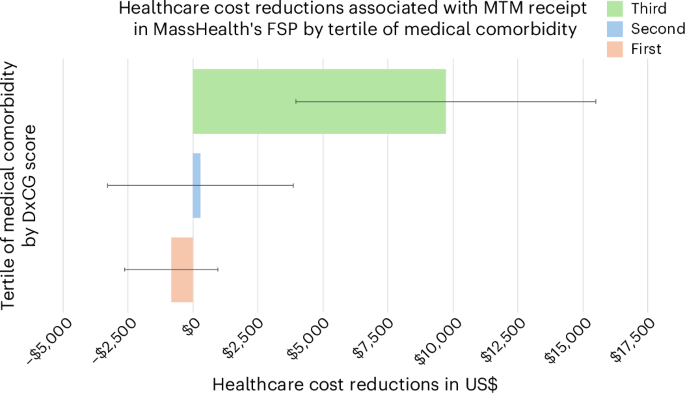
We evaluated stratified analyses by clinically relevant subgroups by having (1) CVD, diabetes and chronic kidney disease because these conditions have causal nutritional pathways and their clinical management is highly sensitive to diet; (2) depression and anxiety disorders, because these were common FSP eligibility criteria and food insecurity is associated with worse mental health; and (3) overall morbidity score (DxCG) by tertiles of risk. We also performed analyses stratified by calendar year of enrollment (2020−2021 and 2022−2023), given the coincidence of the FSP launch with the COVID-19 emergency in early 2020. Propensity scores were recalculated and overlap weighting was repeated for each subgroup analysis.
We conducted several sensitivity analyses to assess the robustness of our findings to different model assumptions. First, an unadjusted, unweighted GEE model produced crude effect estimates. Second, an unweighted GEE model that adjusted for covariates tested differences between propensity score weights and covariate adjustment. Third, alternate propensity score weights were created, excluding baseline outcome measures, testing whether regression to the mean could have been introduced by including baseline values of outcome variables, which may occur if baseline values differ meaningfully between treatment and comparison groups42. Fourth, we evaluated a secondary comparison group drawn from Medicaid MCO enrollees who were ineligible for FSP and were never screened or referred to the program. This group included Medicaid members aged 18−64 years with hypertension, diabetes, CVD or chronic kidney disease, reflecting the most common diet-related conditions in the MTM group (77% of the treatment group had at least one of these conditions). This analysis included clinically similar study participants as only treatment and secondary comparison group members with major cardiometabolic conditions were included. However, food insecurity screening data were not available in the MCO population (100% of the treatment group had food insecurity); therefore, the secondary comparators may have experienced less social risk than the primary comparison group. However, these secondary comparators were not prone to potential selection bias correlated to program uptake. Finally, we conducted a negative control test by fitting similar models on time periods prior to the actual baseline and intervention periods for the primary analysis. Specifically, we compared changes in outcomes between the treatment and comparison groups in months 12−7 prior to the true baseline period (that is, negative control baseline period) and in months 6−1 prior to the true baseline period (that is, negative control program period). These arbitrary periods did not overlap with MTM receipt or the baseline period of our study; thus, we hypothesized that this analysis would not show significant differences in outcomes during this time.
Reporting summary
Further information on research design is available in the Nature Portfolio Reporting Summary linked to this article.



