
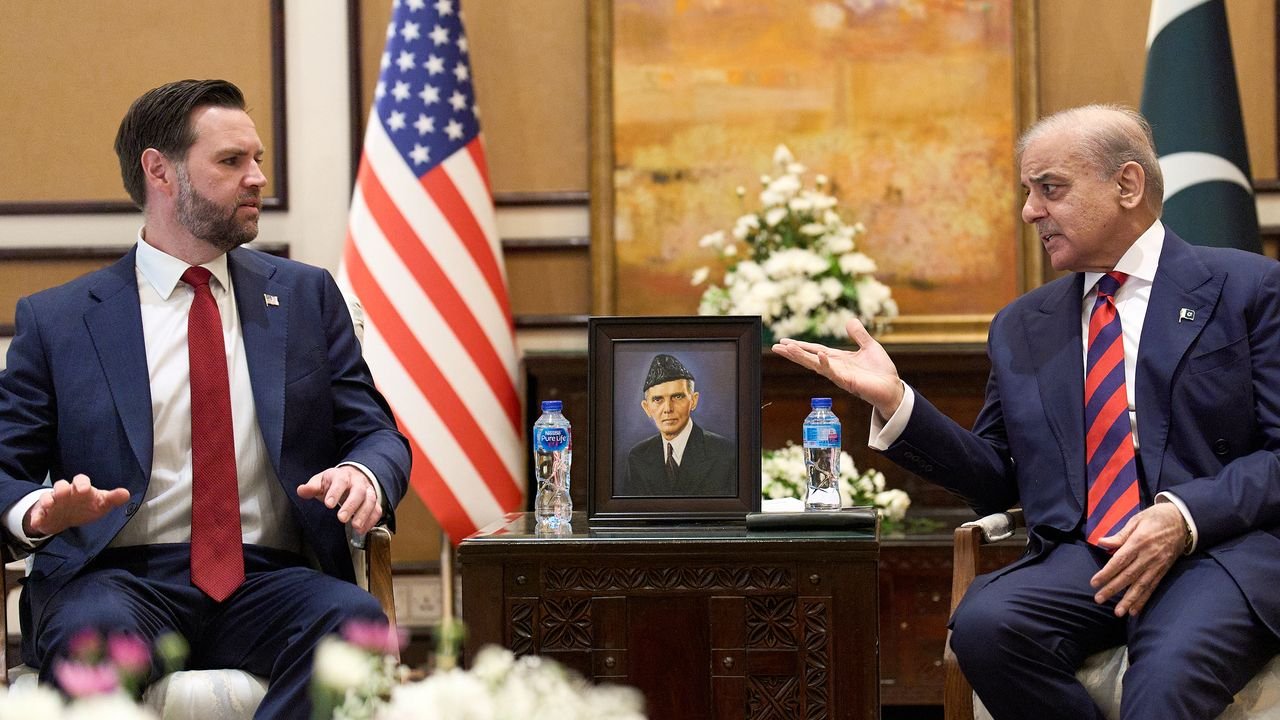
When Trump returned to office last year, Pakistan took the opportunity to reset relations with Washington. Working with the U.S., Pakistani forces captured Mohammad Sharifullah, an alleged mastermind of the bombing at Kabul Airport, in August, 2021, which killed more than a hundred and seventy people—including thirteen American troops—as the U.S. military was evacuating Afghans following the Taliban takeover. Sharifullah was extradited to the U.S. to face charges, giving Trump an immediate victory at the start of his second term. In his address to Congress last year, Trump thanked Islamabad “for helping arrest this monster.”
Early in his Presidential term, Trump approved nearly four hundred million dollars in military assistance to Pakistan, despite a broad freeze on foreign aid. Then, in May, India and Pakistan, nuclear-armed neighbors, engaged in tit-for-tat strikes for four days. When the conflict ended in a ceasefire, Trump took credit and later said he had prevented “a nuclear war.” New Delhi rejected Trump’s assertion and said that it had hashed out the truce directly with Islamabad. Pakistan’s Prime Minister, Shehbaz Sharif, however, declared that Trump had played “a pivotal and paramount role.” A few weeks later, Pakistan formally nominated Trump for the Nobel Peace Prize, declaring that the U.S. President had shown “great strategic foresight and stellar statesmanship” in preventing a larger conflict between two “nuclear states.” “Pakistan understood that this was something that they could seize as an opportunity,” Farzana Shaikh, a Pakistan expert at the London-based think tank Chatham House, told me. The India-Pakistan tensions, along with Sharifullah’s capture, were part of “a fortunate convergence of factors that played into where we find ourselves today,” she said. “It is a dazzling reinvention but one not crafted entirely of its own making.”
But how exactly did Pakistan become the mediator for the U.S.-Iran war? The answer may lie in a meeting between Trump and Field Marshal Munir, which took place almost a year ago. After the ceasefire between Pakistan and India, Trump invited Munir to a private lunch at the White House. It was the first time a U.S. President had hosted a Pakistani Army chief without the presence of the nation’s top civilian leaders, as well. The Twelve-Day War between Israel and Iran was ongoing, and Islamabad had recently denounced Israel’s strikes in Iran as a violation of international law. Munir was expected to push Trump not to enter the conflict and to seek a ceasefire.
At the meeting, which lasted around two hours, Trump and Munir discussed the tensions between Israel and Iran, economic development, mines and minerals, energy, and cryptocurrency, according to the Pakistani military. After the meeting, Trump told reporters that the Pakistanis “know Iran very well, better than most.” He has also repeatedly called Munir “my favorite field marshal.” The next month—after U.S. warplanes had bombed three Iranian nuclear facilities—the U.S. Secretary of State, Marco Rubio, in a meeting with top Pakistani officials, praised Islamabad’s willingness to serve as a mediator with Iran. “Even back then, the Pakistanis had positioned themselves to be seen as a potential mediator,” Kugelman, of the Atlantic Council, said. “It’s a tough job, for sure, but they wanted to do it.” Islamabad, he added, wanted to “push back against India, try to push back against Pakistan’s negative global image. They’re very much about trying to get the world to see Pakistan in a more positive light.”
Pakistan hopes its new stature will bring economic dividends. Munir has expanded his portfolio to include overseeing the country’s trade and foreign investments, and the deals have followed. In September, U.S. Strategic Metals signed a five-hundred-million-dollar investment deal with Pakistan’s military to mine minerals such as gold and copper and antimony. A few days later, Munir was invited back to the White House, this time with Prime Minister Sharif, to discuss Pakistan’s critical-minerals ambitions further. That same month, Pakistan signed a defense pact with Saudi Arabia, committing thousands of Pakistani troops and warplanes to defend the kingdom. This January, Munir also oversaw the signing of a cryptocurrency partnership between Pakistan and an affiliate of World Liberty Financial, a company co-founded by Trump. “President Trump is someone who appreciates strong leaders like Putin, Erdoğan, and el-Sisi,” Shaikh said, referring to the autocrats in Russia, Turkey, and Egypt. “Munir fit that mold.” Pakistan’s offer to mediate, she added, “wasn’t purely altruistic. Pakistan, like other nation-states, calculated there were gains to be had from playing this role.”



