
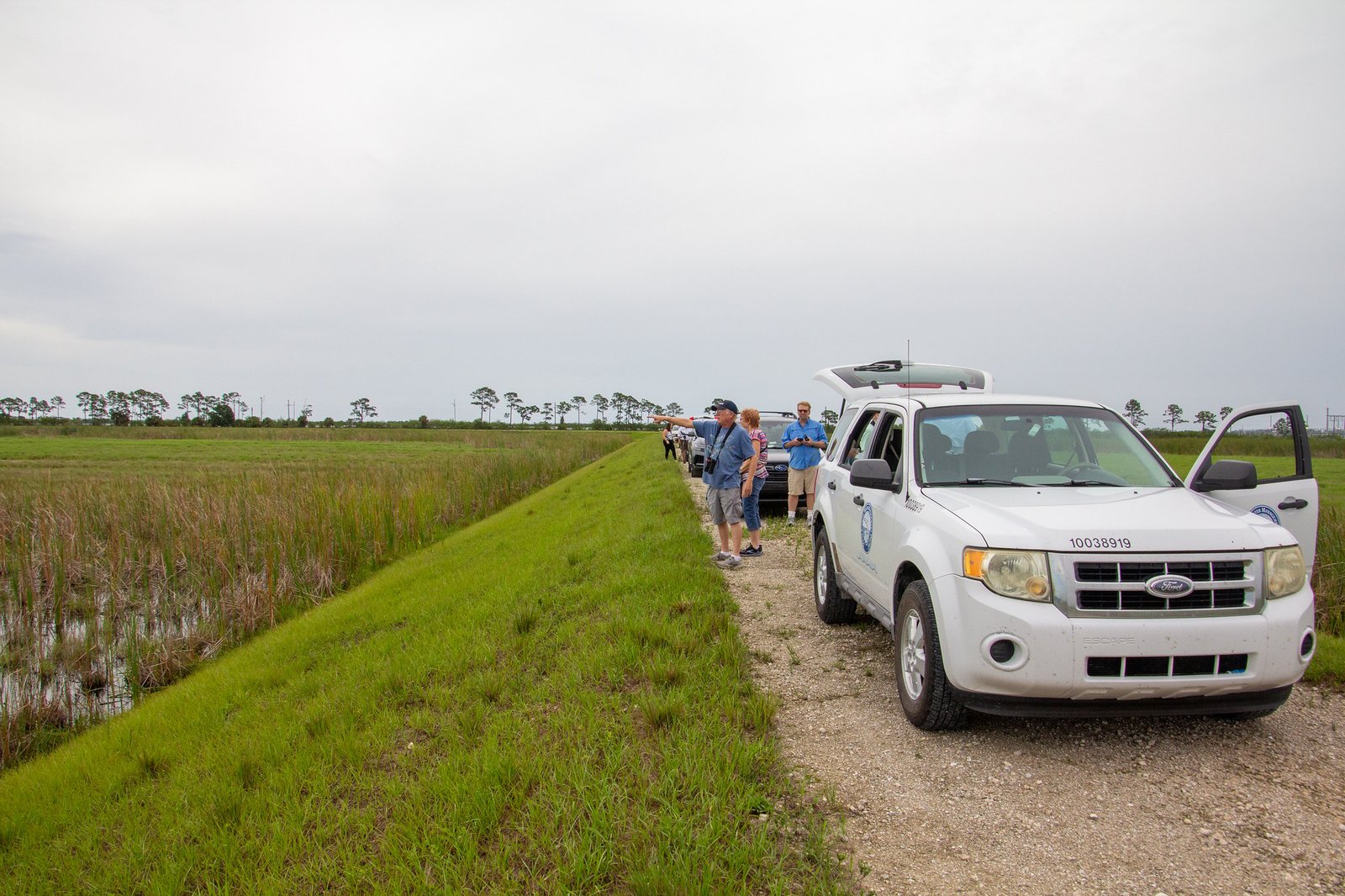
The explorers of Florida found the lonely expanse of the Everglades to be downright f-f-f-f-frightening.
“The bog is fearful,” one wrote during an 1892 expedition that took 21 days. “No island visible except the one we are making for — all saw grass and glades.”
These days, crossing the Glades is as easy as paying a toll and driving across Alligator Alley. Perhaps we Floridians have grown too blase´about the Glades, and not just because crossing them is so simple.
For 25 years, politicians have been pledging to restore the River of Grass. It’s become as rote as a 3rd grade class reciting the Pledge of Allegiance.
Yet surprises still await us. I got one last week when the Florida Trib ran a story headlined, “Florida on track to flunk pollution rules.”
In my head I heard a record-scratch sound like on an old Run-DMC rap and I said, “Wait, what?”
Our politicians have spent so much time yammering about restoring the flow of the Everglades that they seldom mention the other, equally important half of the problem: Restoring the cleanliness of the water. Despite decades of delays, turns out we’re still a looooong way from completing that key task.
The cleanup work depends on 57,000 acres of manmade marshes that the state calls Stormwater Treatment Areas, or STAs. As water flows through the STAs, the marshes clean the pollutants from the water before it gets into the Glades.
The STAs were supposed to achieve specific clean water goals by 2026, but that’s not happening. The STAs have been overwhelmed. They’re losing the battle.
“This year, the state is legally required to meet water quality standards that limit how much phosphorus should flow out of these marshes,” the Florida Trib reported. “But the STAs aren’t on track to comply with clean water rules.”
The news report was based on a study by Friends of the Everglades, so I called up its executive director, Eve Samples, to ask her about it.
Not only are the STAs failing to clean up all the pollution, she said, but they backslid last year. The state’s own data show they cleaned up less pollution than the year before.
I tried to get comments about this impending disaster from people in the sugar industry and spokesmen for the South Florida Water Management District. The cleanup of Everglades pollution is essential to preserving drinking water for South Florida, so this is a big deal we should all be talking about.
They didn’t respond at all — generally not a sign of being proud of your organization’s performance.
“We’ve been kicking the can down the road for 30 years,” Samples pointed out. Now the road is running out.
The governor’s sword
The phosphorus pollution pouring into the Everglades is coming from the fertilizer the sugar barons use in growing their crops.
For decades, they got away with treating the River of Grass the way a dog treats a fire hydrant because state government turned a blind eye to violations of state pollution rules.
The natural Glades is a low-phosphorus environment. The abundant phosphorus in the sugar growers’ waste was rapidly wiping out the native sawgrass and stimulating the choking growth of cattails.
The phosphorus also killed the Glades’ periphyton, a food source for fish and snails that are then consumed by birds, disrupting the entire food chain.
The man who was superintendent of Everglades National Park in the 1980s, Mike Finley, was deeply concerned about the cattail invasion. He compared it to a spreading cancer.
GET THE MORNING HEADLINES.
Phosphorus levels in the Everglades were supposed to be 10 parts per billion (ppb). But the level in Lake Okeechobee had reached about 120 ppb and ran as high as 200 ppb in the runoff from the Everglades Agricultural Area, where the farms were.
Finley brought this up during a meeting with Miami’s newly appointed U.S. attorney. Dexter Lehtinen, whose face bears the scar of his Vietnam War service, hailed from Homestead. He had fond memories of the Glades as it used to be and was appalled to hear how it was changing.
When he was appointed South Florida’s top federal prosecutor, Lehtinen was hailed as the “brightest, toughest, meanest scrapper” around. He proved it in 1988 by suing the state of Florida over the damage being done to federal property in the national park.
Lehtinen didn’t check with his bosses in Washington before suing. He wasn’t sure the Reagan administration would agree to a frontal assault on the powerful sugar industry. Still, he pointed out that he was doing nothing more radical than merely enforcing the law.
“All we are asking is that the state of Florida abide by what is already on the books,” Lehtinen said.
At first, the state fought back, still doing the bidding of the barons. But, by 1991, then-Gov. Lawton Chiles was ready to admit that Lehtinen was right.

I want to give that sword to someone. I want to surrender. We want to start cleaning up the Everglades. Don’t make us keep fighting.
“I’m here with my sword,” the folksy Chiles said in a Miami courtroom. “I want to give that sword to someone. I want to surrender. We want to start cleaning up the Everglades. Don’t make us keep fighting.”
Under the settlement that followed, Florida agreed to build the STAs to filter the sugar industry’s pollution before it reached the Glades. The agreement also called for the state to begin meeting its own water quality standards by 2002.
As you’ve probably guessed, we didn’t make that deadline.
An army in tassel loafers
In 1994, the Legislature passed a law called the Everglades Forever Act that postponed the deadline for cleaning the water going into the Glades to 2006. The joke that went around was that the name referred to how long it would take to clean up the pollution — forever.
Nevertheless, Florida spent $2 billion to build its system of STAs, reservoirs and canals to filter out the phosphorus from the sugar farms in the Everglades Agricultural Area.
By 2003, sugar executives were growing concerned about the deadline. They deployed more than 40 lobbyists — imagine an army clad in silk ties and tassel loafers — to push a bill that said the water didn’t need to be clean by 2006 after all.
Instead, it said, all that had to be done by then was to adopt a plan to stop the pollution. It used such weasel words as “to the maximum extent practicable” and “earliest practicable date.” The industry’s goal: Push the cleanup deadline back at least another 10 years.
Smart alecks (I was one) referred to this as the “Everglades Whenever Act.”
David Struhs, then-head of the state Department of Environmental Protection, had once publicly vowed to meet the 2006 deadline no matter what. But in 2003, during a legislative committee meeting, he testified in favor of the sugar-backed delay.
As soon as he finished speaking, he fled the committee room. I pursued him halfway across the Capitol seeking an explanation. When I cornered him at last, Struhs blamed his flip-flop on what he called “political reality.”
So the deadline became 2016. Despite strong objections from environmental groups, the U.S. Environmental Protection Agency OK’d the delay of Florida’s day of reckoning.
Still digging
There was talk of naming the Everglades Forever Act after “Everglades: River of Grass” author Marjorie Stoneman Douglas.
But the feisty centenarian in a floppy hat refused this dubious honor. She pointed out — accurately — that the law let the sugar companies off the hook and saddled the taxpayers with all the cleanup costs.

In 2004, the organization that Douglas co-founded, Friends of the Everglades, joined forces with the Miccosukee Tribe of Indians, who live in the park, to sue the federal government. Their suit argued the EPA had violated the Clean Water Act by allowing Florida to delay its pollution compliance deadlines.
In 2008, a federal judge agreed, ruling that both the EPA and the Legislature “violated its fundamental commitment and promise to protect the Everglades.” In a 2012 settlement, Florida agreed to expand its STAs, spending an additional $800 million, and to set better phosphorus limits.
The rules that emerged said that the water coming out of the STAs had to be at or below 13 ppb two out of every five years. Additionally, the amount of phosphorus couldn’t ever go above 19 ppb. And the deadline for doing this would be 2026, one Rip Van Winkle-sized nap after the original.
Now here we are, right at the point where the settlement says the phosphorus numbers really count, and the numbers look bad. Four of the five STAs have repeatedly hit numbers above 19 ppb. I mean well above.
“One of the STAs is in the 50s now,” Samples told me.
Only one of the STAs has been producing water below 13 ppb, but that’s not good enough. I asked a longtime Everglades scientist named Tom Van Lent, who now advises Friends of the Everglades, what these pollution numbers mean.
“We’re still doing harm to the Everglades,” he told me. “We’re in a hole and we’re still digging.”
The empty bathtub
But wait — it gets worse!
One of the major components of the $26 billion-with-a-B Everglades restoration program is a 17,000-acre reservoir built in the Everglades Agricultural Area. It’s a joint federal-state project that’s been dubbed “the crown jewel of Everglades restoration.”
The $4 billion reservoir is designed to hold water being released out of an overfilled Lake Okeechobee. Normally, that water is turned loose into the Caloosahatchee River on the west side of the state and the St. Lucie River on the east side. Such releases invariably result in toxic algae blooms in those two estuaries.
The reservoir will allow the water to be released southward toward the Everglades National Park, thus saving the two coasts while recreating the original flow of the River of Grass.
But, Van Lent pointed out, there’s a problem.
The agreement Florida signed with the U.S. Army Corps of Engineers to build the reservoir specifies that “they can’t operate the reservoir if they fail to meet the water quality standards,” he said.
Clearly, Florida is not meeting those standards.

The reservoir is under construction, with completion scheduled for 2030. There’s time left to fix the problem before we wind up with a $4 billion empty bathtub. The question is: How?
A sweetener
Brace yourself. I’m about to say something sweet about the sugar industry — well, most of it.
Many of the EAA’s sugar farmers have cut back on the amount of phosphorus flowing off their land, according to Samples. Collectively, they’ve cut their pollution by more than half, so three cheers for them!
According to Van Lent, there are two options. One is to make the STAs do their jobs better. But at this point, Van Lent told me, they’re operating close to or at their top efficiency.
The other option is to expand the STAs to 100,000 acres. By nearly doubling the acreage, we can greatly increase the amount of filtration, Samples explained.
The second option will require cooperation from landowners in the sugar industry — more than we’ve seen before this. You’d think the sugar barons would be more inclined to help, since they enjoy generous federal subsidies that require we Americans to pay double what the rest of the world pays for their product.
Maybe as a sweetener, Congress could threaten to take those subsidies away from anyone still dumping too much phosphorus. I bet then everyone in the industry would leap to fix the problem they’ve caused.
All I know is, these days it seems like the frightening, fearful bog isn’t the Everglades itself. It’s the swampy politics that has repeatedly protected its polluters.
YOU MAKE OUR WORK POSSIBLE.
Independent Journalism for All
As a nonprofit newsroom, our articles are free for everyone to access. Readers like you make that possible. Can you help sustain our watchdog reporting today?



