
 WASHINGTON — Before the House broke for recess in May, Republican leaders abruptly pulled a bill from the floor to halt U.S. military operations against Iran.
“Are we not voting on it because the American people are sick and tired of this illegal war that is costing tens of billions of dollars, gas prices are through the roof, and people can’t afford their groceries?” Massachusetts Democrat Jim McGovern, arms flailing, shouted from the Democratic side of the aisle. “Is that why you are pulling it?” McGovern asked. “You guys don’t have the guts or the balls to vote on this.”
It turned out Republicans did not have the votes.
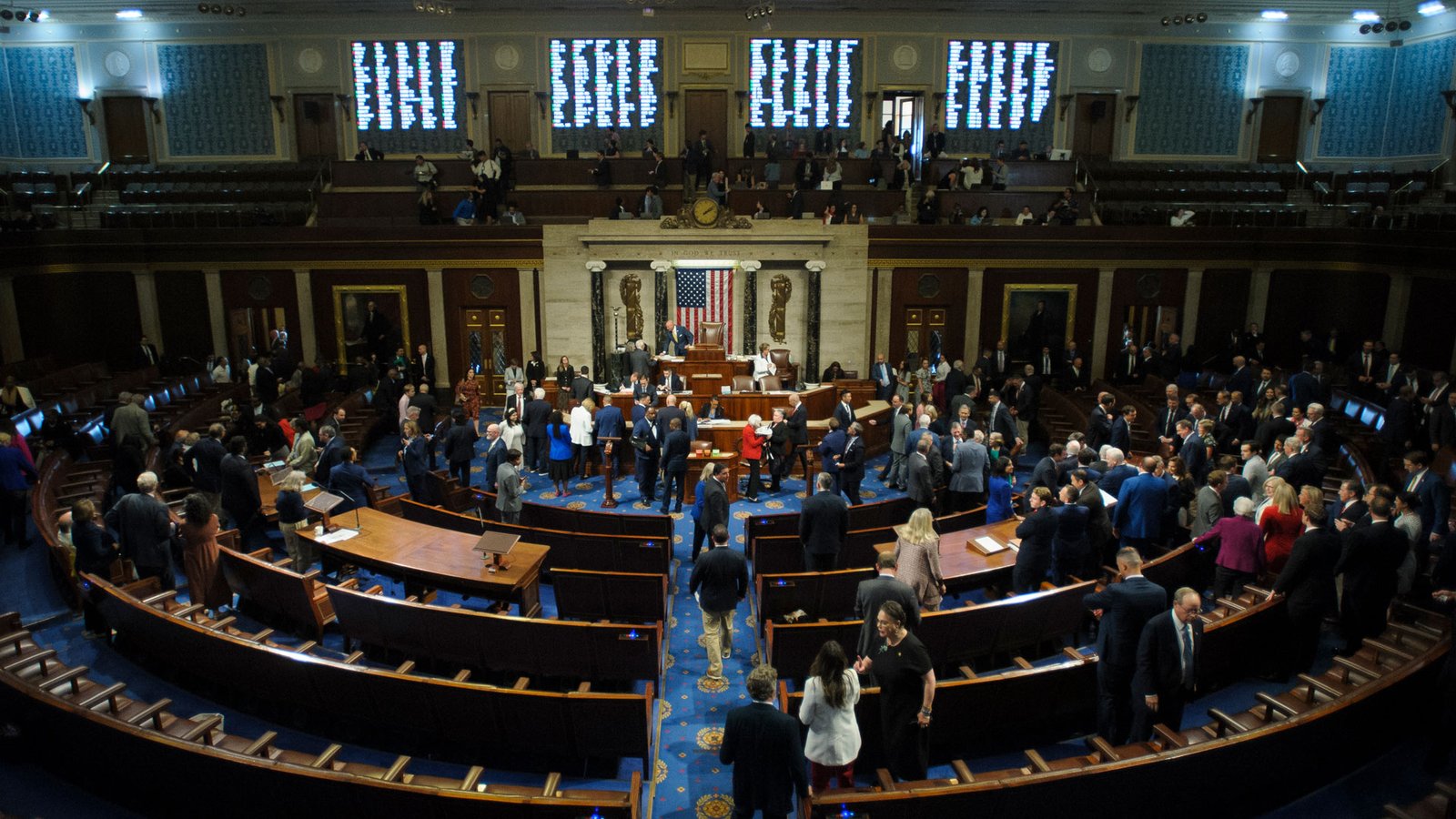
In a symbolic rebuke of the Trump administration, the House voted Wednesday, 215-208, to force the withdrawal of U.S. military forces from Iran. Four Republicans voted with Democrats. President Donald Trump called those Republicans “grandstanders” for voting as they did.
Within New Jersey’s delegation to Congress, Democrats voted for the measure and Reps. Jeff Van Drew (R-2nd) and Chris Smith (R-4th) voted against it. Missing Republican Rep. Tom Kean Jr. did not vote.
The passed resolution is part of a barrage of war powers resolutions that Democrats, with the help of a thin bloc of iconoclastic Republicans, have procedurally forced to votes since U.S. and Israeli forces attacked Iran on Feb. 28.
The measure (H.Con. Res. 86) now heads to the Senate, where under the War Powers Act of 1973, the chamber must take up the resolution in a matter of weeks. It does not require the president’s signature and does not wield the force of law.
“Great to see the House stand up to Trump to put an end to his costly, illegal war in Iran,” Sen. Andy Kim (D-NJ) wrote online after the House vote.
‘Many deficiencies’
In mid-May, the Senate voted 50-47 to pass a comparable resolution to draw down military activities against Iran without approval from Congress, the only branch of the U.S. government with the constitutional authority to declare war.
In a memo, the White House budget office said the resolution has “many deficiencies.”
“There are no present hostilities from which to remove U.S. Armed Forces,” the memo says. “A nuclear-armed Iran poses an unacceptable and urgent threat to the U.S. homeland and to U.S. military personnel deployed across the Middle East: it would embolden the regime’s aggression against U.S. allies and partners, enable the regime to escalate terrorism under a nuclear umbrella, trigger a regional arms race, and potentially lead to a nuclear exchange.”

The ongoing war has cost the U.S. an estimated $29 billion, according to Pentagon officials, though the cost is likely higher, military analysts say.
A resolution from Rep. Josh Gottheimer (D-5th), a hawkish Democrat on Israeli military issues, stalled in the House last month, when members deadlocked 212-212 on the measure.
“You cannot leave the United States Congress any longer — you can’t leave the American people — in the dark,” Gottheimer said then, urging Trump to detail the objectives for Iran in detail.
Three months into the war, dominating the halls of Congress is debate over U.S. military posture in the Middle East and knock-on effects of the war — from elevated gasoline and fertilizer prices, to Israeli military operations in southern Lebanon and the role of Congress to fund and approve wars.
Israeli posters are displayed on the front doors of congressional offices, though that trend appears stronger with Republicans.
Tlaib’s perspective
In two separate votes Thursday, the House sided against restraining U.S. military involvement in Lebanon, where Israeli and the terrorist group Hezbollah have exchanged rocket fire, and to send military aid to Ukraine.
 Credit: (Office of Rep. Rashida Tlaib)
Democrat Rashida Tlaib, the first Palestinian American elected to Congress, filed a resolution to halt U.S. military aid in connection with the Israeli military activities in Lebanon.
Congress must rein in Israel before it razes Lebanon as its forces did to Gaza, Tlaib said.
“This Congress did nothing to save lives in Gaza,” Tlaib said. “We must act now, though, to prevent the same fate in Lebanon.”
Continued Tlaib: “The Trump administration has engaged in unlawful and unauthorized participation in hostilities as part of the Israeli invasion of Lebanon in violation of the War Powers Act.”
The House voted that resolution down, 92-324 with two members voting “present.” Gottheimer and Reps. Donald Norcross (D-1st) and Herb Conaway (D-3rd), both members on the House committee that oversees the military, voted with Republicans on the Lebanon measure.
Later Thursday, the House passed a military assistance package for Ukraine by a vote of 226-195, with 18 Republicans crossing their party and voting for it. New Jersey’s delegation split, with Democrats for and Republicans against.
“I want to point out that this critical legislation was introduced over one year ago,” Rep. Nellie Pou (D-9th) said after passage. “Inexplicably, almost criminally, it has been held up by the administration and majority.”
“These delays have denied Ukraine essential aid and given Vladimir Putin a green light to continue his mass murder,” Pou said.
The bill, which must clear the Senate before it can be signed into law, contains $1.3 billion in direct military assistance, $8 billion in military sales and economic sanctions against Russia.
“This is not one of those conflicts where there is a gray area,” Gregory Meeks, a New York Democrat and the ranking member of the House Foreign Affairs Committee. Referring to autocratic Russian President Vladimir Putin as a “thug,” Meeks said: “If you believe his intentions will end with Ukraine, you have not been paying attention at all.”
Republican allies of the president said the bill would limit Trump in possible peace talks by placing sanctions on Russia.
“If you support this bill, then clearly you are not interested in peace,” said Keith Self, a Texas Republican. The legislation, he said, would “tie the hands of the president.”
Russian forces, after seizing Crimea in southeastern Ukraine in 2014, started a new phase of the war against Ukraine in 2022 — a full-scale invasion that continues. Congress approved a $60 billion weapons and military support package for Ukraine in 2024, during the Biden presidency.
“We should have done this a year ago,” said Don Bacon, a Nebraska Republican who voted for the bill. “Russia is bombing Ukrainian cities every night with ballistic missiles and hypersonic missiles.”
“He attacked his neighbor that’s four times smaller,” Bacon, a former brigadier general in the U.S. Air Force, said of Putin.
As the U.S.-Iran war has unspooled, Republicans maintained that passing resolutions to check the White House would limit the president’s military options.
Of the four Republicans who voted for the House-passed Iran measure, two — Tom Barrett of Michigan and Brian Fitzpatrick of Pennsylvania — are in tough reelection races. The other two, Kentucky’s Thomas Massie and Warren Davidson, from Ohio, have routinely voted against expanding war powers and surveillance.
Livid over the Nixon administration’s secretly bombing Laos, Vietnam and Cambodia in the 1970s, without congressional approval, Congress passed the War Powers act in 1973, overriding Richard Nixon’s veto.



