
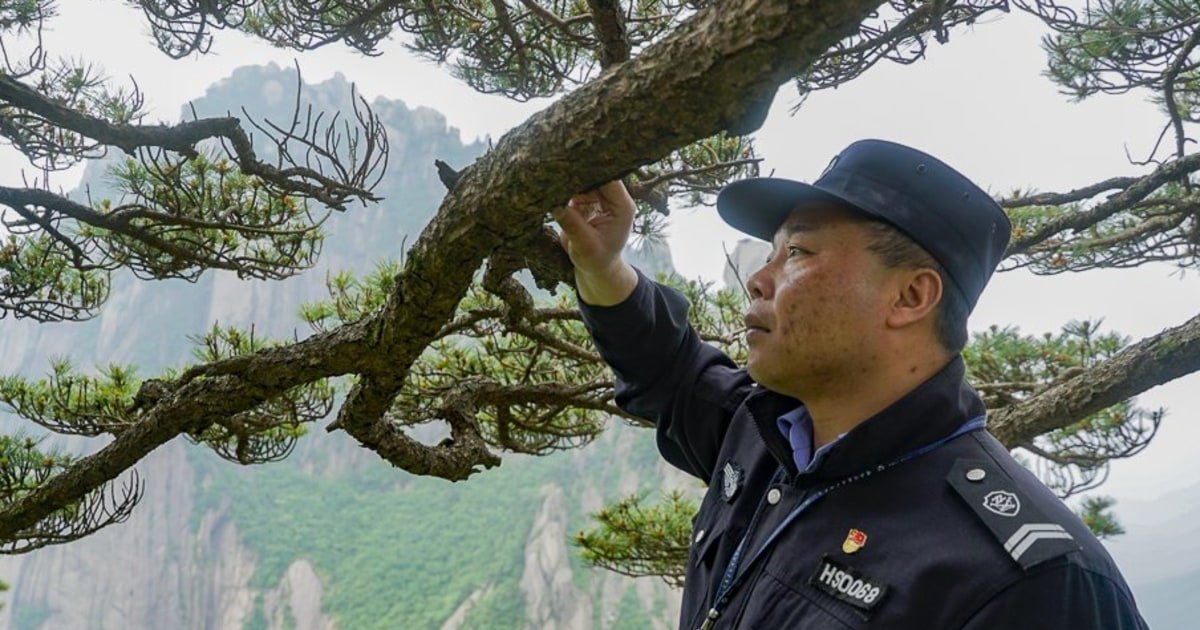
An intrusion prevention alarm system was installed in 2020, with an app that raises an alert if a tourist is coming too close to the pine.
“I can conduct the inspection as soon as I see the alert, and this can save a lot of time,” Hu said.
He said it was “the happiest thing” to see the precious pine still doing well at what is considered a relatively vulnerable age for a tree. But it faces another challenge as changing weather patterns create increasingly severe conditions on the mountain.
“The pine is afraid of the freezing rain the most, as the rain may cause damage to the branches if not handled properly,” Hu explained.
Eastern China recorded more extensive areas of severe freezing rain in 2024 and 2025 compared with historical averages in what the China National Climate Center says is the result of climate change.
“I need to inspect every 30 to 40 minutes when it comes to severe weather, and we stay up all night if there is strong wind or flooding,” Hu said. “It feels heart-wrenching to see it endure that harsh weather.”
It is not just Huangshan that is concerned about climate change.
During the global dialogue in Huangshan last week, mayors from 10 countries, including Italy, Germany and Thailand, discussed how to build more resilient cities.
Dhana Raj Acharya, the mayor of Pokhara, Nepal, said his city had similar concerns to Huangshan’s.
“Pokhara is located within a fragile mountain ecosystem, so we face challenges such as uneven rainfall, flooding, landslides and rapid urbanization,” he said.
Some mayors who are worried about overtourism said they wanted to emulate Huangshan’s visitor diversion system. They included Filippo Gasperi of Gradara, Italy, whose town of 5,000 people gets more than 500,000 visitors a year.
“It is a significant imbalance,” he said during the dialogue.
Other cities are eyeing the electric vehicles that have taken over China’s roads, including in Huangshan, especially as the U.S.-Israeli war with Iran drives up global fuel prices.
“What we really want to duplicate in our home city is China’s application of EVs,” said Anna Giorgetti, who works for the San Marino-China Association.
Giorgetti said San Marino, a microstate within Italy, had recently struck an agreement with major Chinese EV maker BYD in “a big step forward for San Marino.”

While China has attached great importance to building green cities, experts say it still has a long way to go as the world’s biggest emitter of greenhouse gases. Levels of microscopic air pollutants known as PM2.5 are still “significantly” above World Health Organization guidelines, according to last year’s IQAir World Air Quality Report.
But China has made a point of reaching out to state and local officials around the world who are not waiting for their national governments to take action on climate change. China and the world’s second-biggest emitter, the United States, reached no specific climate agreement last month when President Donald Trump met with Chinese leader Xi Jinping for a summit in Beijing that was focused more on trade.
Among the U.S. officials who have promoted climate cooperation with Beijing is California Gov. Gavin Newsom, who made it the focus of a trip to China in 2023.
Mayor Alexander Badrow of Stralsund, Germany, said it was “inspiring” to see officials from different countries come together in Huangshan when “the world is now in a very difficult time.”
Badrow joined other mayors on a visit to the Guest-Greeting Pine, which he called “stunning.”
Hu said he was used to important guests coming to visit his tree.
“To me, it is more like an elder member of my family,” he said. “I am guarding it when it is guarding the mountain.”
Erin Tan reported from Huangshan, and Jennifer Jett from Hong Kong.



