
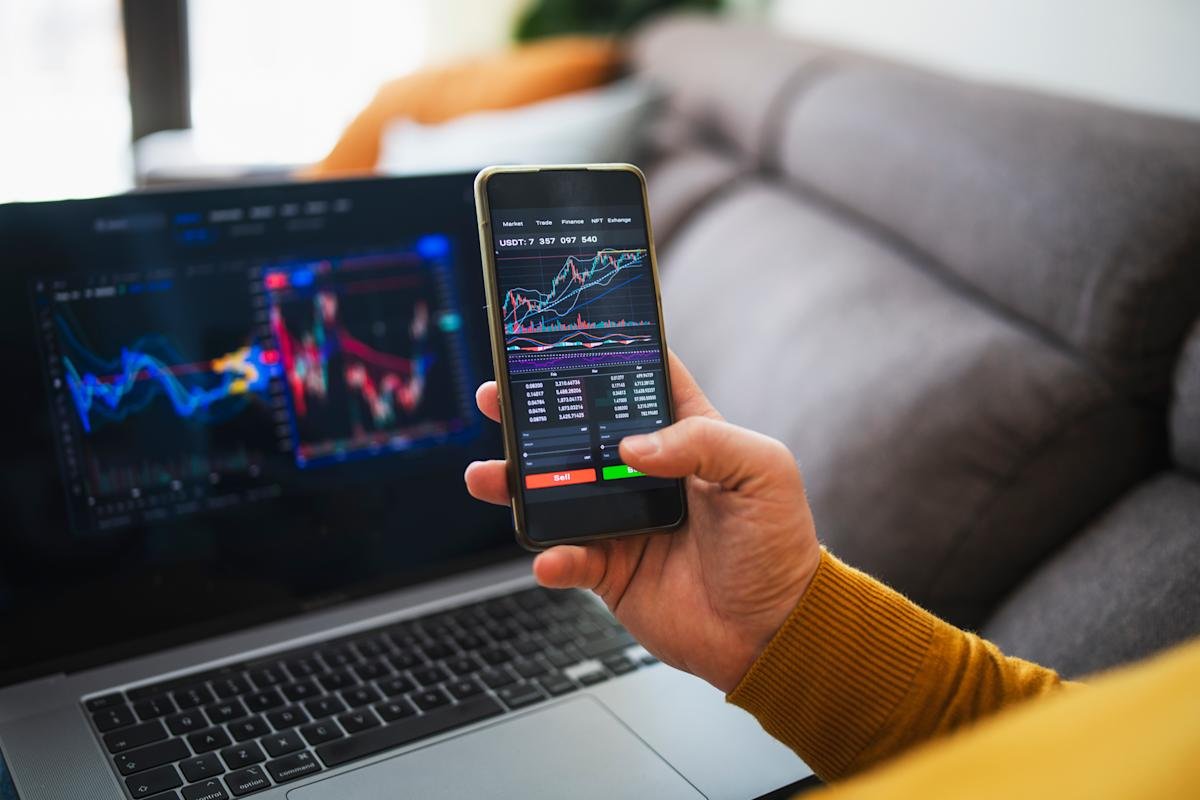
Crypto is often more volatile than markets for more traditional assets such as stocks and bonds. A digital asset could soar or lose 10% of its value in a week, a day, or an hour. That volatility makes crypto a great candidate for dollar-cost averaging, a time-tested investment tactic that takes the guesswork out of investing in crypto — or any other market asset.
A dollar-cost averaging approach means you don’t need to divine how the market will react to events. You just buy a fixed dollar amount at a regular interval. Best of all, dollar-cost averaging naturally optimizes for lower prices. In a nutshell, you buy more of the asset when prices are low and less as prices rise.
In this guide, you’ll learn exactly how dollar-cost averaging works, and why it’s especially suitable when buying crypto. We’ll discuss the pros and cons and how to set up a plan that fits your budget if you think it’s the right approach for your portfolio.
What is dollar-cost averaging?
Dollar-cost averaging isn’t specific to crypto. But crypto’s volatility makes it a good tool for digital asset investors. Benjamin Graham, a famous investor, first coined the term in 1949 in his book, The Intelligent Investor. In the book, Graham defined a strategy for investing a fixed amount of money at regular intervals, regardless of an asset’s price.
For example, let’s say you invest $50 every Monday, or $200 on the first of every month. The specific day matters less than the consistency of investing on a fixed schedule.
Contrast this with lump-sum investing. With a lump sum, you put all your available money into an asset at once. If you have $1,000, you invest $1,000 today. That approach works well if you catch a low price, but it carries significant risk in a volatile market. If the price drops tomorrow, your entire investment loses value immediately.
Dollar-cost averaging works differently due to its core mechanic. When prices are high, your fixed money amount buys less of the asset. When prices drop, that same money buys more.
If a token costs $10, a $100 investment gets you 10 tokens.
If the price falls to $5, your next $100 investment buys 20 tokens.
If you had made your entire investment at $10, the drop to $5 is terrible news. If you’re scheduled to invest again, the $5 price is great news. It means you can acquire twice as much when you buy again.
Dollar-cost averaging removes the stress of guessing market direction. If you’re investing with the conviction that the asset will appreciate over time, the price only matters as a measure of how much you can buy. Over time, dollar-cost averaging smooths out your purchase price. You naturally accumulate more when the asset price falls, and less when it rises.
Why crypto volatility demands a strategy
Crypto markets move fast, and those rapid price changes often shake investors out of positions that could later become profitable. In traditional stock markets, a 3% daily move leads the news. In crypto, a 5% price move is just a typical Tuesday. Newer tokens can see even more dramatic swings due to lower market caps (total market value) and lower liquidity. In short, they have smaller markets, so the price can move more than assets in well-established markets.
These rapid price moves create stress for investors watching the price on a screen. In many cases, it causes them to panic-sell or panic-buy. The latter even has an acronym: FOMO (fear of missing out). Fear can push you to buy as prices peak, often right before a correction. Conversely, when prices crash, panic sets in. Watching your portfolio bleed value makes you want to sell everything just to escape the pain. You lock in your losses, only to watch the asset recover a month later.
This emotional cycle destroys portfolios. Trying to time the market by guessing the exact right moment to buy low and sell high rarely works. The reality is that we’re all busy with other demands in life. Even professional traders who have the time and tools to track the news and chart patterns struggle to anticipate crypto’s unpredictable twists.
Dollar-cost averaging acts as an emotional circuit breaker. Because you commit to buying a set amount on a set date, you don’t have to stare at charts or stress over news headlines.
By automating your decisions, you protect yourself from your own worst instincts. Instead, the focus shifts to choosing investments you think will perform well over the long term, and then staying disciplined in your investment schedule.
How dollar-cost averaging works in practice
Starting a dollar-cost averaging plan requires two basic decisions: how much to invest and how often to do it. Once you make those choices, you just follow your schedule.
Setting your schedule
As a first step, decide on a realistic investment amount. You may need to take a step back and plan a budget. How much can you afford to invest regularly, given your other financial obligations? That number might be $25 a week or $50, or it might be $500 a month, depending on your cash flow and other obligations. The important thing is to choose an amount you can maintain. Dollar-cost averaging benefits from consistency.
Next, choose your interval. For example, you might invest weekly, biweekly, or monthly. Often, the best approach is to align your schedule with your cash flow. This aligns with another investment and budgeting strategy: Pay yourself first. In short, you make your investment before you have a chance to spend the money on something else. For example, if you get paid every two weeks, make your dollar-cost averaging purchase on payday. Consistency is the approach’s engine. The specific day you choose matters far less than your commitment to showing up on that day.
Executing your purchases
Once you set your schedule, the execution is simple. Let’s say you decide to invest $100 into bitcoin every Monday. When Monday arrives, you log into your crypto exchange account and buy $100 worth of bitcoin. You don’t need to look at the chart to decide if it’s a good day. It’s always a good day because you have a predetermined amount of money to invest. Don’t check social media for market sentiment. Don’t bother with the news. Just execute the trade. Discipline.
If bitcoin’s price dropped over the weekend, your $100 buys more satoshis (the smallest unit of bitcoin).
If the price surged, your $100 buys less.
Either way, you follow the plan: a fixed investment amount in dollars and a fixed interval.
When it’s time to buy, you have two primary options. You can set up an autobuy or invest manually. The latter is often more cost-effective, but requires additional steps.
For example, many crypto exchanges, such as Coinbase, offer automatic recurring purchases. This feature lets you set up an amount and frequency for your dollar-cost averaging buys.
However, you’ll pay the “spread.” Effectively, this spread acts as a markup on the transaction and can be more costly than buying directly on the exchange using the advanced trading platform. Fees and spreads for autobuy can reach 2% or more. Funding your purchase with a debit card can drive the cost up further. These added, but not always obvious, costs create a headwind for your future investment gains.
Alternatively, you can fund your account with an ACH transfer from your bank account. The transfer is typically free. Once the funds clear, you can use your balance to buy crypto directly on the advanced trading platform. For simplicity, a market order is the easiest way to place your buy. Here’s why:
A market buy order fills immediately from the open sell orders on the exchange.
A limit buy order waits until the market reaches your price. It might never happen, and using limit orders puts you in the position of trying to outguess the market.
Market orders often cost more than limit orders, but the costs pale in comparison to using autobuy.
Some trading platforms, including Coinbase, offer ways to automate part of the transaction with automatic deposits or purchases of a stablecoin like USDC. Stablecoins track the value of other assets. For example, the USDC stablecoin token is pegged to $1 USD and backed by cash and cash equivalents, such as Treasury bonds.
Automatic ACH bank deposits and automated USDC purchases are often free when using exchanges. However, each exchange has its own fee schedule. If you choose an auto-deposit, set a calendar reminder to log in and make your dollar-cost averaging purchase manually.
The math behind dollar-cost averaging
Let’s look at how dollar-cost averaging works with an example. Imagine you decide to invest $100 per month in a token for 6 months. In this example, the market falls after you buy, then recovers. You’re buying on a fixed schedule throughout.
Here is how the price moves each month:
Month 1: $50 per token
Month 2: $40 per token
Month 3: $20 per token
Month 4: $25 per token
Month 5: $40 per token
Month 6: $50 per token
If you invested a $600 lump sum in month one, you would have bought 12 tokens. By month three, your portfolio value would have dropped to $240. That is a stressful 60% loss.
However, if you used dollar-cost averaging, your results look different. You invested $100 each month, buying tokens at whatever the current price happened to be:
Month 1: $100 buys 2 tokens
Month 2: $100 buys 2.5 tokens
Month 3: $100 buys 5 tokens
Month 4: $100 buys 4 tokens
Month 5: $100 buys 2.5 tokens
Month 6: $100 buys 2 tokens
After six months of using the approach, you invested $600 and now hold 18 tokens total. That brings your average purchase price to $33.33 per token. The market price in month six is $50.
Through dollar-cost averaging, you bought more tokens when the price was low. As a result, your average cost per token is now below the market price. You didn’t have to follow the news or time your purchases perfectly. Dollar-cost averaging automatically optimizes your average cost by buying more when prices are low. However, the key is consistency: the same amount invested, on a fixed schedule.
Benefits and trade-offs of using dollar-cost averaging for crypto investing
The approach offers clear advantages, particularly in taming crypto volatility, but it also comes with trade-offs. You won’t catch the lowest price, and sometimes you’ll pay more than you would have liked.
The benefits
The method reduces the stress that often leads to emotional trading decisions. You don’t need to watch the market constantly or worry about missing the perfect entry point. Your schedule eliminates the need to time the market. Instead, you buy on time, every time.
Dollar-cost averaging also builds a pay-yourself-first investing habit. Regular investing grows your portfolio steadily over time. You treat your investments like a recurring bill, which takes the guesswork out of building wealth.
Lastly, it lowers your average cost in down markets. When prices fall, your fixed investment amount buys more tokens. You turn market dips into an advantage without needing to watch the charts.
The trade-offs
However, dollar-cost averaging has trade-offs. It requires discipline. The math often breaks if you stray from the plan. Even when the market looks terrible and you want to stop, the method requires you to keep buying. If you pause your investments out of fear, you lose the benefits of the strategy.
Also, you probably won’t catch the absolute lowest price. Dollar-cost averaging buys at the average price, not at the bottom. In a market that only goes up, lump-sum investing easily outperforms the approach. If you invested all your money on day one, you would own more tokens, assuming you timed the bottom or bought before the masses. If you were lucky enough to discover bitcoin at $13 (now high five figures) or you timed a dip-buy perfectly, lump-sum investing always comes out ahead.
Finally, transaction fees can take a big bite out of your portfolio balance. Note the trading fees for the platform you’re using to be sure the fees don’t create a headwind. Fee-free methods like ACH transfers keep deposit fees out of the picture, and buying on an advanced trading platform usually keeps trading fees low.
Bottom line
Although well-established assets like bitcoin and ethereum are less volatile than they once were, their prices still move faster than those of traditional investments, such as broad-market funds. Newer tokens, including memecoins and other altcoins, can be even more volatile. Dollar-cost averaging lets you navigate that volatility by just ignoring it.
There’s no need to time your trades or read the market tea leaves. Instead, you research your picks. Then you buy a fixed dollar amount on a regular schedule. If you choose well and invest for the long term, your average cost will likely be lower than the current trading price when it’s time to exit your position.
Dollar-cost averaging doesn’t eliminate risk, and it won’t catch the absolute bottom. Instead, it replaces emotional reactions with a disciplined and time-tested process to reduce your average cost.



