
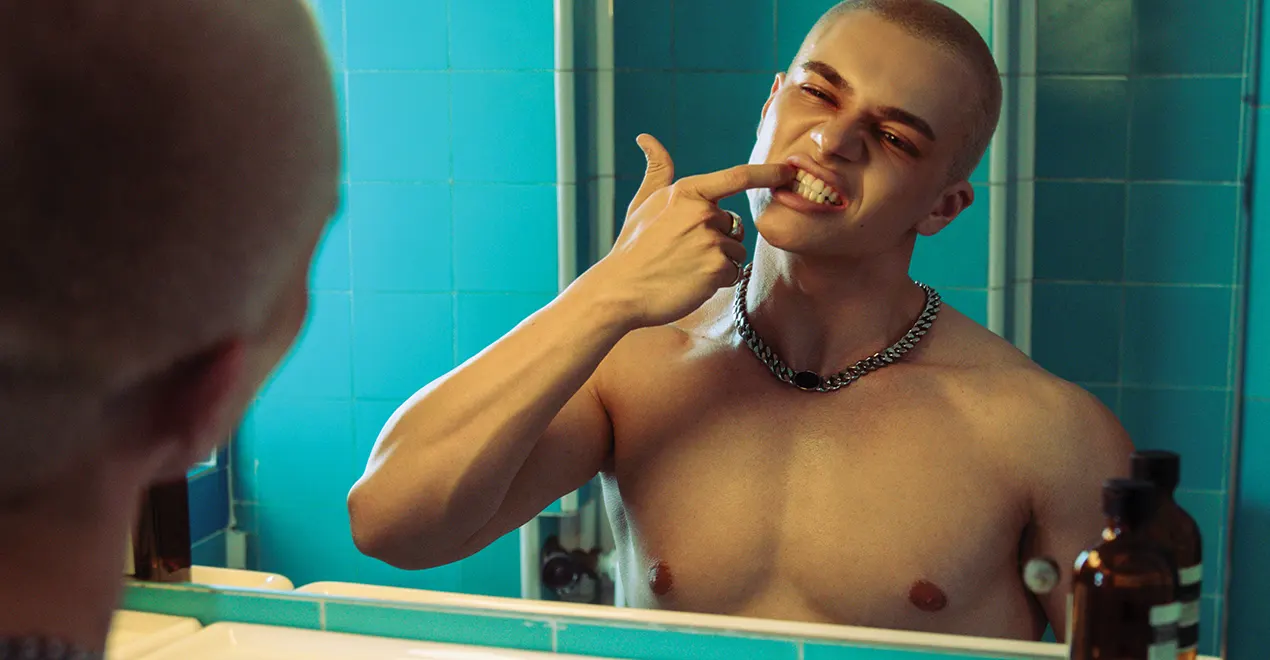
Filarri approaches Od krvi i mesa as a complete work, built to be experienced in its entirety. In conversation with Zarko Davinic, Editor in Chief of DSCENE Magazine, he frames the album as a conceptual body rather than a collection of standalone tracks. The record captures a period shaped by emotional intensity, where personal experiences unfold through sound. He treats the album as a contained moment, one that holds collisions, shifts, and emotional extremes that no longer define his present, but remain preserved within the work.

At the center of the project stands a clear decision to push toward full emotional exposure. “I wanted to be honest to the core, to fully strip myself down emotionally, and to allow the audience to truly get to know me by listening to the album from beginning to end.” That intention shapes both the structure and the pacing of the record. The album moves through eight songs and an interlude, building gradually toward a closing sequence where that openness becomes difficult to avoid. He describes the process as an act of expansion, not reduction, where creative control required him to embrace everything rather than hold anything back.
“Riski” introduces that world. Positioned as the lead single, it operates as an entry point into the album’s emotional logic. “We chose it because it carries a cross-section of the entire album through its vibe, emotion, genre, and energy.” The track reflects a time when instability and intensity defined his daily life. Those conditions no longer shape his present, which he describes as more stable and calm, yet they remain embedded in the material. The album functions as a record of that earlier state, where each track holds fragments of those collisions.
As the narrative unfolds, different versions of the artist emerge. Some remain close to what his audience already recognizes, while others move into more exposed territory. The final stretch of the album concentrates that shift. He points to the closing songs as the most difficult to release, describing them as moments where emotional control disappears. “Every time I listen to the album from beginning to end I completely break down at the end.” The closing tracks strip away distance and present a direct acknowledgment of vulnerability, framed through a simple but deliberate statement of being human.
Beyond the album itself, the conversation moves toward pressure, a condition that extends across both his creative process and public presence. His relationship to pressure has shifted over time. Earlier in his career, he associated it with performance and productivity. Now, he recognizes a need for distance when working on material that carries personal weight. “I increasingly feel the need for my own comfort zone, especially when I am working on something artistically important.” That need translates into a controlled environment, defined by trust and a sense of safety, where creative work can develop without external interference.
This distinction becomes sharper when he describes the difference between music and social media. Music remains a stable point of return, a space where he feels aligned with himself. Social media operates under a different set of expectations. “There, you often have to be smiling, in a good mood, interesting, and engaging enough to keep people’s attention.” The gap between those expectations and internal states introduces tension. Over time, that tension has led him to protect parts of himself that he previously shared more freely. Visibility remains part of his work, yet he approaches it with increasing distance and control.
I wanted to be honest to the core, to fully strip myself down emotionally, and to allow the audience to truly get to know me by listening to the album from beginning to end.
Despite the expectations that usually accompany a debut album, he describes the creation of the album as largely free from external pressure. The process followed an internal logic, guided by instinct and collaboration rather than anticipation of reception. “We worked only according to what we felt and how we saw that entire world without compromise.” That approach extended across the entire project, from songwriting to visual direction. The album reflects a closed system, where each element developed from the same source without adjustment for outside expectations.
Maintaining that autonomy requires constant negotiation, particularly in relation to public perception. He describes a deliberate effort to preserve his connection to music as the central point of focus. “I try to remind myself why I wanted to do music in the first place.” That reminder functions as a form of protection, allowing him to separate the act of creation from the responses it generates. Social media remains unavoidable, yet he establishes distance where possible to prevent it from reshaping his relationship to the work.
Social pressure enters the conversation through questions of identity and expression. He points to rigid expectations surrounding masculinity as a persistent source of tension. “The pressure I have felt most strongly is connected to stereotypes about how a man should or must look and behave.” His response does not involve avoidance. Instead, those pressures become material within the album itself. The songs and visuals translate that experience into a direct message centered on self-acceptance and visibility, without adjustment to fit external norms.
His collaboration with Ljubba forms a central axis within that process. He describes the relationship as instinctive and unforced, built on a shared understanding that shaped the direction of the album. “It felt as if I had something he needed… and he had something I needed.” That exchange operates across both creative and personal levels, allowing the project to develop without formal negotiation. The result reflects a unified perspective, expressed through two distinct voices that align around the same core themes.
When he describes the album as a space, he frames it as immersive and continuous. “From beginning to end, the listener goes through a rollercoaster of emotions.” The structure does not offer resolution in a conventional sense. Instead, it presents a sequence of experiences that move between intensity and release, without smoothing over the shifts between them. The closing track brings that process to a direct conclusion, where the listener encounters the same statement that defines the project as a whole. A recognition of vulnerability, framed through the body, the voice, and the shared condition of being human.
The album remains grounded in that idea. It does not attempt to distance itself from emotion or reorganize it into something easier to navigate. Instead, it holds those experiences in place, allowing them to exist without revision. Through that approach, Od Krvi I Mesa establishes itself as a fixed record of a specific time, shaped by pressure, exposure, and the decision to move through both without compromise.
Photographer LUKA STEPANOVIC
Photographer Assistant UROS PAJOVIC
Styling MANDA JAVORINA
Grooming and Makeup ARTHUR KHATT
Production BORISLAV UTJESINOVIC
Talent FILARRI
Filarri is wearing total looks from HUGO Spring Summer 2026 collection, available now.



