
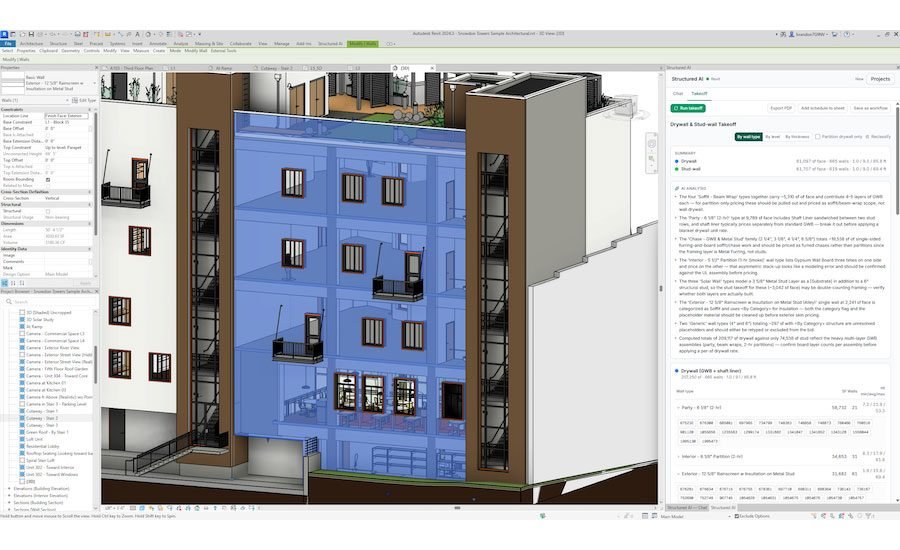
Structured AI, a platform that has quality assurance and quality control artificial intelligence agents developed for construction, has raised a $4.2 million seed round, bringing its total funding to $5 million.
The round was led by FCVC. Other investors include the Y Combinator, 20VC, Cherry Ventures, Zero Prime Ventures, Transpose Platform and Sequoia Scout. Construction documents remain the single source of truth that contractors rely on for most projects, and Structured AI’s optical recognition models are focused on that workflow and analyzing what’s completed in the field against documents.
“We trained our own computer vision models,” says Raymond Zhao, co-founder and CEO of StructuredAI. “Over the last couple of years, vision has gotten really good and identifying the marks on documents and checking them against work in the field has been unlocked.”
Structured AI’s optical recognition platform runs QA checks across entire drawing sets before a senior engineer reviews them. Engineer Syska Hennessy Group has been testing the platform and helping StructuredAI develop its platform.
“About four years ago, we invested in them as one of our seed stage companies, and we also partner with them with sort of a goal of seeing innovation and change in the industry,” says Robert Ioanna, executive vice president of Syska Hennessy Group in New York. “By partnering with some of these startups and giving them access, we get a tool that we really like and can use that’s custom built.”
Syska Hennessy engineers told Zhao and the team at Structured AI early on in their partnership that MEP coordination was a common pain point they faced. That feedback eventually evolved into the OCR and AI-powered platform that addresses all manner of QA/QC issues on projects.
“I shows some promise, and we’re moving forward and have started to solve some pretty complicated things, like toilet exhaust caps in a bathroom, and a lot of these things are not just fixing a line there, or a line here in documents, it’s more like analyzing something and interpret something. They’re moving into the next step, where it’s going to actually be in our drawing software, so literally it’s it’s going to be like, like almost like spell check, where they’re going to recommend a change be made, and then in your native drawing, you get to click accept, and it’s done,” Ioanna says. Revit is the design authoring tool Syska has been using for most of its projects with Structured AI.
Looking for quick answers on construction and engineering topics?
Try Ask ENR, our new smart AI search tool.
Ask ENR →
Zhao says that while Structured AI is focused on speeding up QA/QC processes, it does not want to take decisions away from architects or engineers.
“[Computer vision] has gotten really good at reasoning and doing the logical thinking, but it doesn’t have the context of what an architect would interpret that as,” Zhao says. adding that changes will have to still be approved by a person through system-generated notifications.
Source: www.enr.com



