
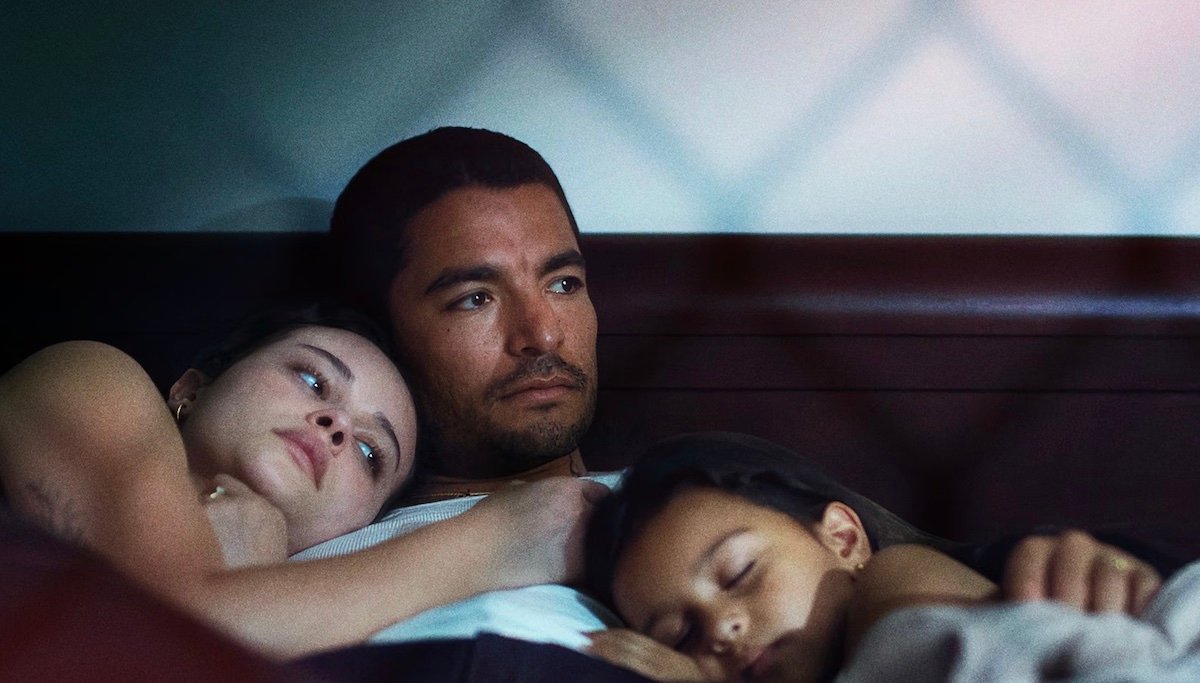
A relationship that couldn’t go on inspired Melissa Fisher to make “Inside These Walls.”
The bittersweet short film looks at the increasingly uncommon prison policy of allowing extended family visitations, in which inmates can spend time with their loved ones in special apartments built on the prison grounds. Once called conjugal visits, they’ve been abandoned in most of the country. The film debuted this week at the deadCenter Film Festival in Oklahoma City.
“‘Inside These Walls’ began as a personal meditation on a relationship constrained by circumstance: a love that was profound but ultimately unsustainable,” Fisher explains. “Metaphorically I thought it would be interesting to portray this relationship through the lens of prison visitation. I imagined a conjugal visit, an intensely literal form of enforced separation, and decided this could be a compelling way to explore love and heartbreak.”
The film, which Fisher directed, and which she co-wrote with Jonathan Clark, stars Isabella Briggs as Ava, a woman who dutifully goes to visit the incarcerated Isaac (Bobby Soto) with their daughter (Natalia Esquivias). The actors beautifully capture the tentative rituals of people trying to settle into the simple joys of normal domestic life, for a few precious hours, before theyr’e cast back into the misery of separation.
Anyone who’s been in a long-distance relationship, and felt the clock running out during too-short weekends together, will get it. But the film also invites deeper introspection about the purpose of incarceration, and whether the purpose of prison is to bring inmates back into the population at large, or just to keep them away.
It is produced by Katie Gunderson and Heather Brawley, who also produced the excellent short “Princeton’s In the Mix,” which similarly uses a small story to look at much bigger issues of fairness.
Fisher, who has worked on projects including La La Land and GLOW, most recently made the moving short “Buscando Alma,” a similarly intersectional drama about a Honduran immigrant reunited with her mother after nearly two decades of separation — and signification transformation. She shared her thoughts with us on family, justice, and making her “Inside These Walls” locations feel like a real prison.
Melissa Fisher on ‘Inside These Walls’
MovieMaker: What made you want to make a film about extended family visitations?
Melissa Fisher: When I began to research modern day conjugal visits (now referred to as family visits), I came to learn that there are only four states in America that still allow for them. I wondered why programs like these were not more accessible. Allowing inmates the ability to maintain healthy family bonds seemed critical to rehabilitation and reintegration in society.
I felt this film could shine a light on an area of incarceration that’s rarely seen or discussed. And I love when I can find my way to a deeper meaning for a project, where the themes transcend my own experiences, and ask more meaningful questions about our collective society.
MovieMaker: How did you pull off what I’m sure was the difficult task of setting this within prison walls? Did you use an actual prison?
Melissa Fisher: Filming in an active prison was not feasible due to cost and logistical challenges. After months of scouting, we stumbled upon a decommissioned L.A. County juvenile hall that closed in 2023. The staff who still maintain the facility were incredibly supportive and allowed us to use the authentic spaces we needed.
One of the things that made this experience so unique was that we collaborated with an L.A. based non-profit called the Anti-Recidivism Coalition, which supports formerly incarcerated individuals. Some of our crew and background extras who came through their programs had served time at the juvenile hall. This felt really meaningful, and provided a profound full circle moment for them.
MovieMaker: You note in the film’s postscript that extended family visits have been suspended in all but four states. Why did you want to include that fact? Do you see the film as advocating for the visits?
Melissa Fisher: It’s no mystery that we have a prison problem in this country. The United States has just 5% of the world’s population, but nearly 25% of the world’s prisoners. We’ve clearly created a system focused more on punishment than rehabilitation.
I hope this film advocates for access to extended family visits, and shines a light on the need for more restorative justice programs. In 1993, 17 states had family visit programs. By 2015, that number was down to only four. However, studies show this kind of visitation program has profound benefits not only to those incarcerated, but also to the general public in the form of reduced crime rates.
The postscript provides vital context and invites viewers to consider the real-world consequences of how our prison system treats incarcerated people and their families.
MovieMaker: How did you find your fantastic cast of “Inside These Walls”?
Melissa Fisher: We were fortunate to work with the exceptionally talented Amber Wakefield as our casting director. This collaboration led to the incredible Isabella Briggs, who had just come off of The Summer I Turned Pretty. Isabella is based in New York and we initially met over Zoom. I was struck by her level of preparation, and found our instincts and artistic sensibilities to be perfectly aligned.
Simultaneously we were on the hunt for our father character, and I had seen Bobby Soto’s work in the short film “Fireline” (directed by Robin Takao D’Oench). Growing up Bobby’s family had navigated the prison system, and this perspective brought a deep level of authenticity to the project.
I initially met Bobby for a coffee from a research standpoint. But after three hours of deep, introspective conversation, I knew he was exactly the kind of actor, artist, and human being I wanted to collaborate with.
Natalia Rose came to us via a self-tape, and we were able to do an in-person callback with her and Bobby. At first I had them sit together and draw a picture. Throughout the process of coloring, I could see how easily they were bonding. Natalia was so connected, and her willingness to be present and vulnerable at such a young age was remarkable.
I’m grateful to have found such a talented cast. Their generosity and authenticity lives beautifully at the heart of the film.
MovieMaker: How did you become a filmmaker?
Melissa Fisher: Like many filmmakers who have come before me, I fell in love with cinema from an early age by watching movies like Star Wars or The Lord of the Rings with my dad. I grew up on the outskirts of Tucson, Arizona and dreamed of being anywhere else. Movies provided that escapism.
But as I grew older and pursued work in the film industry, my artistic sensibilities shifted. I came to realize the power filmmakers have to create change within their communities. I recognized the possibility not just to entertain, but to shift perspectives, create empathy, connect audiences across cultures and backgrounds in order to experience something collectively meaningful. Ultimately I aspire to be the kind of filmmaker who makes a positive impact through my art.
“Inside These Walls” premiered Thursday and plays again Sunday at the deadCenter Film Festival. You can find more of our film festival coverage here.
Main image: Isabella Briggs, Bobby Soto and Natalia Esquivias in “Behind These Walls,” courtesy of the filmmakers.



