
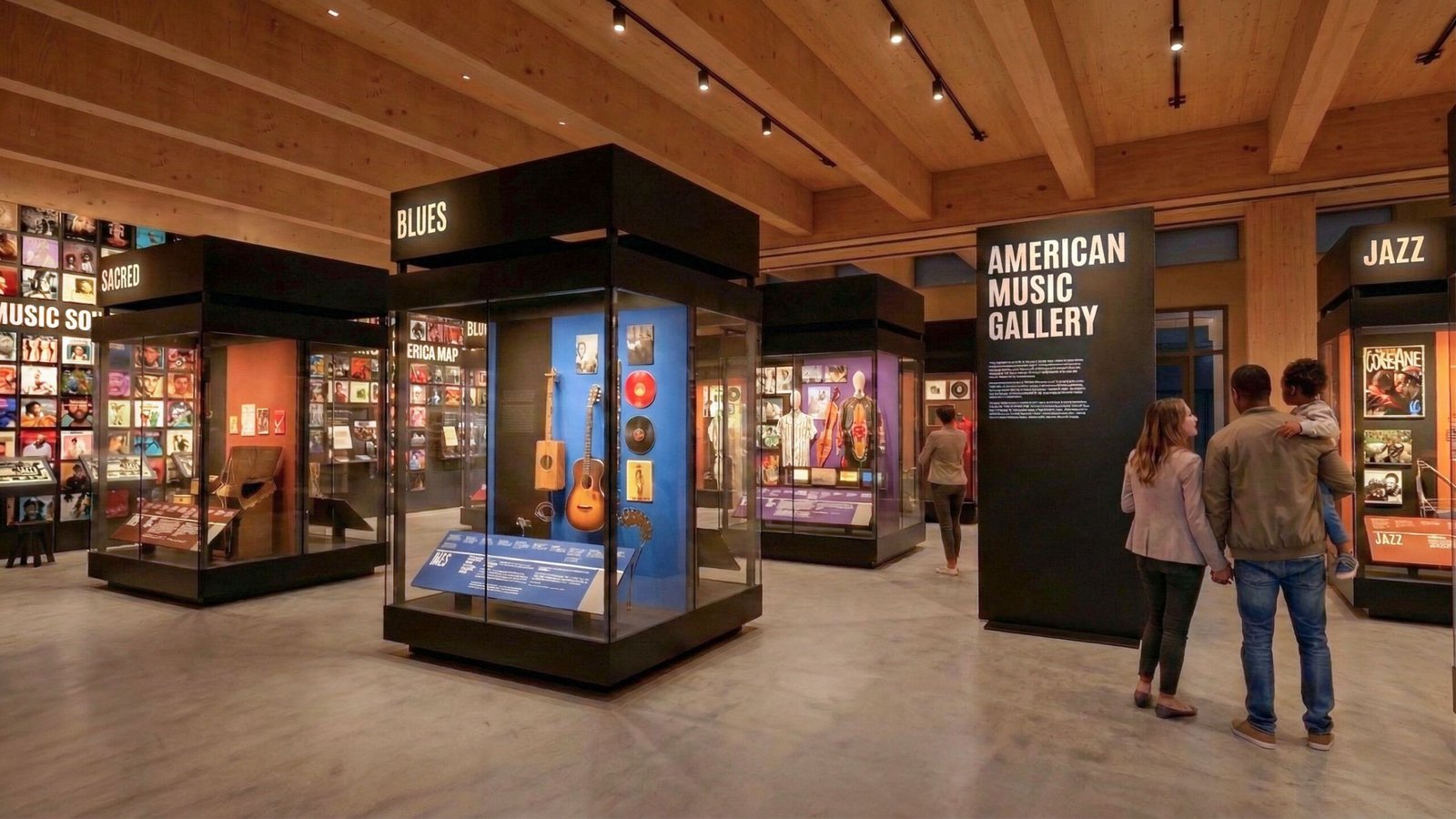
The Bruce Springsteen Center for American Music opened over the weekend at Monmouth University as a home for fans, scholars and visitors to explore one of New Jersey’s most influential artists and the broader story of the genre that shapes him.
The $50 million center includes galleries, research archives, interactive experiences and a performance theater. It will serve as home to Springsteen’s archives, with materials tied to him and the E Street Band, plus programming focused on concerts, lectures, films, workshops and education.
Bob Santelli, executive director of the center, said the goal is to place Springsteen’s work within the larger sweep of American history and culture.
“The goal here for me, both personally and professionally, was to make sure that narrative — that grand narrative that Bruce Springsteen tells about himself and about America in general — is not only preserved, but celebrated,” Santelli said.
The first floor focuses on American music, while the second centers on Springsteen’s life, work and creative process. Springsteen’s story is told “through the sounds and sights of American music,” Santelli said, including the genres that shape his work: gospel, blues, jazz, soul, punk and rock.
The center opened at a politically active moment for Springsteen, who often uses his music and public platform to comment on American life, and who in recent years has become a prominent critic of President Donald Trump, police brutality, wealth inequality and the hollowing of the middle class.
The inaugural exhibit, “Chimes of Freedom: Protest, Politics, and the Power of Song,” explores music as a force for political and social change. That thread, crucial to American music roots, runs through Springsteen’s work.
“American music is our most important cultural resource,” Santelli said. “It’s the national identity, I think, that speaks the loudest and the clearest to most Americans and even those who aren’t Americans, but who look to America for its creative ideals.”
 Credit: (Matthew Geller/Monmouth University)
Programs for students and teachers will guide on how to study music not only as entertainment, but also as a reflection of American history, politics and identity.
The project is personal for Santelli, a veteran Rock & Roll Hall of Fame curator and founding executive director of the Grammy Museum. He is a New Jersey native, a Monmouth University alumnus and a former journalist who covered Springsteen’s rise as a music critic for the Asbury Park Press.
“This is a chance to not only tell the story, but to give back to the people who made that story,” Santelli said.



