
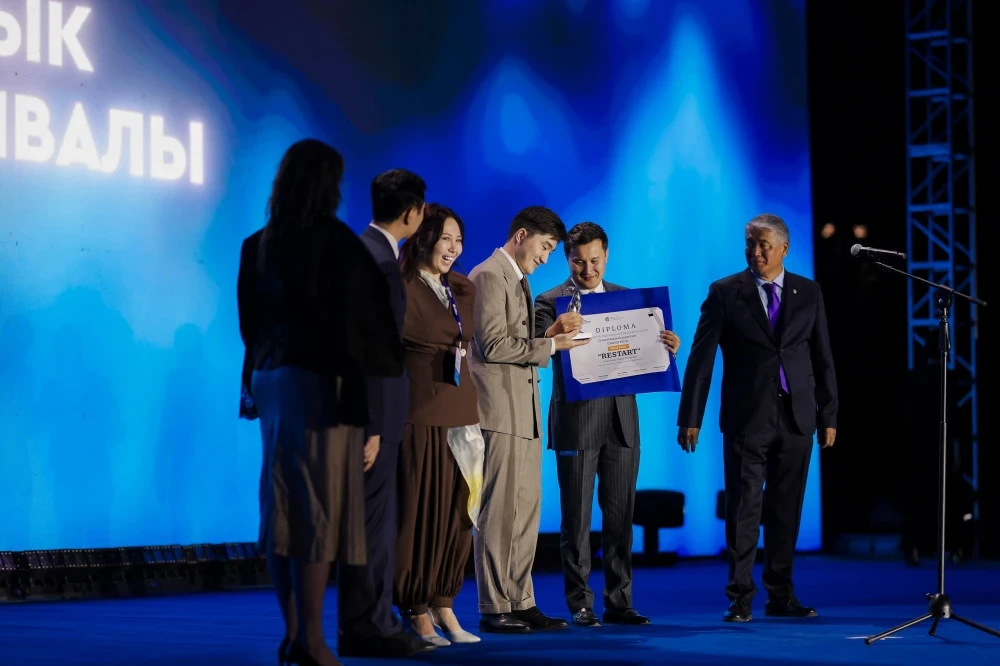
The IV Bishkek International Film Festival concluded on June 12, bringing to a close one of the most significant cultural events of the year in Kyrgyzstan. Held from June 7 to 12, the festival welcomed participants from more than 30 countries and presented a rich program of screenings, premieres, educational events, script workshops, pitching sessions, and professional discussions. For Asian Movie Pulse, the festival also became an opportunity to cover a broad range of works from Kyrgyzstan, Central Asia and beyond, from local genre productions and Kazakh disaster cinema to Tibetan drama, Bengali mysticism, Tajik poetry, Sakha horror and Chinese coming-of-age storytelling.
The edition was not without controversy, however. The Directorate of the IV Bishkek International Film Festival announced the cancellation of the special screening of “Kurak”, directed by Erke Dzhumakmatova and the late Emil Atageldiev, which was scheduled for June 11, 2026 and was intended to serve as the national premiere of the movie. According to the festival, the screening was cancelled after the “Kyrgyztasmasy” State Film Center officially refused to issue a State Registration Certificate, without which a public screening in Kyrgyzstan is legally impossible. The notification, received by the Festival Directorate on June 9, 2026 and signed by Ulukbek Begaly uulu, director of “Kyrgyztasmasy”, cited Protocol No. 1 of the departmental commission of the Department of Cinematography dated June 6, 2026, following an expert evaluation of the movie.
The cancellation stood in contrast to the international recognition “Kurak” has already received. The movie won the main prize of the Jiseok Award program and the Bangladesh July Memorial Award at the 30th Busan International Film Festival, the Grand Prix for Best Film at the 24th Dhaka International Film Festival, and three major awards at the 32nd Vesoul International Film Festival of Asian Cinema, namely the Grand Prix of the International Jury, the Film Critics’ Award and the Youth Jury Award. It also received the Media Award at the DEA Open Air International Film Festival in Tirana. Within this context, the Bishkek edition became not only a showcase of regional cinema, but also a reminder of the complicated relationship between national cinema, public screening, institutional approval and international recognition.
Check the complete Asian Movie Pulse coverage below.
Awards and Festival News
The festival announced its winners across three main competitive sections: the International Competition, the Central Asian Film Competition, and the national KyrgyzBox program. “Restart” won the Grand Prix for Best Film in KyrgyzBox, “Kaitadan” won the Grand Prix for Best Film in the Central Asian Film Competition, while “On Your Lap” from Indonesia was awarded Best Film in the International Competition. Other major prizes went to Ruslan Akun, Nurjamal Karamoldoeva, Ariobarzan, Shabnam Dadkhah, Kerim Kasymaliev, Aylin Talaybekova and others.
Reviews and Interviews
Only Heaven Knows
“Only Heaven Knows” (2026) by Nurzhamal Karamoldoeva Film Review
“Dauren Tashkenbaev Interview: I Both Sympathized with Eric and Judged Him at the Same Time”
Nurzhamal Karamoldoeva’s “Only Heaven Knows” focuses on Chicago’s Kyrgyz immigrant community, gambling addiction, debt, marriage, immigration uncertainty and the place of women inside a supposedly more progressive environment. In our interview, Dauren Tashkenbaev talks about playing Eric, shooting in Chicago as a Kazakh actor in a Kyrgyz production with an American crew, the ambiguity of his character, gambling addiction in Central Asia, and his collaboration with Karamoldoeva and Malika Kanatova.
“Maya Satya Bhram”
“Maya Satya Bhram” (2026) by Samik Roy Choudhury Film Review
“Samik Roy Choudhury Talks Maya Satya Bhram, Godmen, Crime and the Surrealism of India”
Samik Roy Choudhury’s Bengali production “Maya Satya Bhram” mixes crime, mysticism, Godmen, social critique and philosophical inquiry through a non-linear structure. The review explores the movie’s ambitious but overstuffed narrative, its use of Babaji as both mystical figure and sociopolitical comment, and its visual and editing approach. In the interview, Choudhury discusses the story’s mountain origins, its connection to a real crime case in Jharkhand, his views on Indian public discourse, casting Babaji, and the current state of Bengali cinema.
“Witch” / “Jez Kempir”

“Witch” (2026) by Shamilbek Bekbolsun Uulu and Ilgiz Kuvatbek Film Review
“Sharshekul Amanova Interview: This Is a Story Not About Weakness, but About Survival”
Locally known as “Jez Kempir”, “Witch” uses horror to explore xenophobia, racism, mass psychology, guilt, cowardice, patriarchy and alcoholism in a secluded Kyrgyz setting. The review highlights the movie’s Rashomon-like structure, Kerim Kasymaliev’s cinematography and the performances of Nazira Mambetova, Eldiyar Dzharashev and Sharshekul Amanova. In the interview, Amanova speaks about her first leading role as Ayna, the psychology of fear, violence, alcoholism, her collaboration with the directors and Eldiyar Dzharashev, and her work in “Cassandra”.
“Another Birth”

“Another Birth” (2025) by Isabelle Kalandar Film Review
“Isabelle Kalandar Talks Another Birth, Migration, Poetry and the Pain of Abandonment in Bishkek”
Isabelle Kalandar’s “Another Birth” is a Tajik drama set in rural Badakhshan and inspired by migration, abandonment, childhood perception and the poetry of Forugh Farrokhzad. The review focuses on Parastu’s coming-of-age journey, the use of poetry, the village setting and Shukrona Navruzbekova’s performance. In the interview, Kalandar discusses how the story grew out of her own memories, the women and children left behind by male migration, working with family and villagers, the role of poetry in Badakhshan, and the planned “Exile Trilogy”.
“Released”

“Released” (2026) by Khabu Film Review
“Khabu Talks Released, Tibetan Horse Racing and the Future of Tibetan Cinema”
World premiering in Bishkek, Khabu’s “Released” turns a real story from the director’s hometown into a Tibetan drama about tradition, horse racing, women’s exclusion, forbidden love, loss and survival. The review highlights the use of villagers and herders, the importance of horses in the Kham region, Chen Hong’s cinematography and Yangchuk Tso’s performance. In the interview, Khabu talks about the real incident that inspired the project, shooting in Litang, using local non-professional performers, the difficulty of the horse-racing scenes, the sky-burial-related sequence, and the future of Tibetan-language cinema.
“Verdict”
“Verdict” (2026) by Sooronbek Turgunmamatov and Anvar Osmonaliev Film Review
“Director Anvar Osmonaliev Talks Verdict, True Crime, Difficult Shoots, and Kyrgyz Cinema”
Inspired by an actual criminal case, “Verdict” explores family trauma, violence, crime and moral ambiguity in Kyrgyz society. The review examines the way the movie combines melodrama, true crime and social critique, while the interview with Anvar Osmonaliev focuses on the real case that shocked Kyrgyzstan, the team’s hesitation before approaching such difficult material, the casting process, the demanding murder scene, and the director’s thoughts on Kyrgyz cinema beyond purely commercial productions.
“Restart” / “Qaitadan”

“Restart” (2026) by Duman Erkimbek Film Review
Duman Erkimbek’s “Restart”, originally titled “Qaitadan”, is a Kazakh disaster drama with fantasy, comedy, romance and time-loop elements. The review looks at the way the collapsing dam becomes both an action device and a metaphor for neglected problems, social carelessness and repeated mistakes. It also discusses the movie’s audience-friendly energy, its ambitious flood sequences, Azamat Dulatov’s cinematography and the performances of Zhasulan Kopbergenov, Shygula Eshenova, Ashim Akhmetov, Ramazan Makabatuly and Yermek Shynbolatov.
“Shamsiqamar”
“Shamsiqamar” (2026) by Nusrat Khusanov Film Review
Nusrat Khusanov’s Uzbek drama “Shamsiqamar” follows Saodat, a mathematics teacher who becomes pregnant after years of infertility, only to face intense pressure when doctors detect signs of Down syndrome in her unborn child. The review explores the movie’s critique of patriarchy, the health system, education and wider social prejudice, while also noting the strengths of Yulduz Rajabova’s central performance and the melodramatic aspects of the production.
“Backstage Madness”

“Backstage Madness” (2025) by Amanbek Azhymat Film Review
Amanbek Azhymat’s “Backstage Madness” is a chaotic and playful Kyrgyz debut about a 70-year-old screenwriter forced by a young producer to abandon his arthouse ideals and write something more commercial. The review examines the movie’s film-within-a-film structure, its comedy about the pain of screenwriting, its collision of crime, action, slapstick, romance and surrealism, and the way it turns production limitations into part of its wild identity.
“Fear”
“Fear” (2025) by Apollinariia Degtiareva Film Review
Apollinariia Degtiareva’s Sakha chamber horror drama “Fear”, also known in Russian as “Presence”, uses a single apartment, pandemic anxiety, nightmares and Sakha cultural imagery in order to explore isolation, denial and psychological collapse. The review discusses Anastasia Alekseeva’s demanding central performance, the use of surveillance-camera imagery, the echoes of Japanese horror, and the way Degtiareva connects domestic horror with Sakha identity.
“Where the Sun Shines Bright”
“Where the Sun Shines Bright” (2026) by Lam Can-zhao
Lam Can-zhao’s “Where the Sun Shines Bright” is a compact Chinese coming-of-age drama structured around an 18-year-old boy revisiting his growth through encounters with four children. The review explores the movie’s fragmented structure, its use of Chaozhou as emotional foundation, its shifts in visual texture, its focus on childhood shaped by absence, screens and incomplete information, and its playful elements, including Michael Jackson livestreaming and the music-video-like ending.
Industry, Development and Project Interviews
“Tilek Cherikov Talks Red Pants, a Female Criminal Gang in Soviet Kyrgyzstan, and the Project’s Success at Series Mania”
Tilek Cherikov discusses “Red Pants”, an eight-episode Kyrgyz true-crime mini-series in development, inspired by a teenage female criminal gang in the Issyk-Kul region during the Soviet era. The interview covers the real events behind the project, the gang’s Robin Hood-like reputation, the involvement of the KGB, the recreation of the 1980s, and the project’s success at Series Mania, where it received a 50,000 euro prize.
“Amir Amenov Talks Warm Night, Cold Beer and The Taste of Shawarma After a Tipsy Night”

Kazakh filmmaker Amir Amenov speaks about two projects presented in Bishkek: “Warm Night, Cold Beer”, which is close to completion, and “The Taste of Shawarma After a Tipsy Night”, still in treatment stage. The conversation covers friendship, love, illusion, tragicomedy, irony, the influence of François Truffaut and Otar Iosseliani, post-production, color correction, and the project’s connection with the Bishkek festival, where “Warm Night, Cold Beer” had previously been pitched.
Through its competitions, industry events, regional focus and the range of works presented, the IV Bishkek International Film Festival offered a valuable snapshot of cinema from Kyrgyzstan, Central Asia and neighboring cinematic landscapes. For Asian Movie Pulse, the coverage reflected the vitality and contradictions of the event: award-winning titles and emerging filmmakers, genre experimentation and social critique, intimate interviews and broader industry conversations



