
This November, voters in Hillsborough County will face a question that voters in the county faced 60 years ago: Should a school district’s superintendent be elected by voters or appointed by the school board?
Superintendents in Hillsborough County were once elected, but voters in 1966 changed the way superintendents were picked, allowing elected school boards to hire and fire candidates.
That decision came after a controversial superintendent resigned amid an embezzlement scandal and grand jury probe into the district.
J. Crockett Farnell was a successful football coach and educator who served on many local boards. He was elected five times to the position of superintendent, first in 1948, and oversaw a growing district that tripled in size under his watch.
Highlights of his tenure include putting Black teachers on the same pay scale as white teachers, building almost 60 new schools and suing the county’s tax assessor, which resulted in increased funding to the district.
Articles at the time called him equal part politician and superintendent, but the Tampa Times reported in the 1960s that he faced criticism for “running what many considered a political machine within the school administration.” Reports from the Tampa Tribune around that time said he ran unopposed in every election but one, and rumors circulated that after that, the principal who ran against him “wound up counting books in a warehouse because he ran.”
Farnell told reporters at the time that “most superintendents get fired because they’re not political enough.”
In July 1966, Farnell was indicted on charges of grand larceny and misappropriating and embezzling “property, effects, money, things and chattels belonging to the Board of Public Instruction in Hillsborough County.” He was accused of using school district property, including things like building materials, lumber and paint for a camp site with horseback riding and sailing in which Farnell had an ownership stake. He was also accused of using school employees to work on district-paid time at that site.
Florida’s governor at the time, Haydon Burns, suspended him and appointed an assistant superintendent to serve in the interim role.
Hillsborough had taken the issue of an appointed superintendent to a referendum in 1963, but it failed after critics at the time led a campaign saying appointing the position would “remove government from the people,” the Tampa Tribune reported a few years later.
Amid Farnell’s scandal, Hillsborough’s school board again put the issue on the ballot. This time, it passed.
Hillsborough County’s interim superintendent Craig Calvert called the move “educationally sound and this is an important step toward progressive education in Hillsborough County.”
Readers wrote letters to the Times and Tribune with their support.
“Forty-nine states out of 50 can’t be wrong, after the experience of using both the elective and the appointive method,” Tampa resident Natalie Nance wrote. “We can always vote to go back to an elective superintendent if this is not satisfactory.”
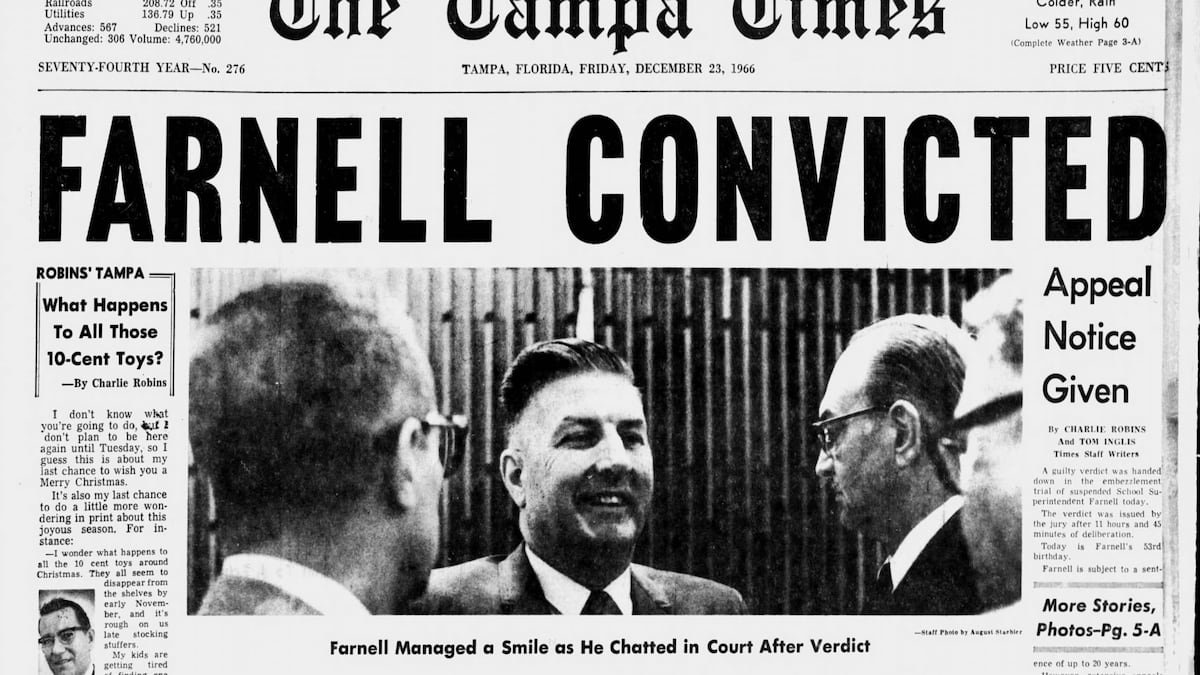
In December 1966, Farnell was convicted on embezzlement charges. He resigned the next month.
The school board started its search for an appointed superintendent in March 1967, requiring at least three years of classroom teaching in a public school, five years of administrative experience and the recommendation of “married men between 35 and 55 years of age.” Previously, the only requirement had been being a registered voter in Hillsborough County.
Raymond Shelton became the district’s first appointed superintendent in 1967. He served in the role for 21 years and was remembered for overseeing the desegregation of public schools, helping develop the state’s funding model for schools and implementing full-day kindergarten in the district.
In 1968, the Tampa Tribune reported an appeals court reversed the conviction against Farnell after finding inadmissible evidence and improperly admitted testimony was used.
Farnell, who spent his later years in cattle ranching, died in 1999. In 2002, a middle school in Westchase was named after him, honoring his contributions to the district.
The Tampa Bay Times Education Hub reports on Florida’s schools and universities and the students they serve. You can contribute to the hub through our journalism fund by clicking here.



