
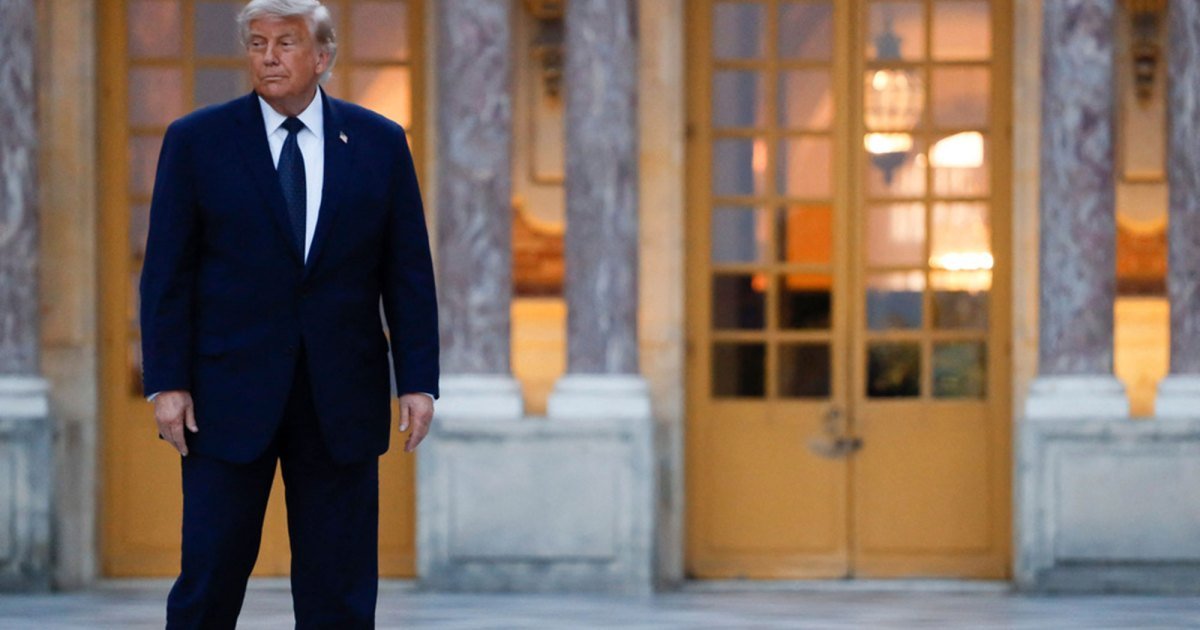
Donald Trump at Versailles on Wednesday.Jean-Bernard Vernier/Sipa via AP Images
A version of the below article first appeared in David Corn’s newsletter, Our Land. The newsletter comes out twice a week (most of the time) and provides behind-the-scenes stories and articles about politics, media, and culture. Subscribing costs just $5 a month—but you can sign up for a free 30-day trial.
Donald Trump’s war in Iran is one of the stupidest foreign policy ventures in US history.
I know that’s not a new or hot take. When he attacked Iran on February 28, it immediately became clear that he had no idea what he was doing. Karoline Leavitt, his press secretary, said he had initiated the attack based on a “feeling”—while negotiations to limit Iran’s ballistic missile and nuclear programs were ongoing.
Trump then had a tough time explaining to the nation what the hell this war was for. To eliminate a nuclear program he had claimed was obliterated by a previous bombing raid? To address an “imminent threat” because Iran was, he falsely claimed, within two weeks of developing a nuclear bomb? To achieve regime change? To wipe out Iran’s arsenal of ballistic missiles? To protect Iranian anti-government protesters? To diminish Iran’s ability to strike at US allies and bases, if Israel attacked Iran? To end Tehran’s support of terrorism? To “get rid of evil”?
If you don’t know why you’re warring, it’s tough to figure out when to stop. After all, what counts as victory?
Then the war became mostly a matter of addressing unintended—but utterly predictable—consequences. Iran shut the Strait of Hormuz, which was an easy-to-foresee possibility, and sparked a global economic crisis. Trump had no plan for that—just as he had no plan to achieve any of the assorted aims he had expressed at different times. Now the mission was to undo what his war had caused.
So dumb. Trump spent gazillions of taxpayer dollars on this endeavor, only to end up fighting for a return to the status quo. He had to put out the fire he started. And thousands of Iranian civilians—including an estimated 168 schoolgirls—have been killed, as well as 13 American servicemembers. It’s a pointless loss of treasure and lives. With the higher gas prices, the war so far has cost Americans $132 billion. This folly has also raised food prices—which has an especially dramatic impact on poorer, food-stressed nations. It further strained US ties with its closest allies.
The signing this week of a memo of understanding between Washington and Tehran to end the war highlighted the imbecility of this action. The terms met none of the revolving goals Trump had tossed out. It kicked down the road any discussion of Iran’s nuclear and ballistic programs. But the deal handed the repressive government of Iran much-desired deliverables, such as an end to sanctions, an unfreezing of assets, and a $300 billion reconstruction fund. Iran could immediately start to sell oil. Ka-ching! It only had to keep the strait open, as it had always done prior to the war. It looked as if Trump was rewarding the mullahs with tremendous riches for doing what they used to do for free. Art of the deal, right? Trump had previously called for a “unilateral surrender” from Iran. This was not that.
Critics of all ideological stripes blasted the deal. Hawks and Republicans saw it as a total sellout, as well as an abandonment of Israel. (The agreement called for an end to Israeli attacks in Lebanon—a provision that did not please the Netanyahu crowd.) The New York Post lambasted Trump. Neocons exclaimed on podcasts, “What’s going on?”
Democrats and liberals noted this was the equivalent of an American surrender to a government still presumably committed to running a repressive regime and supporting terrorism, and it fell far short of the agreement that the Obama administration had forged with Iran in 2015. It was good that the fighting was over—at least for the moment—but nothing had been settled. Only the most cultish of Trump cultists (Jesse Watters, I’m looking at you) could hail the deal as a masterpiece of statesmanship and a win for the United States.
Trump signed the MOU during a trip to Versailles, which in a previous era hosted the signing of a notoriously lousy accord that led to a conflagration we call World War II.
What was especially ludicrous was how Trump and his crew talked about the deal. On March 1, the White House declared that Trump had attacked Iran to “destroy its ballistic missile arsenal.” On Wednesday, he said it was no biggie for Iran to retain ballistic missiles: “If other countries have them, it’s a little unfair for them not to have some.” He added, “Am I going to let Saudi Arabia have missiles, but [Iran] can’t have them? It doesn’t work that way.”
As for Iran’s stockpile of highly enriched uranium—which is now not suitable for use in a nuclear bomb but could be refined to weapon-grade level—Vice President JD Vance on MSNOW said, “One of the core parts of the agreement is that the [International Atomic Energy Agency] and the United States are going to help Iran destroy the highly enriched stockpile, and that’s something that’s spelled out very clearly in the MOU.”
But the MOU said nothing about this. And Trump sent conflicting signals about what he hoped to do about this half ton of material that ostensibly was one of the key reasons for the war. At one point on Wednesday he said, “We’re going to get it.” At another, he remarked, “I don’t think anybody could get at it.” (This material is apparently beneath a mountain that was bombed last year by US and Israeli warplanes.)
Trump zigged and zagged on another issue. At the start of the war, he said, “We’re now totally independent of the Middle East. We don’t need their oil.” A few weeks in, he reaffirmed this: “It doesn’t really affect us. We have so much oil. We have tremendous oil and gas, much more than we need.” On Wednesday, he asserted that if he didn’t agree to the MOU, we “would run out of reserves at about four weeks…We would really run out, and there’ll be a time when you wouldn’t be able to get it.”
Once this war was about ballistic missiles and highly enriched uranium and oil was no concern. Now, who cares about the missiles or the uranium? And Trump had to give Iran so much to get the oil flowing. Meanwhile, instead of regime change, it’s likely there’s been regime worsening. As for helping the Iranian people rise up against the tyrannical mullahs? Fuggedaboudit.
No sane person expects consistency from Trump. But during a war, erraticism is particularly dangerous and idiotic. His impulsive attack on Iran has accomplished none of his stated objectives. It’s been a foolish waste.
During a press conference on Wednesday at the G7 meeting in France, with Secretary of State Marco Rubio and Commerce Secretary Howard Lutnick standing behind him, Trump mused, “In war, terrible things happen. Like you mentioned…the [girls’] school gets hit. Other things get hit. Bad things happen in war. War is a nasty place. I see it. I see it better than maybe anybody has ever seen it.” Yes, even at this point, Trump was claiming he understands this war better than anyone else. But he had no vision of what this war was for, of how to wage it, or of how to win it. This was a vanity project for him. He thought he could unleash violence and chaos—threaten to commit war crimes and destroy an entire civilization—and end up the star triumphantly bathed in military glory and, oddly, deserving of the Nobel Peace Prize.
In the end, this disaster does not demand deep analysis. It was a foolhardy move from a narcissistic numbskull who now cares more about a ballroom, an arch, and a reflecting pool than the carnage and damage he wreaked. A stupid war is yielding stupid results—and with Trump its author that’s no surprise.



