
Key events
This is not a vintage Brazil squad but in Vinicius Junior they have a match-winner capable of upholding the grand traditions of the Selecao, if only they’d get over their obsession with Neymar and make this his team.
If Vinícius is now Brazil’s undisputed star, the 25-year-old has also yet to really make the team his own. He has turned in frustrating and often fruitless performances at major international tournaments, while scoring a mere nine goals in 49 appearances entering this, his second World Cup.
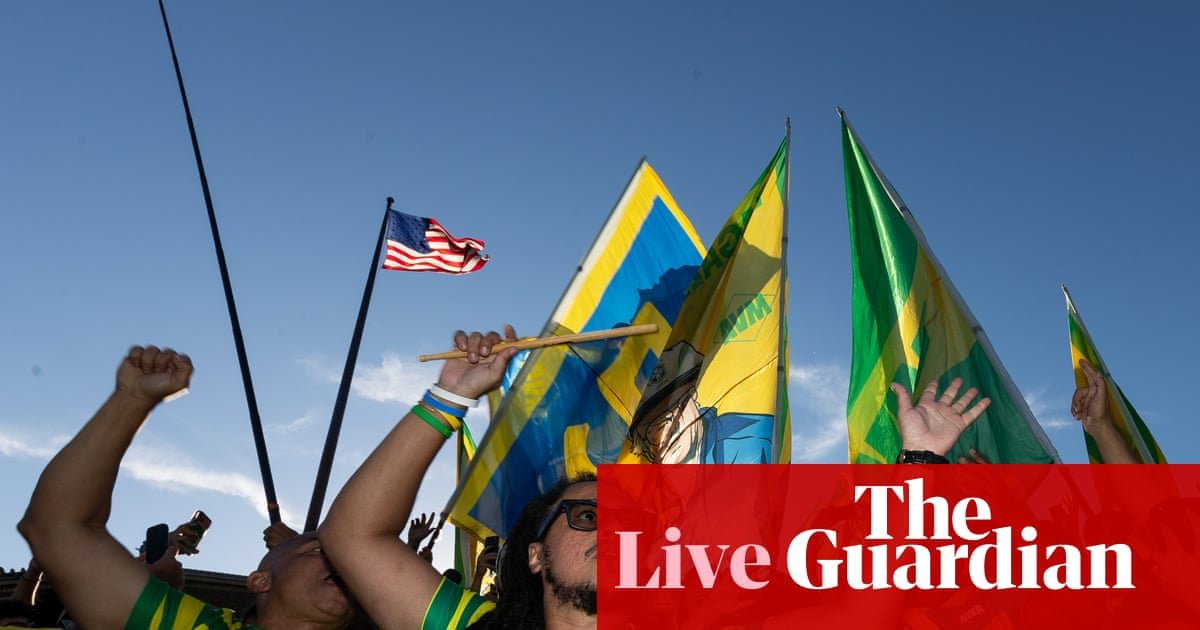
He has yet to wrest top billing from Neymar, whose jersey was worn by huge swaths of the Brazilian fans in their draw with Morocco on Saturday.
Haiti XI
Sebastien Migne has added an extra defender to his starting line-up with Jean-Kevin Duverne turning a back four into a back five. Wilson Isidor is the man sacrificed, while the only other change sees Deedson replaced by Casimir.
Haiti XI (5-4-1): 1 Placide, 2 Arcus, 4 Ade, 5 Delcroix, 22 Duverne; 8 Experience, 21 Casimir, 17 Jean Jacques, 10 Bellegarde, 15 Providence; 20 Pierrot.
Brazil XI
Ancelloti has made two changes to his starting XI and, I assume, a tactical switch. Danilo comes in at right back, while further forward Matheus Cunha replaces Igor Thiago. The Man Utd man’s inclusion means Brazil start without a recognised No 9 so expect a more fluid attack focussed on Vinicius.
Brazil (4-2-4): 1 Alisson, 13 Danilo, 4 Marquinhos, 3 Gabriel, 16 Santos; 5 Casemiro, 8 Guimaraes; 11 Raphinha, 20 Paqueta, 7 Vinicius, 25 Cunha.
Following that victory I have the USA as favourites to reach the quarterfinals. Complete your own Bracketology and prove me wrong.
Only one contest has been played to completion so far this matchday and it was a good one for the USA. The hosts guaranteed their participation in the knockout phase with a needly 2-0 victory over an Australian side that regressed towards the mean following their outstanding opening win over Turkey.
Australia looked like a bunch of bananas in their all-yellow strip against the USA, and it is tempting to call this comprehensive 2-0 defeat a banana skin in the Socceroos’ World Cup campaign. In truth, however, this was less a slip up than a humbling, and the visitors proved ripe opposition as the hosts came and took what they wanted.
Two presumably unrelated pieces of climate change and big sponsor news.
Two of the first round of matches at the World Cup were played at a level of severe heat that a football players’ union has previously said should trigger the delay or postponement of games, a Guardian analysis has found. A further four games were played in cities with temperatures also beyond that level of heat, though conditions inside the stadiums were mitigated by air conditioning.
Climate activists – including former and current professional athletes – are calling for Fifa and other professional sporting organizations to cut ties with the oil and gas industry…
The protesters’ key target is Saudi Aramco, the exclusive energy sponsor for this year’s tournament, which is also the world’s largest corporate carbon emitter. Players have for years called on Fifa to drop the company as a sponsor, and in May, a group of health, climate science and sports experts signed an open letter highlighting the organization’s Aramco sponsorship, arguing that the “active promotion” of fossil fuels creates “a conflict of interest with the protection of player welfare”.
If you prefer your World Cup roundups in written form, Dominic Booth has you covered.
An old footballing adage tells us that no World Cup is quite complete without a gutsy run of results from the host nation(s), who dutifully go deep in the tournament to stir up local fervour. See South Korea in 2002 for a prime example: a plucky and at times controversial slalom to the semi-finals before being crushed by a traditional heavyweight. Way back when, a host nation winning the whole thing was commonplace, occurring in five of the first 11 World Cups when Uruguay (1930), Italy (1934), England (1966), West Germany (1974) and Argentina (1978) triumphed on home soil. Nowadays, thanks to Fifa’s completely altruistic desire to spread the game globally, the prospect of a host nation actually lifting the trophy is somewhat diminished, with South Africa and Qatar crashing out in the group stage in recent-ish years.
With nearly two hours to kick-off, you have plenty of time to catch up with Max and Barry’s game of four quarters.
Preamble

Jonathan Howcroft
Hello everybody and welcome to live coverage of match 31 of the 2026 World Cup between Brazil and Haiti. Kick-off in this Group C clash at Philadelphia Stadium is 8:30pm local time (1:30am BST/10:30am AEST).
On paper this is a mismatch of historic proportions.
The Selecao have five stars above their crest, Carlo Ancelotti in the dugout, and the Champions League-winning skipper wearing the captain’s armband. Haiti have only played four matches at the finals, lost them all, and are managed by a Frenchman who has been in charge for two years without ever setting foot in the country.
But the team in gold were, to put it charitably, rusty, in their opening draw with Morocco, and Les Grenadiers were spirited in defeat to Scotland.
Anything other than a comprehensive Brazilian victory would set alarm bells ringing in the home of jogo bonito. It is 24 years and five World Cups since the country last tasted success. They have never gone longer between open top bus parades.
I’ll be back shortly with team news and a roundup of all the matchday action so far. In the meantime you can keep an eye on Scotland v Morocco and email any thoughts about the World Cup to jonathan.howcroft.freelance@theguardian.com.



