
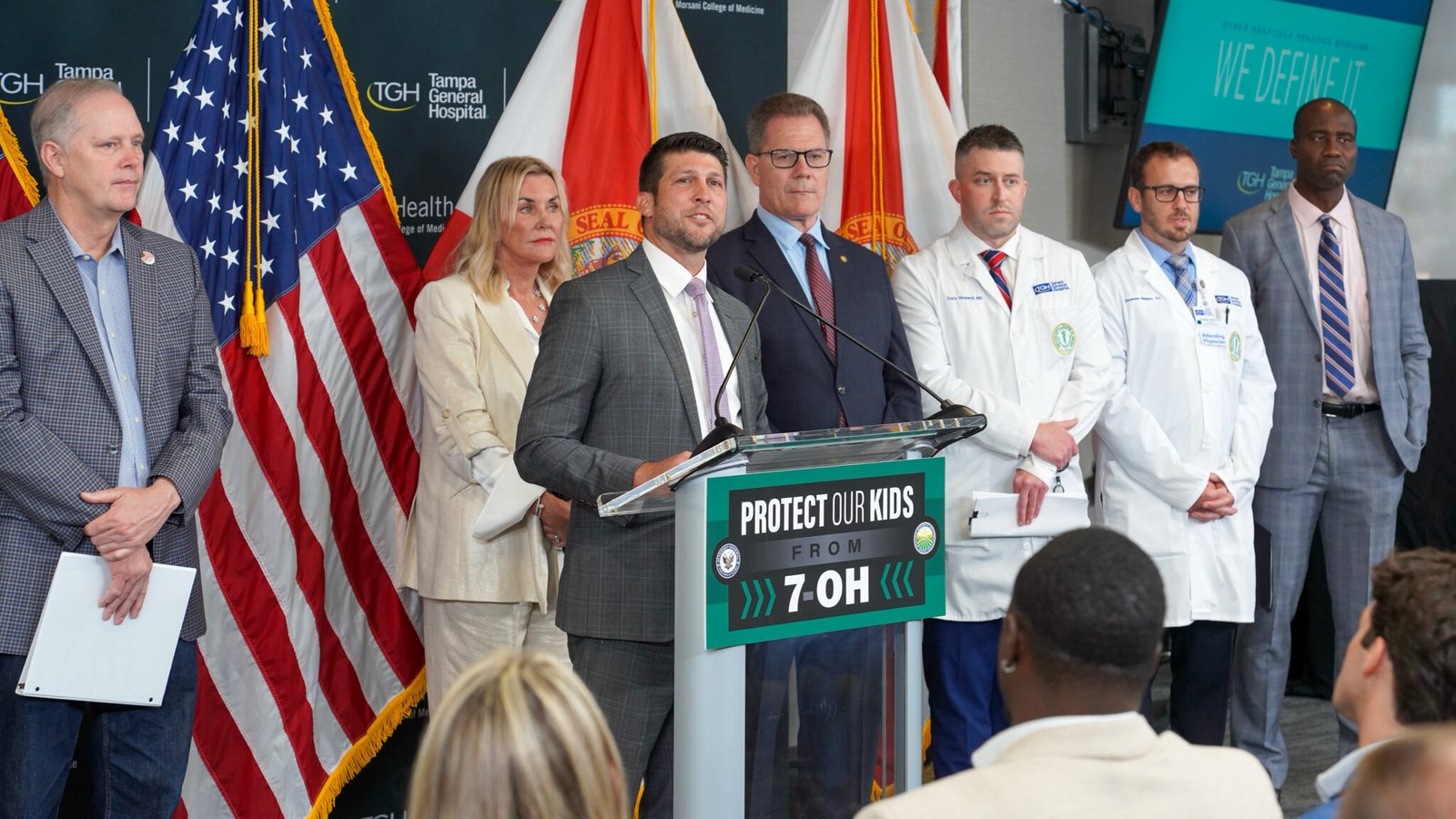
Florida Attorney General James Uthmeier announced a new emergency rule Monday to further crack down on sales and use of concentrated 7-hydroxymitragynine (7-OH) and other related chemical products in Florida.
Appearing at Tampa General Hospital, Uthmeier — appointed by his former boss Gov. Ron DeSantis more than a year ago but facing Florida voters for the first time in November — was joined by Agriculture and Consumer Services Commissioner Wilton Simpson, Florida Surgeon General Joseph Ladapo, and state Rep. Dean Black, R-Jacksonville.
Two emergency room physicians — Dr. Cory Howard and Dr. Thomas Nappe — along with Tampa General Hospital President Melissa Golombek, also joined Uthmeier.
Kratom is an herbal extract that comes from a tree that grows in Southeast Asia. According to the Mayo Clinic, people who use kratom report that, at low doses, it acts as an upper. At higher doses, kratom users report that it reduces pain and acts more like a sedative.
7-OH occurs naturally in kratom in trace amounts (0.01–0.04%), but concentrated versions sold in gas stations, vape shops, and online under brands like Hydroxy, 7Tabz, and 7OHMZ are far more hazardous.
The rule is an extension of a similar one Uthmeier announced last year that labeled 7-OH as a Schedule 1 substance.
Florida AG issues emergency rule banning kratom compound
Specifically, the new emergency rule announced Monday labels these 7 OH-related compounds as Schedule 1 drugs, according to the AG’s office: 7-hydroxymitragynine, mitragynine pseudoindoxyl, 7-acetoxymitragynine, 9-hydroxycorynantheidine, 10-hydroxycorynantheidine, MGM-15, or MGM-16.
The federal Drug Enforcement Agency labels has defined level 1 substances as those with great potential for abuse but no accepted medical use. Schedule 1 substances cannot legally be prescribed or dispensed.
The Tampa General representatives said the hospital has seen its share of overdoses from the synthetic drugs.
“With access to 7-OH at every convenience store, we are having kids, we are having teens purchase this without understanding the true addiction and the highly lethal ability that this drug has,” said Golmobek.
Howard, who also is associate medical director at the Florida Poison Control Information Center in Tampa, said that in the first four months of 2026 there have been 95 calls involving these drugs and derivatives. He has seen overdoses in people as young as three months to as old as 97.
“We are seeing this affect Floridians of all ages, from infants to the elderly, which speaks directly to how aggressively and irresponsibly this drug is marketed,” he said.
Uthmeier warned Monday that anyone violating the rule could be arrested and charged with a felony.
“If you violate our rule, we are going to make you pay for it. You could be looking at up to a 30-year prison sentences — and believe me, we will be looking to make some examples of bad actors,” Uthmeier said.
In addition to the pair of Uthmeier-issued rules, Simpson issued an emergency rule last year that requires retailers to list how much of the opioid-like compound exists in each package.
If the concentration is over 400 parts per million, Simpson said at the time, his agents will remove the “gas station morphine” from the shelves.
“Since our emergency rule took effect, FDACS has removed over 23,000 illegal 7-OH packages from retailers across Florida, and our inspectors continue to conduct routine checks and targeted sweeps across our state,” Simpson said Monday. “We will use every tool available to protect consumers, safeguard our communities, and keep these addictive substances out of the hands of kids and families.”



