
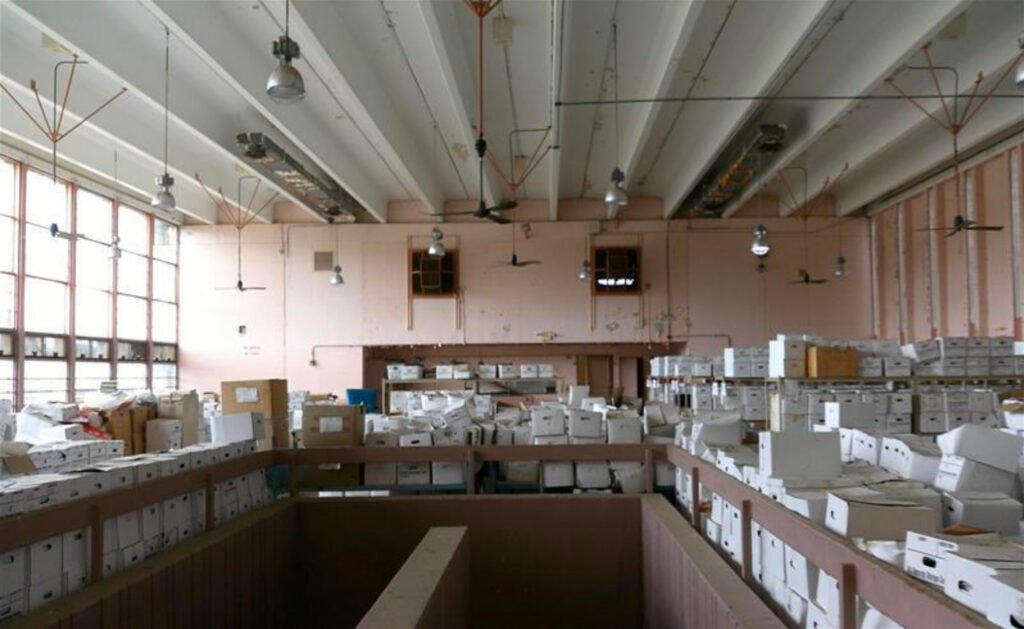
The dining hall at Bayside State Prison in Leesburg now is used for storage, forcing incarcerated people to eat all three meals in their cells. (Photo courtesy of New Jersey Corrections Ombudsperson)
While state and federal lawmakers have blasted the Trump administration for deplorable conditions at Newark migrant jail Delaney Hall, New Jersey’s prisons watchdog has issued a new report detailing overcrowding, intolerable heat, and other deficiencies at Bayside State Prison in Cumberland County.
Bayside, one of the state’s largest lockups, now houses almost 1,300 people, more than twice its capacity, according to the report released Tuesday by the state corrections ombudsperson’s office. The mixed-security prison, which opened in 1971 in Leesburg, was built to hold 504 people.
Delaney Hall unrest prompts reminder of poor conditions in NJ prisons, jails
“Turning single-occupancy rooms into double-occupancy rooms … leaves each incarcerated person with significantly less storage and personal space,” the report says.
The crowding is compounded by the closure of Bayside’s dining hall, which is now used for storage, the report says. That closure forces prisoners to eat all three meals while perched on their beds or foot lockers in their cramped cells, which at 70 square feet are less than half the size of a parking space.
Inspectors from the ombudsperson’s office also found old, thin mattresses, birds in the kitchen and housing units, and dirty showers, among other problems.
The prison lacks air conditioning, so inspectors also encountered stifling heat during summer inspections, with temperatures reaching 94 degrees in cells and shared spaces and 116 degrees in the kitchen, according to the report.

State health inspectors, who last inspected Bayside in November 2023, also dinged the prison for a “repeat deficiency” for the presence of insects or rodents, the report says.
The ombudsperson’s office recommended that Department of Corrections officials allow people to eat meals outside their cells in a courtyard area or day rooms if they cannot reopen the dining hall and improve cleaning of kitchen equipment and showers, among other things.
Officials have tried to improve some problems, such as replacing mattresses and exhaust fans and vents in shower areas, as well as putting up barriers to keep out birds, the report says.
Reopening the dining hall, which has been closed since 1997, is “not logistically feasible” because of cost, staffing, and security concerns, the department said in a response to the report. They said they won’t move meals to common areas, also citing security reasons.



