
Mother Jones illustration; Scott Olson/Getty; Sue Dorfman/ZUMA; Andrew Holbrooke/Corbis/Getty
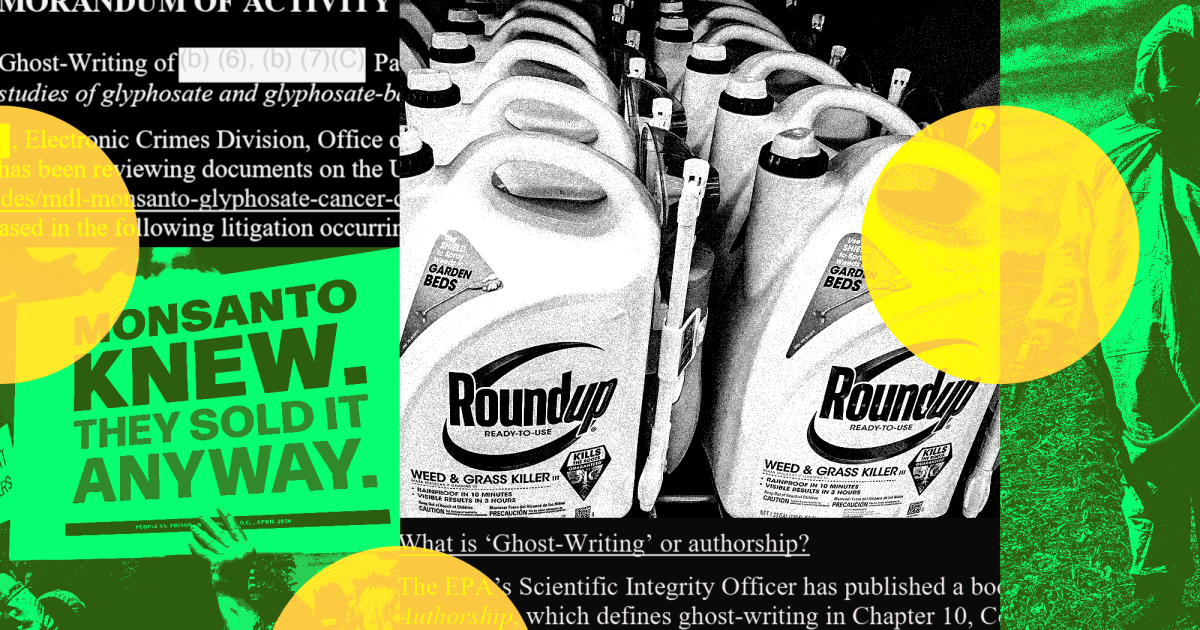
The US Environmental Protection Agency has known for nearly a decade that an influential 2013 scientific paper that concluded glyphosate is safe was actually ghostwritten by developer Monsanto. But the agency never informed the public and continued to rely on it, according to an EPA memo obtained by Mother Jones and revealed here for the first time.
The EPA cited the compromised paper as evidence that the world’s most widely used herbicide glyphosate—the key ingredient in Roundup—is safe to use in its 2020 assessment, despite its own internal investigation that concluded the research paper hid Monsanto’s role as an author. Now, nearly ten years after the agency came to its conclusion, the paper’s publisher, Taylor & Francis, said it has opened its own investigation into whether the paper was ghostwritten following a formal request made by a Harvard professor and her research associate to retract the study, as first reported by Retraction Watch last week.
The EPA’s Inspector General’s Office opened its investigation into the research paper in 2017, a few years after the paper was published in the influential science journal Critical Reviews in Toxicology with independent toxicologists Larry Kier and David Kirkland listed as its authors.
The Monsanto employee was therefore a “‘ghost writer’ which is a form of research misconduct.”
But the EPA memo concluded that Monsanto and one of its employees—with the financial backing of a consortium of other glyphosate manufacturers—seemed to have contributed key criteria including the “intellectual content” of the report. The Monsanto employee was therefore a “‘ghost writer’ which is a form of research misconduct,” according to the memo, which was written by a US special agent in the EPA Inspector General’s Office’s crimes division. The memo does not make clear whether Monsanto disclosed to the consortium, known officially as the Glyphosate Task Force, that it would be a “ghost writer” on the report.
This is the latest example to emerge of Monsanto’s concerted efforts to sway public understanding of its blockbuster herbicide glyphosate. In December, another influential review article that had found glyphosate to be safe was retracted after the publisher announced the paper’s authors had not disclosed Monsanto’s role. And a Mother Jones investigation about glyphosate being sprayed in forests found other examples of Monsanto’s hand in secretly orchestrating research papers. Now, Taylor & Francis said it is investigating both the 2013 research paper and a second peer-reviewed 2015 article also published in its journal Critical Reviews in Toxicology to assess whether they were ghostwritten by Monsanto employees.
Bayer, the German chemical company that purchased Monsanto in 2018 and continues to generate billions of dollars of revenue from Roundup every year, said in a statement that the EPA memo’s “allegations about the Kier & Kirkland paper was based on a limited set of documents that didn’t include elements such as sworn testimony from the authors.” Aside from the sworn testimony, it’s unclear what, if anything else, should have been included given the Inspector General relied on company emails and documents made public during litigation.
Since the late 1990s, studies by non-industry scientists showing glyphosate can damage genetic material in lab tests have set off a debate about whether the herbicide can cause cancer. According to the EPA Inspector General memo, a consortium of 25 glyphosate manufacturers wanted to publish their own research paper citing unpublished internal studies conducted by company scientists that showed glyphosate does not damage DNA.
“But once they had pulled all of the various studies together on genotoxicity for this review paper,” wrote the special agent in the EPA memo, “it was hard to present a ‘story’ that glyphosate was not genotoxic, because of ‘…the complicated ‘noise’ out there,’”—meaning the growing debate about whether it causes cancer—and “‘the story as written stretched the limits of credibility among less sophisticated audiences.’”
So “to add credibility to the proposed manuscript” they decided to pay a scientist named David Kirkland—considered a “heavy-hitter in the area of genotoxicity”— to be one of the named authors, along with scientist Larry Kier. The report that was eventually published presented Kier and Kirkland as the “sole” two authors who were “independent” of Monsanto and the consortium.
Yet there was another person helping shape the paper’s assessment: a Monsanto employee named David Saltmiras, according to the EPA memo. While all three of their names are redacted in the memo, they are found in now-public company emails that were exposed during litigation brought by people who said glyphosate made them sick.
In one of those emails from 2012, Kier said they should include Saltmiras as a co-author. “He is very deserving of this recognition and he was a co-author on the original literature review manuscript which was a predecessor to this publication,” Kier wrote.
Kirkland, in an email response, replied that if they included Saltmiras as a co-author they would no longer be “independent” of the company, and in that case he doubted the scientific journal would publish their report.
The Inspector General determined they hid Saltmiras’s contributions. “Because [Saltmiras] does not appear as a co-author on this manuscript, Monsanto’s involvement is also hidden,” wrote the US special agent, whose name was also redacted from the memo. The EPA memo continued: “Monsanto does have a vested interest in portraying glyphosate as a safe to use herbicide…By not making their involvement known in the manuscript discussed above, and the revenue generated by the sales of glyphosate products on a global basis, Monsanto appears to have a conflict of interest.”
The EPA memo concluded that the study’s named authors, Kier and Kirkland, “were not ‘the authors [which] had sole responsibility for the writing and content of the paper.’” The unnamed Monsanto employee Saltmiras “was a co-author of this report” for his substantive contributions on behalf of Monsanto, but was only named “in the acknowledgement section of this manuscript.”
“Why cite this paper when they knew that it was ghostwritten?”
Kier could not be reached for comment, and Saltmiras referred questions to Bayer, his current employer. Kirkland disputed the EPA memo’s findings. “I believe the memo is incorrect and I reject the claim. Our 2013 paper was NOT GHOSTWRITTEN,” he wrote an email. Saltmiras “did not contribute to or influence the analysis of the reports I reviewed,” he added in a later email.
Yet two researchers, Harvard professor Naomi Oreskes and Alexander “Sasha” Kaurov, who study corporate influence on science and who looked at the company emails made public during litigation came to a similar conclusion that the paper was ghostwritten. “The authors tried to mislead the public intentionally,” said Kaurov, a research fellow at Motu Economic & Public Policy Research in New Zealand.
And he questions why the EPA would have continued to rely on it. “It’s upsetting. Why cite this paper when they knew that it was ghostwritten?” asked Kaurov.
For instance, in the EPA’s revised “Evaluation of Carcinogenic Potential,” issued as part of its glyphosate assessment that concluded the herbicide was safe in 2020, the agency relied on the 2013 report for its data and its summaries of 16 other studies, meaning the agency accepted the compromised review as essentially a collection of studies finding that glyphosate was safe to use.
An EPA spokesperson in a statement wrote that its review of glyphosate “evaluated more than 6,000 studies across human-health and ecological disciplines, and its determinations reflected that full body of evidence.” But the agency did not respond to the question of why it continued to rely on the 2013 study despite concluding it was ghostwritten. The spokesperson confirmed that the agency never informed the public or other regulatory agencies abroad about that discovery.
The 2013 paper did make its way abroad: The European Food Safety Agency also cited the Kier and Kirkland study for its 2023 re-assessment of glyphosate that determined the herbicide is safe.
Evidence that glyphosate may be harmful to health continues to mount: Recent studies suggest the herbicide could contribute to metabolic disorders, brain inflammation, and damage to the gut microbiome. Notably, after a group of environmental and labor groups filed a lawsuit challenging the EPA’s 2020 assessment that glyphosate was safe to use, the 9th Circuit Court of Appeals overturned the EPA’s safety assessment, ruling that the agency’s “errors in assessing human-health risk are serious” and “most studies EPA examined indicated that human exposure to glyphosate is associated with an at least somewhat increased risk of developing non-Hodgkin’s lymphoma,” a type of cancer. The EPA, which is currently relying on its 1993 safety assessment of glyphosate, is expected to release an updated review of the herbicide this year.
And Bayer is now on the hook for more than $12 billion in payouts to people who say the herbicide made them sick. The Supreme Court is currently considering whether to shield Bayer from some of these lawsuits. The Trump administration, which reportedly said in 2017 that it had “Monsanto’s back on pesticides regulation,” also intervened in the Supreme Court case to support Bayer. As Bayer argued in court, the company believes it should largely have immunity from lawsuits since the EPA concluded that glyphosate products were safe.
But it’s now becoming clearer that the EPA came to that conclusion based in part on compromised scientific research that Monsanto secretly orchestrated.
“It’s just sad,” Kaurov said.



