
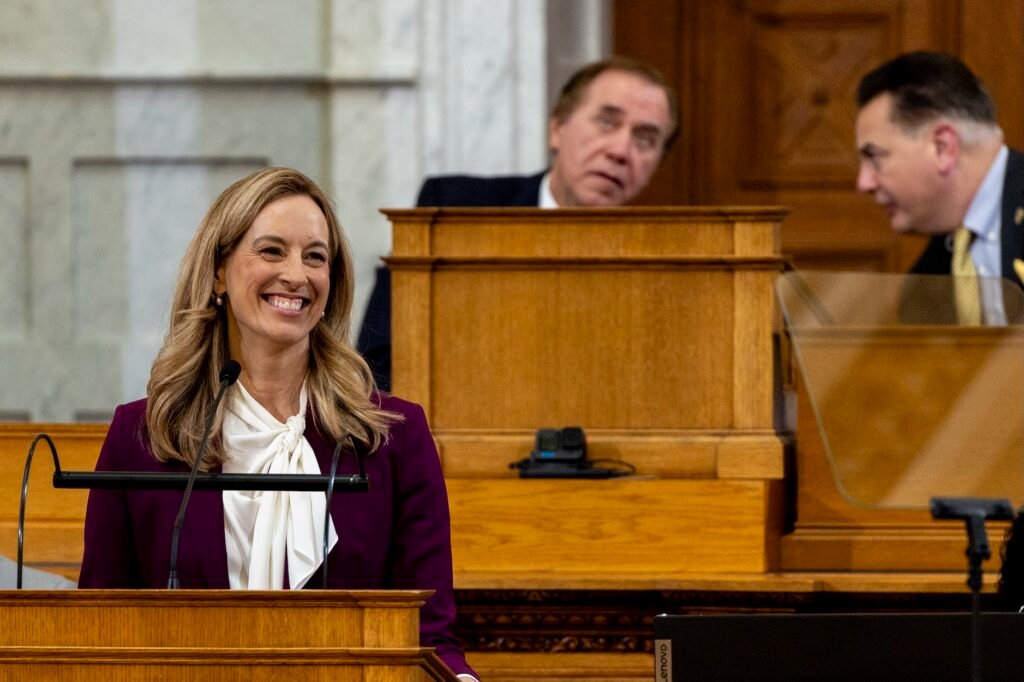
Gov. Mikie Sherrill gives her first budget address at the Trenton Statehouse on March 10, 2026. (Photo by Anne-Marie Caruso/New Jersey Monitor)
New Jersey’s top Democrats are still working out the state’s budget days after they announced a deal on the annual spending bill, and the process again appears poised to stretch to the eve of a government shutdown.
Though Gov. Mikie Sherrill and top Democrats in both legislative chambers said they had reached a budget accord Tuesday that would keep the state’s annual spending to $60.7 billion, the governor and other top officials could not say how much new spending they had agreed to add or what expenditures would be cut to keep spending roughly level with the budget proposal Sherrill made in March.
“I said from the beginning, look, if you have additions, we need subtractions,” the governor told reporters Wednesday.
Sherrill, Senate President Nicholas Scutari (D-Union), and Assembly Speaker Craig Coughlin (D-Middlesex) announced they had reached a budget deal in a joint statement issued Tuesday, but Sherrill and Sen Paul Sarlo (D-Bergen), the chamber’s budget chairman, on Wednesday said details about key provisions were still being worked out and language was still being drafted.
Among other things, it was unclear how much the state would spend on legislative priorities and an expansion of the state’s child tax credit.
Also unclear were an array of cuts that would be needed to keep overall spending at about the level Sherrill proposed in her budget speech.
The governor said Wednesday that new cuts would be small and spread, with some coming from programs that were less expensive than the administration predicted.
“I think there were a lot of smaller areas that we looked across and programs that didn’t end up needing as much funding as we thought, and we felt like they could be better utilized elsewhere,” she said.
The deal announced Tuesday does decide the fate of Stay NJ, a property tax relief program aimed at New Jersey seniors. The program is a key initiative for Coughlin but critics have worried that its total cost makes it unfeasible in the long-term.
As part of the agreement, that program’s income limit will fall to $200,000 — from the $500,000 in current law and the $250,000 proposed by Sherrill — and tier payments based on income, with the largest awards going to seniors with lower earnings.
The deal will leave the program’s maximum benefit at $6,500 (Sherrill had proposed lower) and the annual cost for the state will shift to $742 million, down from $1.2 billion under current law.
Sherrill credited Coughlin for the change when speaking to reporters Wednesday.
“I actually think Stay is in a better place than it was, and so that was a great fix,” she said.
The New Jersey Globe first reported the accord over the property tax program.

The announced deal also includes an expansion of the state’s child tax credit, but details about that expansion remain scant. It’s not clear whether the credit’s award levels or eligibility thresholds will change, nor have officials named the expansion’s cost. Sarlo said only that it would cost “a lot less” than the $100 million added to Stay NJ’s total price tag compared to Sherrill’s proposal.
Scutari declined to take questions at the Statehouse Wednesday.
Sarlo and Sherrill said lawmakers were still working out which legislative priorities would be funded in the budget, and it’s not clear how much the state will spend as a result of budget resolutions, legislative add-ons generally included in the budget at the last minute. In past years, budget resolutions have routinely added about $1 billion in new expenditures.
Documents detailing how the budget has changed are seldom made public until shortly before the Legislature’s budget committees vote to advance the spending bills. In past years, budget committees have sometimes cleared a budget bill never seen by the panels’ Republican members.
Sarlo said committee votes on the budget are tentatively scheduled for the weekend or possibly Monday. Those timelines leave lawmakers little flex, but he stressed the government would remain open.
“There is a deal in place. There will be no government shutdown or anything like that. We’re just up against the clock, and people are working really hard. Let those folks who need to do the work do their work,” he said.
The budget must be signed before July 1 to keep the state government open, and the New Jersey constitution requires a full day elapse between a bill being cleared from committee and voted on by the full Legislature.
Lawmakers can circumvent that limit with a three-fourths supermajority vote, but the Democratic caucuses cannot achieve such a majority on their own, and few Republicans are likely to aid them there.
Sarlo said staff was still working on “score sheets, cuts, matching restorations, and language,” and said lawmakers were brushing up against the deadline to leave more time to proof the budget, which runs for hundreds of pages.
“We do not want to come prematurely and pass a document that has potential mistakes in it, so we want to make sure we take our time,” he said. “We have a few days here. Let’s take all the time we need to make sure we get it done right and correct.”



