
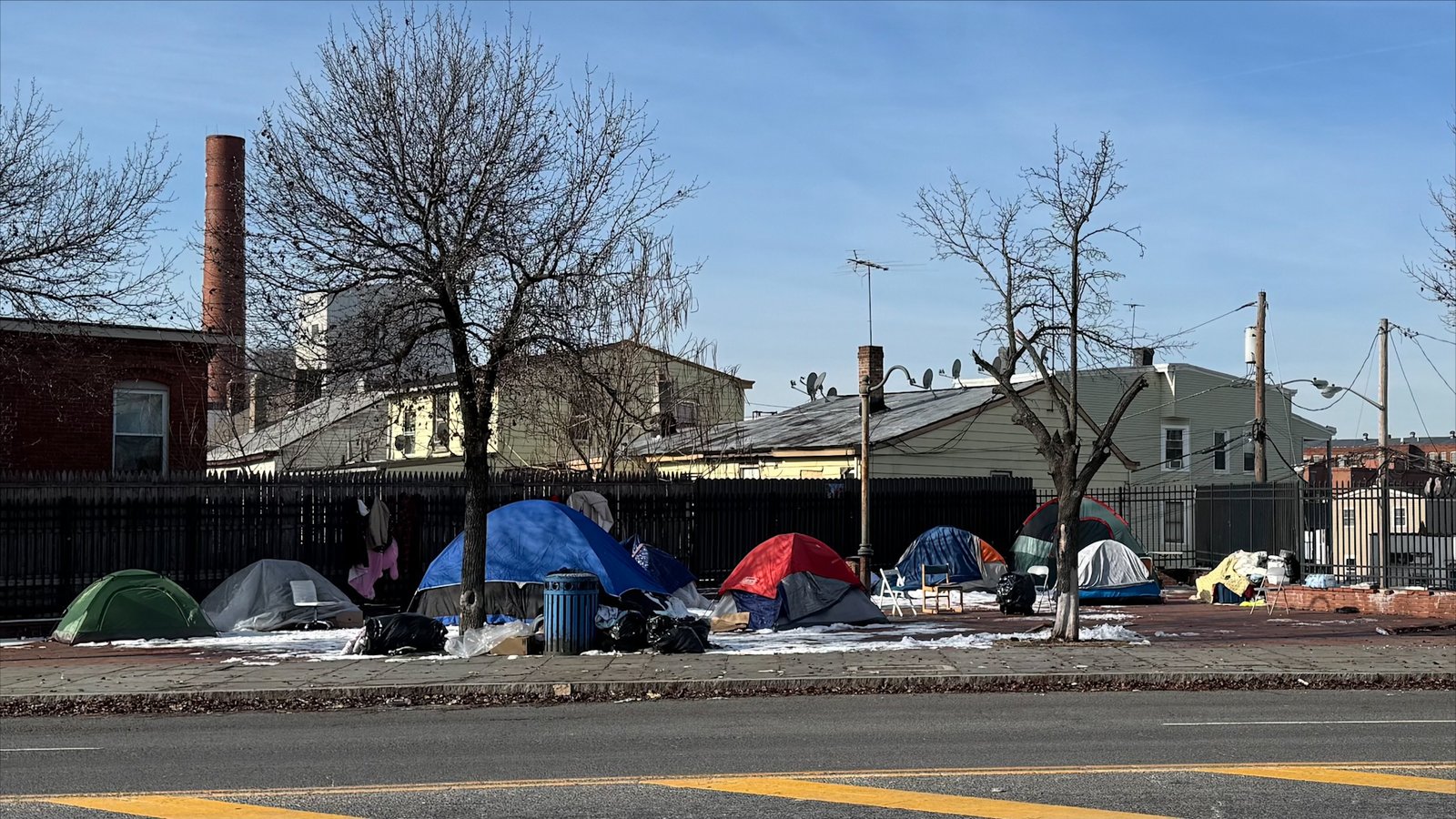

New Jersey state government is responding to a growing homeless population as federal funding for many key services is in flux.
The state, though, is spending less on programs and services addressing homelessness than several peer states in several categories, according to a research team at Rutgers University’s Bloustein School of Planning and Public Policy.
Two states detailed in the report, Massachusetts and Vermont, are funding services to address homelessness on an annual basis at nearly double the rate of New Jersey’s allocations.
The researchers released their findings at an important time in the state government’s annual budget-making process.

Lawmakers must approve a spending bill that will become state government’s spending plan by early next week.
“This report should be a wake-up call for New Jersey,” said Raisa Rubin-Stankiewicz, policy director for the Princeton-based New Jersey Coalition to End Homelessness.
“For too long, we have underfunded the services and supports that help people avoid homelessness, find shelter and secure permanent housing,” Rubin-Stankiewicz said.
New Jersey’s homeless population increased by roughly 70% from 2021-2025, according to the report, which cites annual Point-in-Time counts conducted by Cranford-based Monarch Housing Associates.
The researchers attributed the increase in homelessness in New Jersey to factors including rising home prices, a shortage of affordable housing and recent changes in federal funding for key social services carried out by President Donald Trump’s administration.
Connecticut, Rhode Island and Illinois also were part of the six-state study.
“Overall, the analysis identifies common themes across the selected states, including increased state involvement in homelessness funding, expanded coordination across agencies and service providers, and growing attention to system planning and data infrastructure,” according to the report.
“The findings also reflect the challenges states are facing as homelessness increases and federal funding policies continue to evolve,” the report states.
Connecticut and Massachusetts allocated the most annually for each unhoused resident — $26,130 and $26,622, respectively, the researchers found.
Of the six states studied, New Jersey placed second to last in this category, at $13,556.
Massachusetts also led the way in the amount spent annually by state government to address homelessness relative to total annual spending. New Jersey placed second to last in this category, the report states.
In addition to the spending on services and programs, the researchers also reviewed local attempts to make homelessness a crime.
“Illinois, Connecticut, Vermont, Massachusetts, and New Jersey are all currently considering bills to limit the power of municipalities to criminalize homelessness,” according to the report.
“For Vermont and Massachusetts, this legislation would also include a bill of rights for people experiencing homelessness,” the report states.
In several states, the efforts to address homelessness incorporated mental health services, the report found.
New Jersey Gov. Mikie Sherrill’s $60.7 billion proposed budget for the fiscal year that begins July 1 sets aside $25 million to expand programs for those in “imminent risk of homelessness,” according to the Budget-in-Brief released by the Sherrill administration in March.
Another $11 million is earmarked for a joint initiative serving homeless veterans.
Sherrill, a first-term Democrat, proposed realigning some state spending on direct property tax relief programs as part of a broader effort to cut expenses.
A $250 bonus for senior renters participating in the Anchor program would be preserved, while senior homeowners earning more than $250,000 would become ineligible for Stay NJ benefits.
Sherrill’s budget plan, which also calls for reducing diversions from the state’s Affordable Housing Trust Fund, has been the subject of a lengthy review by lawmakers in recent months.
Majority Democratic legislative leaders are expected to introduce a spending bill this week. The state constitution requires a government shutdown if the governor and lawmakers do not agree on a budget by July 1.
This story is made possible in part by the Corporation for Public Broadcasting, a private corporation funded by the American people.



