
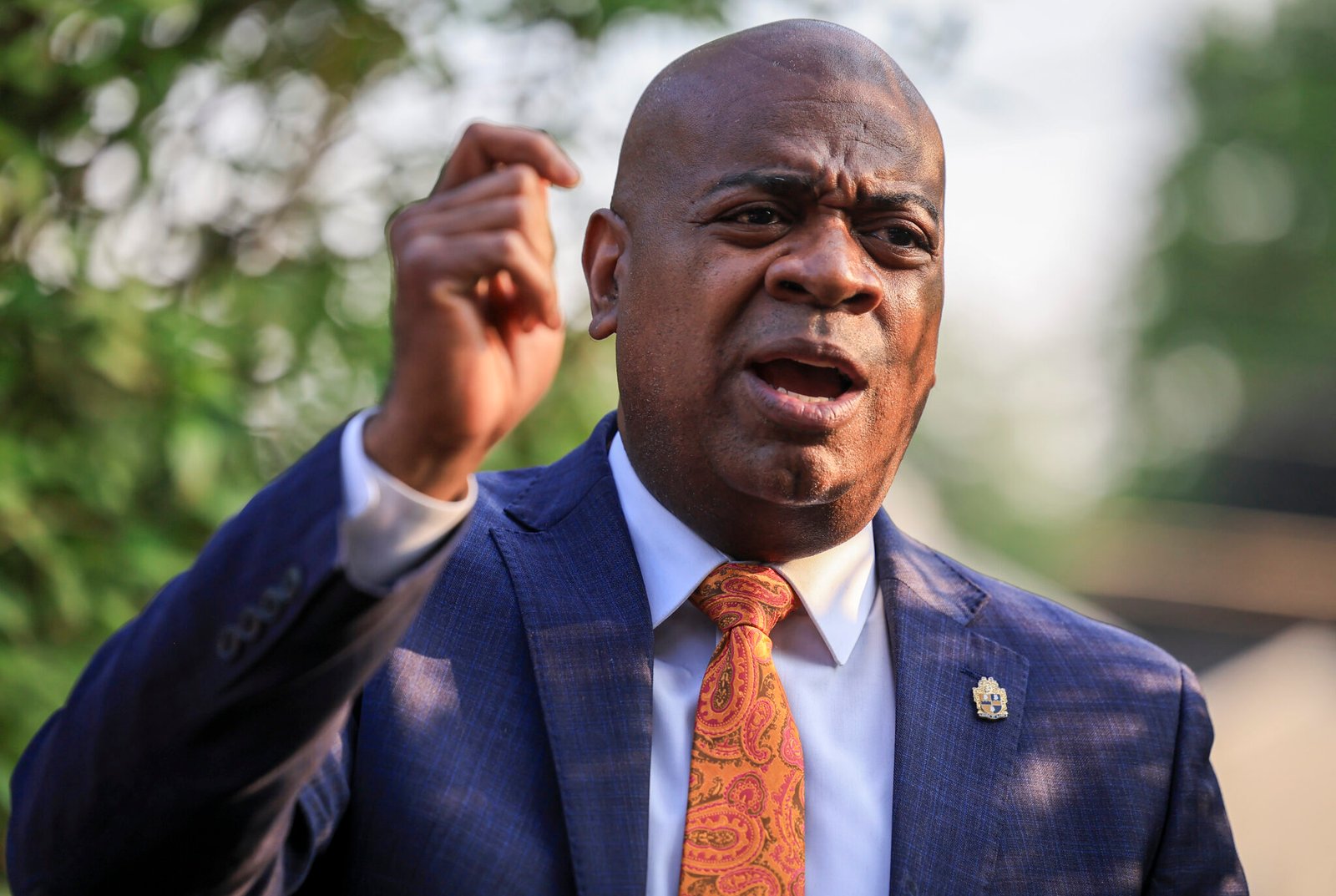
Newark Mayor Ras Baraka said he felt vindicated this week when a federal judge tossed the Trump administration’s lawsuit targeting four New Jersey cities’ sanctuary policies for immigrants.
But Baraka, a Democrat whose city was one of the plaintiffs in the lawsuit, warned the victory may be short-lived.
“I’m sure they’ll try to find some other way to pressure us into doing things that we don’t think is right,” he said in an interview Friday. “They can take grants from you, they can find ways to make you return money — all kinds of things that these guys come up with to try to isolate you and pressure you.”
Baraka himself felt that pressure last year when federal agents arrested him for trespassing at Newark migrant jail Delaney Hall, a charge prosecutors dropped 10 days later. Baraka said the arrest was an example of the Trump administration targeting a political foe.
The best thing the Trump administration can do now, Baraka said, is “leave state and local government alone.”
“Stop pressuring us, forcing us to do things, stop beating people, stop chasing people through the streets,” he said. “It’s all nonsense. They should be working on making people’s quality of life better.”
U.S. District Court Judge Evelyn Padin on Wednesday dismissed the Trump administration’s challenge to policies limiting local law enforcement’s cooperation with federal civil immigration enforcement in Newark, Jersey City, Paterson, and Hoboken. Padin ruled that the federal government had no standing to sue, and she noted that even if the cities’ sanctuary policies were withdrawn, local cops would still have to abide by the statewide policy, known until recently as the Immigrant Trust Directive (an order that was signed into law earlier this year by Gov. Mikie Sherrill).
The U.S. Department of Justice did not respond to requests for comment on whether it plans to appeal Padin’s decision.
Baraka has been one of the most vocal voices in New Jersey pushing back against federal immigration enforcement.
He attempted to prevent private firm Geo Group from opening Delaney Hall — the company contracts with the federal government to house immigrant detainees there — and while running for the Democratic nomination for governor last year, he was firm in his support for the Immigrant Trust Directive.
Baraka said he’d like to see other municipalities pass stronger policies limiting cooperation with immigration enforcement, saying it would be harder for the federal government to “isolate” certain localities if more of them followed Newark’s lead. He noted that most cities have more important things to focus on than “running around chasing immigrants.”
Going after people who are still “processing their immigration status is not on a top priority list,” he said. Most mayors are focused on finding ways to help people afford homes, buy affordable groceries, reduce violence, and ensure kids go to school and graduate.
He accused Geo Group of violating local and state laws by not allowing health officials to inspect conditions inside the jail. He also said the city has tried to obtain surveillance video of the Sunday incident where a jail employee hit a protester with a car in the driveway of the detention center, and that Geo Group has refused to comply.
Baraka suggested the Trump administration’s lawsuit and the conduct at Delaney Hall is connected to something bigger: a sense that the country is moving backward. He said debates about immigration policies are fracturing communities, driven by the openly hostile attitude toward immigrants by the Trump administration, but also existing economic anxieties.
“Generation after generation has advanced the struggle for more people, expanding democracy to more and more people. I think this is the first time in a long time that we’re not going forward,” he said. “Democracy has always been a work in progress — 250 years of celebrating the work in progress is happening — and what they’re doing is putting a black eye on the history of the progress of the country.”



