
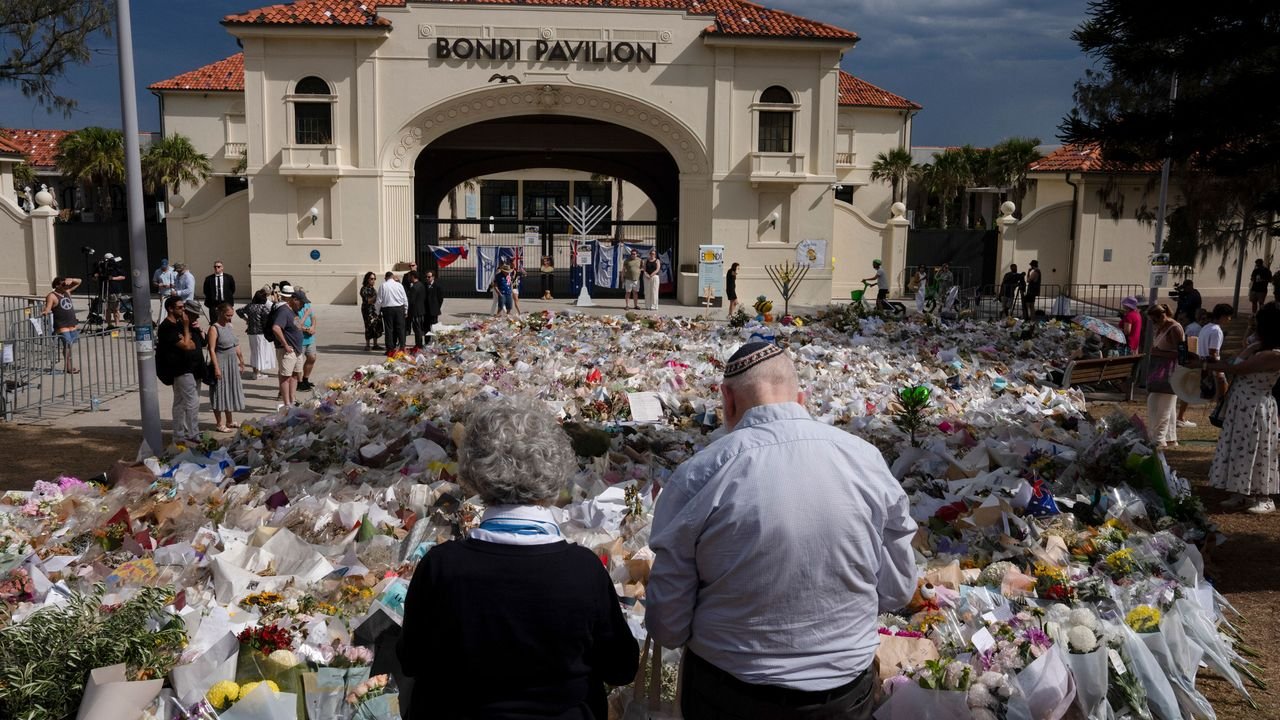
Howard’s framing of what happened at Bondi very quickly became a fulcrum for the discourse. A few days after his remarks, the former Nationals leader David Littleproud echoed him almost word for word, denouncing gun control as “nothing more than a cheap political diversion” from “the real problem in this country, which is radical Islamists.” In conversation with me, Howard suggested that it was not just fringe extremism but also the climate of antisemitism that had been allowed to “fester” since October 7th that had led to the massacre. He pointed the finger squarely at Albanese, whose rhetoric, he argued, had failed to show full-throated support for the country’s Jews. “The natural and probable consequence” of this, he said, was to give “license for a continuation of antisemitism.”
Since 2023, Albanese, like many other Western leaders, has presided over a country that is host to a pro-Palestine protest movement of unprecedented scale. It has involved weekly solidarity marches, encampments at all the country’s major universities, and blockades at factories producing parts for Israeli F-35s and at ports where Israeli-owned containers attempt to unload cargo. The protests have been disruptive but mostly peaceful, though some have displayed concerning features. At a march that took place on October 9, 2023, estimated to have included around a thousand people, a handful of attendees called out a phrase that was at first reported in the media as “gas the Jews,” and was eventually found by police to be “where’s the Jews.” (The demonstration’s organizers condemned the chants, claiming that they were made by a small, unaffiliated group of gate-crashers.)
In Howard’s view, Albanese had allowed a “tone” and “mood” of anti-Jewish hatred to take root in Australia. As in the rest of the world, this is a line of argument that has been vigorously prosecuted by conservative media outlets and pro-Israel groups, including the Executive Council of Australian Jewry, which characterized Hamas’s October 7th attack as a “signal” for “many Islamists and left-wing extremists that it was open season on Jews.” Jillian Segal, a prominent lawyer whom the Albanese government, in 2024, appointed to serve as the country’s Special Envoy to Combat Antisemitism, thereby becoming the highest government authority on the matter, said much the same thing in a written statement published shortly after Bondi: “It began on 9 October 2023 at the Sydney Opera House. Now death has reached Bondi Beach.”
The idea that Albanese has failed to address antisemitism is questionable. His response to Bondi has certainly alienated Australians across the political spectrum—when many called for him to instate a national inquiry into antisemitism, he initially resisted; then, in early February, he invited the Israeli President, Isaac Herzog, for a series of visits to Australian cities that sparked confrontations between protesters and police. But he has also consistently condemned anti-Jewish prejudice and taken official steps to address hate crimes, including by establishing a special unit within the Australian Federal Police, the country’s equivalent of the F.B.I., to investigate antisemitic threats. During Albanese’s tenure, the Australian Security Intelligence Organization has been focussed on gathering intelligence about antisemitic attacks; last August, it found that two major such incidents were carried out at the direction of Iran’s Islamic Revolutionary Guard Corps, leading Albanese to expel Iran’s Ambassador. (Iran denied the allegations.)
To Howard, though, nothing Albanese has done has been strong enough, and all of it has been compromised by Albanese’s stance on Palestine. Last September, after Albanese announced his plans to take the largely symbolic action of recognizing Palestinian statehood, alongside the governments of the U.K., Canada, and France, Howard co-authored a statement calling the move a “reckless and dangerous course.”
Yet, in Australia as in many other Western countries, support for a two-state solution is not a fringe position. A poll conducted in July, 2025, found that forty-five per cent of Australians backed the recognition of a Palestinian state—a ten-per-cent increase over the previous year—and that less than a quarter opposed it. When I suggested to Howard that Albanese had a duty to consider these constituents, Howard replied, “You see, balancing—that’s the problem, right? That’s dealing with it politically, right?”
Howard was wielding the word “politically” as an accusation. He saw Albanese’s actions as an attempt to hedge Jewish and pro-Palestinian support, not as a choice derived from both the exigencies of electoral politics and of genuine moral judgment. The exchange revealed much about how Howard governed during his eleven years in power. He was a conviction politician. Throughout his leadership, his economic program was stridently neoliberal (he once referred to Margaret Thatcher as his “guiding light”) and socially conservative (an observant Anglican, he has argued that “a united, caring, loving family is the best social-welfare system that mankind has ever devised”). Howard had shaped the country around his own narrow ideals. If your convictions happened to align with his—if you agreed that Australia’s head of state should remain a British monarch, that modern Australians bore no responsibility for the sins of their colonial forebears, or that the war on terror was necessary—he fought for you. If not, then you were sidelined.



