
Viral load fails to explain asymptomatic infection in influenza A/H3N2-inoculated volunteers
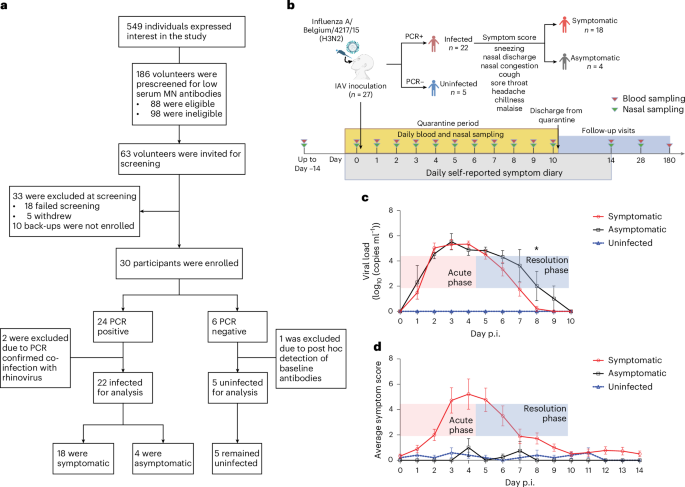
Thirty healthy participants aged 18−55 years, with low strain-specific serum neutralizing antibody titers (≤1:20 by microneutralization), were inoculated with 5 × 10⁵ 50% tissue culture infectious dose (TCID50) of influenza A/Belgium/4217/2015 intranasally (Fig. 1a,b). Of these, three were excluded due to viral co-infection or seroconversion before inoculation. After inoculation, participants were quarantined for up to 10 days with daily sampling and follow-up at days 14, 28 and 180 (Fig. 1b). Symptoms were monitored using self-reported symptom diaries. Of the 27 participants, 22 (81.5%) developed polymerase chain reaction (PCR)-confirmed infection and five (18.5%) remained uninfected. Infected participants were categorized using the modified Jackson criteria20 into symptomatic (18/22; 81.8%) and asymptomatic (4/22; 18.2%) groups. No significant differences were observed in demographics between groups and no differences related to sex or gender; male and female participants were, therefore, analyzed together (Extended Data Table 1).
Healthy adult volunteers were enrolled, assessed and sampled periodically before and after inoculation with a GMP-manufactured influenza A(H3N2) virus. a, CONSORT diagram showing participant enrollment, infection outcomes and development of symptomatic disease. b, Diagram showing the study setup and sampling timepoints. Diagram created in BioRender; Xu, J. https://biorender.com/xtooyrz (2026). c, Average viral shedding of symptomatic (n = 22), asymptomatic (n = 4) and uninfected (n = 5) participants as determined by M gene qPCR from nasal lavage. Significance between symptomatic and asymptomatic participants for each timepoint was tested by two-sided Mann−Whitney U-tests (day 8 p.i. P = 0.026, *P < 0.05). d, Self-reported total daily symptom score for symptomatic (n = 22), asymptomatic (n = 4) and uninfected (n = 5) participants. Data in c,d show mean ± s.e.m. MN, microneutralization assay; IAV, influenza A virus.
In symptomatic participants, viral load (VL) and symptom score both peaked at day 4 post-inoculation (p.i.), thus defining an acute phase from day 0 to day 4 and a resolution phase from day 5 onwards (Fig. 1c,d). In asymptomatically infected participants, VL peaked at day 3, but symptoms remained essentially zero throughout. Uninfected participants did not develop any detectable VL or symptoms (Fig. 1c,d and Supplementary Fig. 1). Symptomatic participants showed a trend toward more rapid viral clearance, with significantly lower VL on day 8 p.i. (Mann−Whitney, P = 0.026) although not statistically significant by linear mixed-effects modeling. However, no differences were observed between the VLs of symptomatic participants and asymptomatic participants during the acute phase.
Symptomatic infection is associated with early innate transcriptional changes
To reveal pathways potentially explaining these differential clinical outcomes, whole blood (systemic) and inferior turbinate tissue (nasal mucosa) samples were analyzed by RNA sequencing (Extended Data Fig. 1a). Differentially expressed gene (DEG) analysis by DESeq2 revealed minimal pre-inoculation differences in gene expression of blood associated with clinical outcome (Extended Data Fig. 1b,c and Supplementary Table 1). In nasal mucosa at baseline, only six DEGs were identified comparing infected and uninfected, whereas 431 DEGs appeared between symptomatic and asymptomatic (Extended Data Fig. 1d,e and Supplementary Tables 1 and 2). However, on detailed inspection, no interferons (IFNs), interferon-stimulated genes (ISGs) or cytokines/chemokines associated with viral infection were present among these baseline DEGs, and Ingenuity Pathway Analysis (IPA) indicated only one enriched pathway that was directly immune related: NIK-related non-canonical NF-κB signaling (Extended Data Fig. 1f). Further unpaired analysis comparing symptomatic and asymptomatic participants at peak VL/day 3 p.i. revealed no statistically significant differences in blood and only nine DEGs in the nasal mucosa (Extended Data Fig. 1g,h and Supplementary Table 1).
Next, pairwise comparisons were undertaken to identify DEGs between each p.i. timepoint and pre-inoculation. In whole blood from uninfected participants, no significant DEGs were identified during the acute phase (Supplementary Fig. 2 and Supplementary Table 3). During convalescence at day 14, 38 DEGs were identified, but IPA showed no relevant functional enrichment (Supplementary Tables 4 and 5). By contrast, among infected participants, 4,030 DEGs were identified at day 2 and 6,560 at day 3 p.i. Hierarchical clustering of the top DEGs (n = 179, log2 fold change > 2 and adjusted P value (Padj) < 0.01) visualized by heatmap revealed two major clusters, with a group of 161 DEGs peaking at day 2 (46) or day 3 (115) p.i. and a smaller group of 18 DEGs peaking at day 7 p.i. (Supplementary Fig. 2; DEGs detailed in Supplementary Table 6). Using IPA, top DEG-enriched pathways at days 2−3 p.i. were mostly involved in pro-inflammatory and innate immune processes, with a pattern of quicker and greater induction in symptomatic participants (Fig. 2a and Supplementary Fig. 3). By contrast, at day 7 p.i., top pathways were primarily involved in cell cycle and DNA replication, indicative of cellular proliferation (Fig. 2a).
a, The most significantly DEG-enriched pathways (Benjamini−Hochberg Padj < 10−5, z-score > 3.5) in the blood p.i. are shown by IPA. b, The most significantly DEG-enriched pathways (Benjamini−Hochberg Padj < 10−6, z-score > 3.5) in the nasal mucosa p.i. are shown by IPA. c−e, Gene expression clusters 2 (c, n = 15), 5 (d, n = 23) and 7 (e, n = 9) were identified by maSigPro. Solid lines connect the median DEG expression values for each group of participants, and dashed lines show the regression curves fitted to the data. f−h, DEG-enriched pathways (Benjamini−Hochberg Padj < 0.05) with DEGs from clusters 2 (f), 5 (g, top 20 pathways out of 49) and 7 (h) are shown by IPA. For a,b,f−h, significance was assessed using right-tailed Fisherʼs exact tests. The P values were adjusted using the Benjamini−Hochberg method for multiple hypothesis test correction. For b, the most significantly DEG-enriched pathways using as cutoff Benjamini−Hochberg Padj < 10−5 and z-score > 3.5 are shown in Supplementary Fig. 5. B-H, Benjamini−Hochberg.
Surprisingly, transcriptional responses in nasal tissue were delayed compared to the circulation. After inoculation, 46 DEGs at day 2, 2,775 DEGs at day 3 and 3,496 DEGs at day 7 were found in the nasal mucosa. In uninfected participants, minimal differential gene expression was observed except at day 10 p.i. where 240 DEGs were seen (driven by a single outlying asymptomatic participant, resulting in enrichment of neutrophil-related pathways by IPA) (Extended Data Fig. 1i). After infection, hierarchical clustering of the top DEGs (n = 264) was visualized by heatmap (Supplementary Fig. 4; DEGs detailed in Supplementary Table 6). Pathway analysis of significant nasal DEGs using IPA revealed similar pathways as blood, but these were slower to resolve, persisting to at least day 7 p.i. (Fig. 2b).
Cellular activation signatures are preceded by early antiviral transcriptional responses
To further investigate longitudinal patterns of transcriptomic change, a temporal model was generated using maSigPro, clustering significant DEGs based on their similarity in expression patterns over time and between groups. This generated nine clusters with distinct temporal patterns of expression (Supplementary Fig. 6; corresponding DEG-enriched pathways in Supplementary Fig. 7). Gene clusters generated from nasal tissue revealed no consistent patterns; further analysis, therefore, focused on blood. Three clusters (clusters 2, 5 and 7) demonstrated clear responses to infection (Fig. 2c–e), consistent with earlier pairwise comparisons. Cluster 2 was dominated by IFN signaling, with 15 DEGs grouped by IPA as primarily ISGs (Fig. 2f and Supplementary Table 7). Supporting this unsupervised analysis, a panel of canonical ISGs, including those in cluster 2, was selected for individual-gene longitudinal tracking, with both analyses again showing an early peak in symptomatic participants around day 3 and lower response for asymptomatic participants (Fig. 2c and Supplementary Fig. 8a). Cumulative expression values during the acute phase (area under the curve (AUC), baseline to day 3) of seven of 15 DEGs in cluster 2 correlated significantly with symptom scores (Extended Data Fig. 1j). By contrast, ISGs in the nasal mucosa showed trends toward higher peak expression in asymptomatic participants but with substantially greater variability, thus limiting interpretation (Supplementary Fig. 8b).
In cluster 5, 23 DEGs peaked at day 7 with higher expression levels in symptomatic participants (Fig. 2d). These enriched for cell cycle, DNA repair and epigenetic modification pathways (Fig. 2g). The day 7 fold change (from baseline) of normalized gene counts of 15 of 23 DEGs in cluster 5 correlated with symptom scores, implying a relationship between symptomatology and later enhancement of cellular responses (Extended Data Fig. 1k). Additionally, nine DEGs in cluster 7 peaked at day 7 for asymptomatic participants and at day 10 for symptomatic participants where gene expression was more prolonged and pronounced (Fig. 2e). Cluster 7 DEGs mostly enriched for complement cascade, Fcγ receptor-dependent phagocytosis and B cell development pathways (Fig. 2h). Thus, gene expression analyses imply that greater early innate activation correlates with both concurrent symptoms and subsequent cellular activation/proliferation.
Soluble mediators are induced earlier and to higher levels in symptomatic participants
With cytokine signaling pathways having dominated the transcriptomic response, soluble mediators in plasma and nasal lining fluid were next analyzed. At baseline, no significant differences were observed in the levels of major inflammatory mediators (IFNγ, IFNλ1/IL-29, CXCL10/IP-10, IL-6, TNF, IL-15), IL-10 or the chemokines CCL13/MCP-4 and CCL22/MDC (Extended Data Fig. 2a,b; other soluble mediators in Supplementary Figs. 9 and 10). After inoculation, no responses were seen in uninfected participants, but greater and quicker elevation in several soluble mediators was observed acutely in symptomatic participants, with significantly higher systemic IFNγ and IL-6 by day 2 and IFNα2a, TNF and IL-10 by day 3 p.i. and IL-15 showing a similar trend (Fig. 3a). Additionally, IL-10 and IFNγ showed biphasic responses with a second peak of significantly increased plasma concentrations at day 6 in symptomatic participants (Fig. 3a), aligned with and potentially reflecting the cluster of DEGs upregulated at day 7 (Fig. 2d).
a−d, Soluble mediators (a,b) and CCL13 and CCL22 (b,d) in plasma (a,c) and nasosorption (b,d) samples from symptomatic (n = 18), asymptomatic (n = 4) and uninfected (n = 5) participants were measured by MSD. Data are mean ± s.e.m. e, UMAP analysis was undertaken on gated live lineageneg cells based on the markers CD14, CD16, CD11c, CD1c, CD141, CD123 and HLA-DR, for symptomatic and asymptomatic participants. Monocyte and DC subgroups were manually gated and overlayed onto the corresponding UMAP plots. f,g, Relative percentages of monocyte subgroups compared to total cells (f) or total monocytes (g) acquired by flow cytometry from symptomatic, asymptomatic and uninfected participants. h, Frequency of DC subgroups compared to total cells. i,j, Surface expression of CD169 (i) and HLA-ABC (j) on monocyte subgroups. k,l, Surface expression of CD169 (k) and HLA-ABC (l) on DC subgroups. m, Correlation matrix showing Spearmanʼs r numbers between the relative percentage of IMs (out of total monocytes), CD169 and HLA-ABC MFI at day 3 and day 4 p.i. in monocyte and DC subgroups and the modified Jackson symptom score for all available infected participants (day 3: n = 19 and day 4: n = 16). Significance was assessed using Spearmanʼs rank correlation coefficient (two-sided). For a−d,f−l, significance between symptomatic and asymptomatic participants was tested by a two-way linear mixed-effects model (REML) with Geisser−Greenhouse correction, and post hoc pairwise comparisons were adjusted using the Holm−Sidak method. Results are shown as mean ± s.e.m. No statistical tests are shown for uninfected participants. For a,b,i−l, data were normalized to baseline (day 0 values were abstracted from each timepoint). For e,f,l, data were generated from n = 18 symptomatic, n = 4 asymptomatic and n = 5 uninfected participants (n numbers per timepoint are detailed in the Methods). *P < 0.05, **P < 0.01, ***P < 0.001, ****P < 0.0001. MFI, median fluorescence intensity; D0, day 0; REML, restricted maximum likelihood.
Analysis of the aforementioned mediators in nasal mucosa confirmed a delayed inflammatory response, with IFNα2a, IFNγ, IL-6 and IL-15 peaking 1−2 days after blood. Here, only IL-6 and IL-15 intermittently showed significantly higher expression in symptomatic participants (Fig. 3b). By contrast, in a reversal of the pattern seen in blood, there were significantly higher levels of nasal IL-10 by day 3, of nasal CCL13 at day 6 and of nasal CCL22 at day 2 in the asymptomatic group (Fig. 3a–d). Significant negative correlations between day 2 nasal TNF and CCL13 concentrations with symptom scores were identified, suggesting potentially protective associations, whereas day 2 plasma CXCL10 and day 6 IL-10 concentrations were positively correlated with symptom scores, suggesting that both pro-inflammatory and anti-inflammatory mediators may be involved with symptom development (Extended Data Fig. 2c).
Symptoms are associated with early myeloid activation and antigen cross-presenting capacity
With multiple myeloid and antigen presentation pathways enriched for DEGs, we proceeded to investigate innate cells by flow cytometry (Extended Data Fig. 3a and Supplementary Table 8). Monocytes are divided into three subgroups: CD14+CD16− classical monocytes (CMs), CD14+CD16+ intermediate monocytes (IMs) and CD14dimCD16+ non-classical monocytes (NCMs). Dendritic cells (DCs) are defined as CD14−HLA-DR+ and divided into four subgroups: CD123+ plasmacytoid DC (pDC), CD11c+CD141+ conventional DC1 (cDC1), CD11c+CD141−CD1c+ conventional DC2 (cDC2) and a CD11c+CD141−CD1c− less-characterized DC subgroup21. To visualize changes, dimensionality reduction by uniform manifold approximation and projection (UMAP) gated on live, lineageneg (CD3−CD19−CD56−) cells was performed. Unsupervised clustering by FlowSOM did not distinguish between monocyte subgroups (day 3 p.i.; Extended Data Fig. 3b,c), but manual gating showed CMs as the dominant population in blood throughout infection, with expansion of IMs and NCMs occurring during the acute phase, suggesting that these might have emerged from the CM pool (Fig. 3e and Extended Data Fig. 4a).
In symptomatic participants only, a significant increase in total circulating monocytes was seen peaking at day 3 and persisting until day 5 (Extended Data Fig. 4b), but no significant differences were observed in total DCs (Extended Data Fig. 4c). Although all monocyte subgroups increased as a percentage of total cells, this was greatest in IMs followed by NCMs that peaked 2 days later at day 5 (Fig. 3f). Similar differences were seen by percentage of total monocytes (Fig. 3g). The DC response to infection was predominantly marked by a significantly greater frequency of pDCs in symptomatic participants that peaked at day 4 p.i. (Fig. 3h and Extended Data Fig. 4d).
Comparison of DEG kinetics had highlighted the more rapid upregulation of genes such as SIGLEC1 (CD169), HLA-A, HLA-B, HLA-C (HLA-ABC), CD86, CD40 and HLA-DRA, HLA-DRB1, HLA-DRB5 (HLA-DR) in symptomatic participants (Extended Data Fig. 4e). Here again by flow cytometry, the pattern of quicker and greater increase in expression associated with symptomatic infection was shown for CD169, HLA-ABC and CD40 within 4 days p.i. on all three monocyte subgroups and CD169, HLA-ABC and CD86 on all four DC subgroups (Fig. 3i–l and Extended Data Fig. 4f,h (normalized) and Extended Data Fig. 5 (non-normalized)). Expression of HLA-DR on monocytes was similarly consistent with the exception of IMs, where expression in symptomatic individuals showed a short-lived decrease with a trough at day 2 that was significantly lower than asymptomatic participants, which may be due to transition of CMs, with their lower baseline expression of HLA-DR, to IMs (Extended Data Fig. 4g). Significant correlation between the frequency of IMs or MFI of CD169 and HLA-ABC and symptoms was observed at days 3−4 p.i. in all infected participants (Fig. 3m). Thus, symptom scores significantly correlated with day 3 IM percentage, with day 3 CD169 MFI on all monocyte and DC subgroups except pDCs and with day 3 HLA-ABC MFI on IMs.
Therefore, earlier and greater activation of circulating monocytes and DCs alongside increased expression of markers involved in antigen presentation/cross-presentation distinguished symptomatic from asymptomatic influenza infection, with frequency of IMs and expression level of CD169 on monocytes and cDCs potentially representing symptomatic correlates.
Natural killer and CD8+ T cell proliferation correlates with early systemic innate cell activation
During the early resolution phase, a cluster of DEGs involved in cell proliferation pathways was identified distinguishing symptomatic participants from asymptomatic participants (Fig. 2d,g). We hypothesized that this second phase of the peripheral blood DEG response reflected proliferation of cells involved in viral clearance, such as natural killer (NK) and CD8+ T cells, and was influenced by innate activation during the acute phase. The activation of circulating NK cells was, therefore, assessed by co-expression of Ki-67 (Supplementary Table 8). UMAP and FlowSOM clustering on gated NK cells revealed four clusters with high Ki-67 expression (clusters 2, 3, 4 and 8; Fig. 4a,b and Extended Data Fig. 6a,b). The frequency of these clusters generally peaked at day 7 and was significantly higher in symptomatic participants at day 7 for clusters 2 and 8 and at day 10 p.i. for clusters 2 and 3 (Fig. 4c; clusters 1 and 5−7 in Extended Data Fig. 6c) compared to asymptomatic participants. Additionally, gated circulating NK cells were manually divided into two subgroups: CD56bright and CD56dim (Extended Data Fig. 6a). After infection, the frequency of the dominant CD56dim NK cells increased, with a significantly higher percentage of these cells in asymptomatic participants at day 3 p.i., with corresponding decrease in CD56bright NK cells (Extended Data Fig. 6d). In line with other innate cell markers, the activation marker CD38 expression on CD56dim NK cells followed the pattern of quicker and greater increase in symptomatic participants (not seen in CD56bright NK cells; Extended Data Fig. 6e). Furthermore, at the later day 7 timepoint, greater expansion of NK cells expressing Ki-67 was seen in both NK cell subgroups in symptomatic participants (Fig. 4d). Finally, correlation analysis revealed strongly significant correlations between the frequency of IMs at days 3−4 as well as CD169 and HLA-ABC expression on monocytes and DC subgroups with the percentage of CD56dimKi-67+ NK cells at day 7 (Fig. 4e).
a, UMAP analysis and FlowSOM clustering were undertaken on gated NK cells based on the markers CD56, CD16, CD57, NKG2C and Ki-67. b, Heatmaps of marker expression by FlowSOM NK cell clusters for symptomatic (top) and asymptomatic (bottom) participants at day 7. c, Longitudinal analysis of NK cell FlowSOM cluster percentage fold change out of total NK cells. d, Percentage fold change for each timepoint p.i. compared to day 0 of CD56brightKi-67+ NK cells out of total CD56bright NK cells (left) and CD56dimKi-67+ NK cells out of total CD56dim NK cells (right) in the blood of symptomatic, asymptomatic and uninfected participants. e, Heatmap of correlation matrix showing Spearmanʼs r values for correlation of the day 7 p.i. percentages of CD56brightKi-67+ NK cells (out of total CD56bright NK cells) and CD56dimKi-67+ NK (out of total CD56dim NK cells) with the modified Jackson symptom score and day 3 and 4 p.i. innate activation markers, the percentage of IM monocytes out of total monocytes, and the CD169 and HLA-ABC MFI of monocyte and DC subgroups, for all available infected participants (day 3, n = 19; day 4, n = 16). f, UMAP analysis and FlowSOM clustering were undertaken on gated T cells based on the markers CD4, CD8, CD69, CD38, Ki-67, CD11a, CD49d and CXCR3. g, Heatmaps of marker expression by FlowSOM T cell clusters for symptomatic (top) and asymptomatic (bottom) participants at day 7. h, Longitudinal analysis of T cell FlowSOM cluster percentage fold change out of total T cells. i, Percentage fold change for each timepoint p.i. compared to day 0 of CD38+Ki-67+CD8+ of total CD8+ T cells (left) and CD38+Ki-67+CD4+ of total CD4+ T cells (right) in the blood of symptomatic, asymptomatic and uninfected participants. j, Heatmap of correlation matrix showing Spearmanʼs r values for correlation of day 7 p.i. percentages of CD38+Ki-67+CD8+ T cells (out of total CD8+ T cells) and CD38+Ki-67+CD4+ T cells (out of total CD4+ T cells) with the modified Jackson symptom score and day 3 and 4 p.i. innate activation markers, the percentage of IM monocytes out of total monocytes, and the CD169 and HLA-ABC MFI of monocyte and DC subgroups, for all available infected participants (day 3, n = 19; day 4, n = 16). For a,b,f,g, numbers of samples analyzed are detailed in the Methods. For c,d,h, results are shown as mean ± s.e.m. For c,d,h,i, data were generated from n = 18 symptomatic, n = 4 asymptomatic and n = 5 uninfected (d,i only) participants (n numbers per timepoint are detailed in the Methods). Significance between symptomatic and asymptomatic participants was tested by a two-way linear mixed-effects model (REML) with Geisser−Greenhouse correction, and post hoc pairwise comparisons were adjusted using the Holm−Sidak method. No statistical tests are shown for uninfected participants. For e,j, significance was assessed using Spearmanʼs rank correlation coefficient (two-sided). *P < 0.05, **P < 0.01, ***P < 0.001. D, day; FC, fold change; REML, restricted maximum likelihood.
Previous studies showed correlations between pre-existing influenza-specific T cells in blood and reduced symptoms after infection12,13,22. To assess for potential confounding by T cell memory responses, IFNγ ELISpot was performed using cryopreserved peripheral blood mononuclear cells (PBMCs) and two previously established influenza peptide pools biased toward CD4+ and CD8+ T cells, respectively23. At baseline, no significant differences in IFNγ-producing CD4+ or CD8+ T cells were observed between infected and uninfected participants or between symptomatic and asymptomatic participants (Supplementary Fig. 11a–d). Furthermore, in participants who became infected, no significant correlations were observed between baseline T cell frequencies and symptom scores or VL (Supplementary Fig. 11e–h), suggesting that, for this cohort, there was no strong relationship between pre-existing T cells and clinical outcome.
Immunophenotyping of circulating CD4+ and CD8+ T cells was undertaken by flow cytometry (Supplementary Table 8). UMAP and FlowSOM clustering revealed clusters of CD8+ (cluster 8) and CD4+ T cells (cluster 6) upregulating high levels of CD38 and Ki-67 (Fig. 4f,g and Extended Data Fig. 7a,b). In symptomatic participants, the CD8+ T cell cluster peaked earlier at day 7 p.i. and to significantly higher frequencies compared to asymptomatic participants (Fig. 4h; clusters 1−5 and 7 in Extended Data Fig. 7c). These patterns of activation/proliferation were supported by manual gating, with a trend toward greater increases in the frequency of CD38+Ki-67+ T cells in symptomatic participants (Fig. 4i). Furthermore, analysis of the early activation marker CD69 demonstrated significantly higher frequencies of CD69+CD8+ and CD4+ T cells at day 3 p.i. in symptomatic participants (Extended Data Fig. 7d). As with CD56dimKi-67+ NK cells, the frequency of CD38+Ki-67+CD8+ T cells at day 7 p.i. significantly correlated with the percentage of IMs at days 3−4, along with myeloid activation marker MFI at days 3−4 (Fig. 4j). Day 7 CD38+Ki-67+CD4+ T cells correlated with day 7 CD38+Ki-67+CD8+ T cells, with the latter further correlating with day 7 Ki-67-expressing CD56dim NK cells (Extended Data Fig. 7e).
Together, these findings suggest that an exaggerated innate response at the peak of influenza VL (days 3−4 p.i.) is associated with subsequently greater NK and T cell activation/proliferation, which could be responsible for the somewhat accelerated viral clearance seen in symptomatic participants.
Integrative analyses reveal temporal dependencies across anatomical sites and immune modalities
With these data highlighting the importance of timing for the coordinated response to infection, piecewise mixed-effects linear regression modeling was used to test the association of kinetic features, including activation time, peak time and magnitude, and growth and decay rates, with soluble mediators, VL and symptoms (Fig. 5a,b). This revealed strong correlations between VL growth rate and maximum symptom score (Fig. 5c) as well as activation time of IFNγ in the nasal mucosa with reduced VL growth rate and peak (Fig. 5d,e).
a,b, Model schematics showing VL (a) and immune response (b) kinetics analyzed by piecewise linear regression. Tpeak, the time point after inoculation when the measured analyte reaches its maximum value; Tactivation, The time point after inoculation when the measured analyte is first detected above its baseline level (or detection limit). c−e, Spearmanʼs correlation’s between VL growth rate and peak daily symptoms (c) or activation time of nasal IFNγ (d) and between peak daily VL and activation time of nasal IFNγ (e). Significance was assessed using Spearmanʼs rank correlation coefficient (two-sided). f, MEFISTO-identified factors and their temporal patterns throughout the infection for symptomatic and asymptomatic participants. Dots represent inferred factor values per participant and timepoint. g, MEFISTO-generated conditional dependency networks showing correlations among the top 20 features in each factor. h,i, Network representation of the conditional temporal dependencies among immune factors in the blood (h) and nasal mucosa (i) compartments, analyzed by multivariate time series modeling of n = 16 independent participants (13 symptomatic and three asymptomatic). Directed edges represent coefficients estimated using a VAR framework (Methods), where a positive coefficient indicates that the source node positively predicts the value of the target node at the subsequent timepoint conditional on all other features in the model. Nodes within two network steps of the ‘Viral load’ and ‘Symptom score’ nodes and the edges connecting them (absolute coefficient ≥ 0.01 and permutation-based P < 0.05) are shown. j,k, Top predictive edges involving ‘Viral load’ and ‘Symptom score’, in the blood (j) and in nasal mucosa (k) compartments, ranked by coefficient values. Error bars represent the mean ± s.d. of the null distribution generated by n = 100 permutation runs, where permutation is done by random shuffling of timepoint label pairing within each individual to disrupt temporal dependencies. For h−k, empirical two-sided P values were determined by comparing observed coefficients (‘True’) to null distributions generated by permutation of timepoint label pairing (100 permutations, ·P < 0.1, *P < 0.05, **P < 0.01). perm., permutation.
To further explore potential drivers of immune response and disease control, integration of gene expression, VL, soluble mediator and cellular phenotyping data was undertaken using MEFISTO24 for temporal dimensionality reduction and interpolation modeling. This revealed four patterns of variation (factors) (Fig. 5f and Extended Data Fig. 8a,b) for which conditional dependency networks of the top features contributing to each factor were generated (Fig. 5g). Factor 1 showed the most pronounced differences between symptomatic and asymptomatic participants. Its top-weighted features primarily included DEGs in the nasal mucosa that limit viral replication (for example, EIF2AK2/protein kinase R, SAMHD1 and APOBEC3F higher in symptomatic participants and OAS2 higher in asymptomatic participants) and cellular proliferation/apoptosis in the blood around the time of peak VL. CXCL10 protein level in blood appeared as a central node connecting nasal and blood compartments. Although differences in Factor 2 were modest, these also centered around pro-inflammatory cytokines in the nasal mucosa. Factor 3 peaked around day 7, including genes involved in adaptive immune responses, whereas Factor 4, like Factor 1, showed an early peak for symptomatic participants, mainly including pro-inflammatory cytokine receptor genes.
To refine these putative regulatory frameworks, a multivariate time-series-based machine learning approach was developed using a vector autoregression (VAR) framework that infers directed edges between features (x → y if the state of x at an earlier time predicts the state of y at a subsequent timepoint)25. We excluded the large-volume gene expression data that dominated MEFISTO analysis and focused on VL, cellular and protein data from the first 10 days p.i. to infer temporal dependencies in blood and nasal samples (Fig. 5h,i). Unsurprisingly, in both compartments, top features that were positively predicted by VL were enriched for antiviral/inflammatory mediators. In blood, these included CXCL10, IFNγ and TNF (Fig. 5j), whereas, in nasal mucosa, they included IFNλ1/IL-29, IFNα2a, CCL3/MIP-1α and CCL4/MIP-1β (Fig. 5k). In blood, several features predicted symptom score, particularly IFNγ and the frequency of CMs (Fig. 5h,j), with VL also predicting symptom score (Fig. 5j,k). Notably, blood IL-10 was predicted by both VL and blood IFNγ levels (Fig. 5h). Similarly, IFNγ was connected to IM frequency, which, in turn, predicted NCM frequency, and the frequency of NCMs positively predicted subsequent NK cell proliferation/activation. This, in turn, was negatively associated with VL, consistent with a temporal relationship between NK cell activation and viral control. In the nasal compartment, VL and symptom score both predicted subsequent IL-15 (Fig. 5i,k), which is known to activate NK cells, whereas IL-15 levels negatively predicted symptom score and VL, the latter more weakly (permutation P = 0.059). Together, these suggest an IL-15-mediated negative feedback circuit: IL-15 increases after VL/symptoms, which then activates NK cells that reduce VL.
To assess whether the inferred temporal network differed between acute and resolution phases, we applied our VAR framework to early and late timepoints separately in blood and nasal compartments (Extended Data Fig. 8c–h). In both compartments, VL-associated pro-inflammatory/antiviral edges were observed in both early/acute and late/resolution models, suggesting broad conservation of regulatory relationships. Finally, a joint compartment model integrating blood and nasal immune features (Extended Data Fig. 8i) confirmed nasal IL-15 and blood NCMs as strong predictors of NK cell activation in the blood. Together, these data suggest that early induction of mucosal cytokines (notably IL-15) and myeloid responses drive NK cell proliferation/activation to promote viral clearance.
Susceptibility to symptomatic influenza is associated with greater pre-infection responsiveness to innate stimulation
To test the hypothesis that greater responsiveness of myeloid cells at the point of viral exposure predisposes to symptomatic disease, pre-inoculation PBMCs were cultured with heat-inactivated virus and soluble mediator concentrations measured after 24 hours. In culture supernatants, significantly higher levels of IL-1β were detected from those who would later go on to symptomatic infection (Fig. 6a). A similar trend was observed with TNF, IL-6, IFNα, IL-10 and CXCL10, although not reaching statistical significance (Fig. 6b), whereas the rest of tested mediators showed no consistent patterns (Extended Data Fig. 9a).
a,b, IL-1β (a) and TNF, IL-6, IFNα, IL-10 and CXCL10 (b) concentrations in culture supernatants of pre-inoculation PBMCs from symptomatic (n = 14) and asymptomatic (n = 4) participants, before (none) and after (HI virus) stimulation with HI virus for 24 hours. Data are mean concentrations ±s.e.m. Significance was tested by two-sided Mann−Whitney U-tests. c, Cytokine-producing PBMC populations without or after stimulation with HI virus, TLR ligands R848 and PolyI:C or PMA and ionomycin for 6 hours, shown as percentage of cytokine-positive cells (n = 14). Comparison between symptomatic and asymptomatic participants was not done because of the low number of asymptomatic participants (n = 2 of 14 tested). No statistical tests were performed. d, IL-1β-producing CMs and IMs without or after stimulation with HI virus for 6 hours, shown as percentage of IL-1β-positive cells (n = 14). Data are mean ± s.e.m. Significance was tested by two-sided Wilcoxon matched-pairs signed-rank tests. e, IL-1β concentration in culture supernatants of pre-inoculation/baseline (symptomatic participants: n = 11, asymptomatic participants: n = 3) and day 14 p.i. (symptomatic participants: n = 10, asymptomatic participants: n = 3) PBMCs after stimulation with HI virus for 24 hours. Data are mean concentration ± s.e.m. Significance between symptomatic participants and asymptomatic participants was tested by two-sided Mann−Whitney U-tests. f, Cytokine and chemokine levels in culture supernatants of pre-inoculation/baseline (IL-1β, n = 14; rest of mediators, n = 15), day 14 p.i. (n = 13) and day 28 p.i. (n = 10) PBMCs of infected participants, after stimulation with HI virus for 24 hours. The orange line connects each timepointʼs median. Significance was tested by two-sided Wilcoxon matched-pairs signed-rank tests. g, Heatmap of Spearmanʼs correlations and corresponding two-sided P values between baseline to day 3 log2FC of soluble mediator concentrations in the blood (in vivo) and baseline to day 14 log2FC of soluble mediator concentrations in culture supernatants of HI virus-stimulated PBMCs (in vitro). In vivo features with low temporal variability (variance < 0.1) were excluded. For in vitro measurements, a small offset was added prior to log transformation to avoid zero values (ε = 0.1 × minimum non-negative value across all features). *P < 0.05, **P < 0.01, ***P < 0.001, ****P < 0.0001. BL, baseline; HI, heat-inactivated; Iono, ionomycin; NS, not significant.
We next challenged available cells for 6 hours in vitro with heat-inactivated virus, Toll-like receptor (TLR) ligands that mimic viral activation or PMA/ionomycin for non-specific T cell activation, and we used flow cytometry to assess cytokines in monocytes, DCs, T cells, B cells and NK cells (Extended Data Fig. 9b). Although the number of available samples did not allow for comparison between symptomatic and asymptomatic participants, this analysis showed that monocytes were the main producers of IL-1β, TNF, IL-6 and IL-10 after TLR ligand stimulation, whereas DCs responded to a much lesser degree (Fig. 6c). NK cells were the main producers of IFNγ, followed by monocytes and pDCs, and IMs were the main producers of IL-10. Stimulation with virus induced much less cytokine production in monocytes and DCs compared to TLR ligand stimulation (Fig. 6c), with increases mainly in IL-1β production in CMs and IMs (Fig. 6d and Extended Data Fig. 9c).
Finally, to test whether differential monocyte responsiveness was intrinsically fixed or acquired and modifiable, we compared virus-stimulated soluble mediator secretion from PBMCs collected before inoculation and at days 14 and 28 p.i. from infected participants. This confirmed that virus-stimulated pre-inoculation PBMCs from symptomatic participants secreted significantly more IL-1β compared to asymptomatic participants both before inoculation and at day 14 p.i. (Fig. 6e and Extended Data Fig. 9d). However, compared to the pre-inoculation timepoint, PBMCs from day 14 p.i. showed a generalized refractoriness (Fig. 6f) with significantly lower TNF, IFNα, IL-1RA and CCL13. Of note, day 28 PBMC secretory capacity after stimulation was restored to pre-inoculation levels, indicating the transitory nature of the earlier decreases. Correlation analysis between in vivo soluble mediator concentrations during the infection and in vitro PBMC mediator secretion after viral stimulation revealed a negative correlation between day 3/baseline fold change of in vivo mediators and day 14/baseline fold change of those in vitro (mainly IFNγ), implying that early systemic innate activation after infection is associated with refractoriness to secondary viral stimulation (Fig. 6g). Thus, the sensitivity of monocytes to stimulation by viral infection is likely influenced by recent exposures, potentially explaining the varied susceptibility to symptomatic infection between individuals and within a short timeframe.



