
Trial design
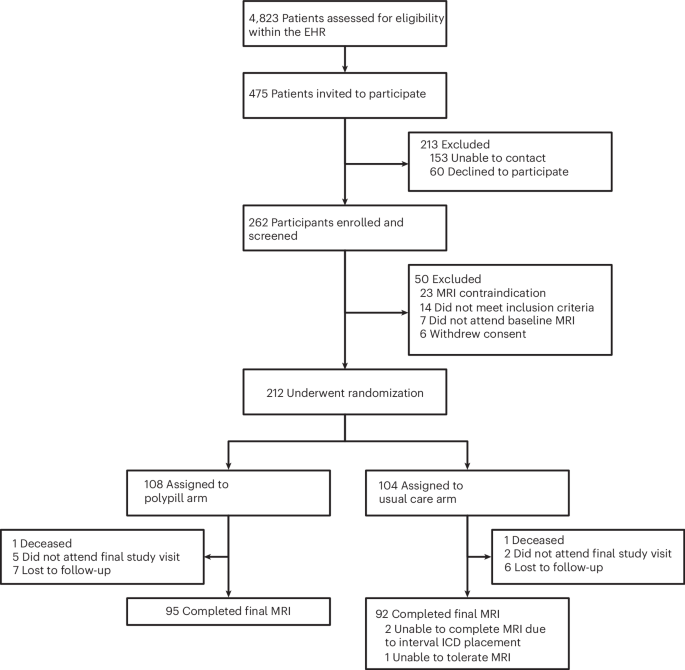
The POLY-HF trial was an open-label, randomized controlled trial conducted between November 2021 and October 2025. The trial protocol was approved by the Institutional Review Board of the University of Texas Southwestern Medical Center (STU2020-1340) and monitored by an independent data safety and monitoring board. Details of the trial design have been published previously, and the trial was registered on ClinicalTrials.gov (NCT04633005)30. The study protocol and statistical analysis plan are provided as Supplementary Information.
Setting and trial participants
The study was conducted at two hospitals in Dallas, Texas: Parkland Hospital, a safety-net county hospital, and Clements University Hospital. Participants were recruited during hospitalizations for HF or at outpatient cardiology visits. Eligibility requirements included age ≥ 18 years, symptomatic HF with LVEF ≤ 40% on screening echocardiogram and not receiving the target doses of quadruple GDMT. Key exclusion criteria included serum creatinine >2.5 mg dl−1 for men or >2.0 mg dl−1 for women, contraindications to GDMT or inability to undergo CMR. All participants provided written informed consent.
Randomization and treatment intervention
Participants were randomly assigned 1:1 to polypill-based therapy or enhanced usual care using computer-generated block randomization stratified by acute versus chronic HF status and Black versus non-Black race. Polypills were created by overencapsulating the following individual medications in an inert gel capsule without chemical combination or compounding: empagliflozin 10 mg, spironolactone 12.5 mg and metoprolol succinate (25, 50, 100 or 150 mg). The rationale for polypill dosing and components has been detailed previously30. In brief, polypill dosing was informed by data from BIOSTAT-CHF demonstrating that achievement of at least 50% of target doses was associated with outcomes similar to 100% of target doses31. Spironolactone was included at 12.5 mg based on evidence of effective aldosterone blockade with a rate of hyperkalemia similar to placebo at this dose32. Four doses of metoprolol succinate were available to allow uptitration to the most commonly utilized doses. A renin–angiotensin system inhibitor was not included in the polypill to facilitate preferential use of sacubitril/valsartan, which requires twice-daily dosing and is not suited for inclusion in a once-daily formulation. The United States Food and Drug Administration provided an Investigational New Drug exemption for the polypills used in this study. The polypill was assembled by an external pharmacy (Pharmacy Solutions). Encapsulation of a 30-day supply was performed by a certified pharmacy technician using a commercially available capsule-filling machine (ProFiller 1100, Torpac).
At randomization, participants assigned to the polypill arm were switched from an individual beta-blocker, MRA and/or SGLT2i to a polypill containing these therapies. Participants received an initial 30-day polypill prescription at randomization. Participants continued a renin–angiotensin system inhibitor or sacubitril/valsartan therapy separately. In the enhanced usual care arm, the study team collaborated with participants’ primary care or cardiology providers to initiate and optimize individual GDMT components. This included providing GDMT initiation or uptitration recommendations, along with study visit blood pressures and heart rates, to participants’ physicians. A study physician provided prescriptions for GDMT for participants who had not yet seen an outpatient provider. Patients were provided beta-blockers, MRAs, and SGLT2i medications at no cost to minimize any financial barriers to GDMT in the enhanced usual care arm.
Follow-up and assessments
Participants attended in-person visits at months 1, 3 and 6. At each study visit, GDMT was assessed and uptitrated toward maximally tolerated doses. In the polypill arm, metoprolol succinate was uptitrated across the four available polypill doses based on clinical response and tolerability. In both arms, recommendations for renin–angiotensin system inhibitor or sacubitril/valsartan optimization were provided to participants’ providers. Participants received 30-day medication refills until maximally tolerated doses were achieved; 60- or 90-day supplies were then dispensed. At the 6-month visit, participants in the polypill arm were transitioned to equivalent doses of individual GDMT components to ensure continuity of care after trial completion. At each visit, vital signs and blood samples were obtained for measurement of the metabolic panel and NT-proBNP. Quality of life was assessed using the KCCQ, and functional capacity was measured using the 6-minute walk test. Medication adherence was assessed using therapeutic drug monitoring with quantitative liquid chromatography-tandem mass spectrometry to measure serum levels of metoprolol and spironolactone, as previously reported33,34. Self-reported medication adherence was assessed at each study visit using the MMAS-8, a validated eight-item questionnaire with scores categorized as high (8), medium (6 to <8), or low (<6) adherence35. CMR was performed at baseline and 6 months on a 3 T system (Achieva; Philips Medical Systems) at the Advanced Imaging Research Center, University of Texas Southwestern Medical Center. Short-axis imaging was used for primary LVEF analysis at baseline and follow-up. In participants with suboptimal short-axis images at either baseline or follow-up (n = 10), long-axis images were used for LVEF assessment. Images were analyzed and confirmed in a core laboratory using standardized software (CVI42, Circle Cardiovascular Imaging) by cardiologist with advanced training and board certification in CMR who was blinded to treatment assignment. Echocardiography was performed according to standard protocols in a core laboratory at baseline and 6 months. In a subset of participants who did not undergo protocol-specified baseline echocardiography, clinical screening echocardiograms obtained at index hospitalization were utilized for LVEF assessment.
Outcomes
The primary outcome was LVEF at 6 months assessed by CMR. Prespecified secondary outcomes included the following: HF hospitalization, ED visit for HF or all-cause mortality; HF hospitalization or ED visit for HF; LVEF by echocardiography; quality of life (KCCQ-OSS); exercise capacity (6MWD); measured and self-reported medication adherence; and NT-proBNP. We also calculated a win-ratio-based composite endpoint that included the following outcomes in hierarchical order: all-cause mortality; ≥5-point improvement in KCCQ-OSS; total HF hospitalizations or ED visits for HF; ≥5% improvement in LVEF from baseline to 6 months by CMR; and adherence by drug monitoring. Participants were classified as adherent if they had detectable serum levels of all tested medications and nonadherent if any tested medication was undetectable.
We characterized use of GDMT in several ways: quadruple GDMT utilization (prescription of all four GDMT classes at any dose); optimal GDMT utilization (prescription of all four GDMT classes with beta-blocker ≥50% of target doses, ACEi or ARB at ≥50% of target dose or any dose of sacubitril/valsartan, any dose of SGLT2i and any dose of MRA; and the mHFC score4,36. These thresholds for defining ‘optimal GDMT’ were selected to mirror the definition used in GDMT implementation studies and registries5,37. Current ACC/AHA/HFSA guidelines recommend titration to maximally tolerated doses, and the ≥50% threshold for ‘optimal GDMT’ reflects a pragmatic benchmark for assessing GDMT implementation rather than a substitute for the guideline-recommended target2. Safety outcomes included serious adverse events, hyperkalemia (serum potassium >5.5 mM and >6.0 mM), systolic blood pressure <90 mmHg, all-cause hospitalizations or death. A complete list of all prespecified outcomes is provided in the study design manuscript30.
Statistical analysis
We estimated that a sample size of 175 participants would provide >90% power to detect a five-percentage point difference in LVEF between treatment groups at 6 months at a two-sided significance level of 0.05. Assuming 15% loss to follow-up and a 6% rate of inadequate MRI quality, we enrolled 212 participants to maintain adequate power.
The primary outcome was analyzed using a modified intention-to-treat approach among participants with available CMR data at baseline and follow-up (excluding 25 participants who lacked follow-up CMR imaging scans). We also performed an intention-to-treat analysis that included all 212 randomized participants, with the last observation was carried forward for participants with missing follow-up CMR data. Participants with missing MRI data on follow-up were censored at the 6-month visit. Three participants had improved LVEF ≥ 55% on baseline CMR, and an additional analysis was performed excluding these participants. For the primary outcome (LVEF by CMR) and echocardiographic LVEF, treatment group differences were assessed using a linear mixed- effects model with maximum likelihood, with treatment group, timepoint (baseline, 6 months) and treatment group by time interaction as fixed effects, and participant as a random effect with adjustment for age, sex, race/ethnicity, NYHA functional class, HF etiology (ischemic, nonischemic), HF chronicity (acute, chronic), eGFR and baseline NT-proBNP. For KCCQ-OSS, 6MWD and MMAS-8, the same modeling approach was used with timepoints at baseline and at 1, 3 and 6 months. Treatment effects are presented as least-squares mean differences with 95% CIs. The composite outcome was analyzed using win-ratio methodology, with each participant in the polypill group compared with each participant in the enhanced usual care group in a pairwise fashion according to the prespecified hierarchy.
Clinical endpoints were analyzed using the Andersen–Gill model for recurrent events with robust variance estimation accounting for within-subject correlation. Both unadjusted and adjusted models were fitted, with covariate adjustment similar to that for the primary outcome. Results are presented as HRs with 95% CIs. The rate of HF hospitalization or ED visit was also analyzed using Poisson regression models with person–time as an offset. Person–time was calculated from the randomization date to the final study visit for participants who completed the study, to the date of loss to follow-up (defined as the date they missed their scheduled follow-up visit), or to the date of death for those who died. Poisson model assumptions were formally assessed using simulation-based residuals; a dispersion test identified significant overdispersion (φ̂ = 2.34, P = 0.02). Accordingly, quasi-Poisson regression was used as the primary analytic approach, a semiparametric correction that retains identical Poisson point estimates while providing conservative, overdispersion-corrected s.e. without requiring additional parametric assumptions about the variance structure. Both unadjusted and adjusted models were fitted, with a similar adjustment as the primary outcome. Results are presented as rate ratios with 95% CIs.
Among other outcomes, NT-proBNP was analyzed using a linear mixed-effects model with timepoints at baseline, 1, 3 and 6 months, with log-transformed values. Results are presented as geometric means with 95% CIs. Between-group comparisons were expressed as geometric mean ratios. Medication adherence, as assessed by drug levels (adherent versus nonadherent), and achievement of optimal GDMT at 6-month follow-up (yes or no) were evaluated using Poisson regression with a log link. Results are presented as rate ratios with 95% CIs.
Sensitivity analyses were performed to assess the robustness of the study findings for the primary outcome. Participants with poor-quality short-axis MRI scans at baseline and/or follow-up (n = 10) were excluded. Secondary analyses were performed for the primary endpoint and for NT-proBNP, with stratification for baseline quadruple GDMT utilization (yes versus no); for the primary outcome by baseline use of all three polypill component classes (beta-blocker, MRA and SGLT2i; yes versus no) and by age group (<60 versus ≥60 years). Treatment effect modification was assessed using a three-way treatment × time × subgroup interaction term. In a post hoc sensitivity analysis, the primary linear mixed-effects models for the primary outcome (LVEF by CMR), echocardiographic LVEF, KCCQ-OSS, 6MWD, MMAS-8 and NT-proBNP were refit using restricted maximum likelihood estimation in place of maximum likelihood estimation.
All analyses were conducted using R version 4.4.1 (R Foundation for Statistical Computing). Statistical significance was defined as a two-sided P value <0.05. The study was monitored by an independent data safety and monitoring board.
Reporting summary
Further information on research design is available in the Nature Portfolio Reporting Summary linked to this article.



