
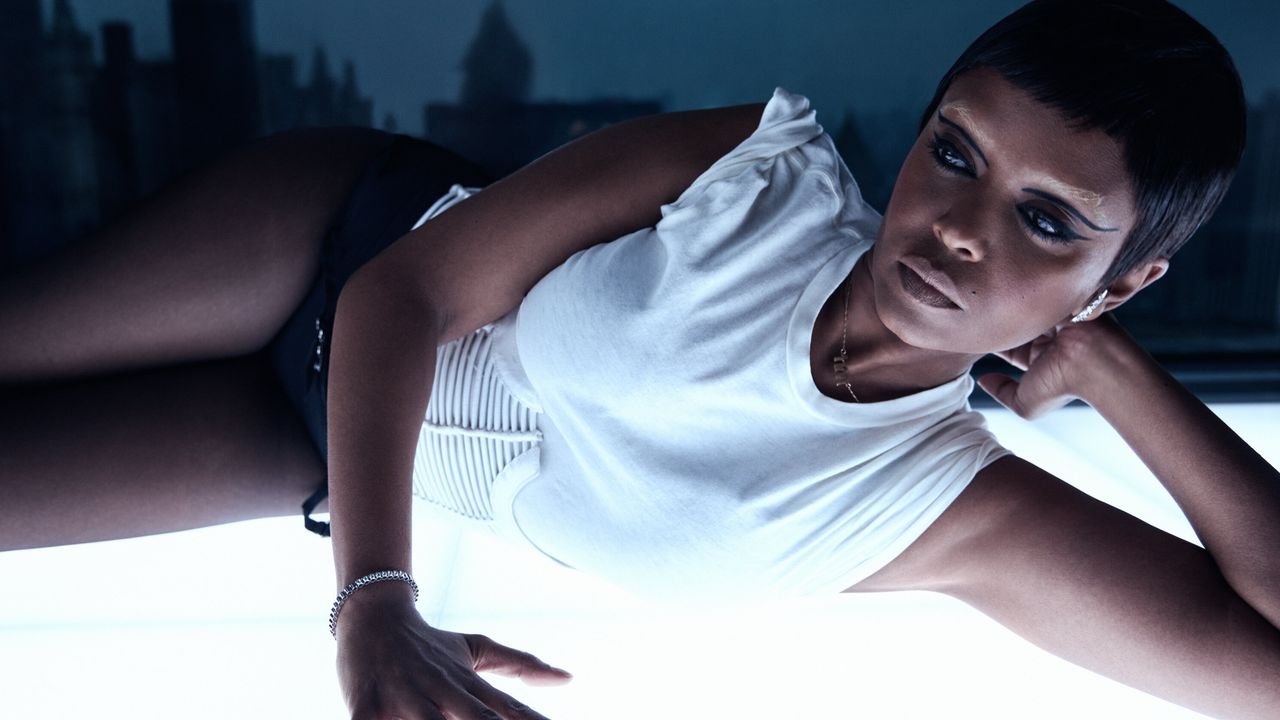
There’s a striking line on the second single, “point blank,” that I sat with for weeks, feeling its weight without fully understanding its meaning: “The bullet set me free.” At first, I wasn’t sure which direction the bullet was headed, away or towards her. Then, during a long walk around Prospect Park, I started to piece together the ego death and subsequent spiritual rebirth that the lyrics traced. That’s the thing about Kelela: she sings in riddles. Her lyrics demand kinetic engagement to unfurl, rewarding the moment mid-singalong, on a crowded dance floor or during a late-night drive with friends, when everything suddenly clicks.
Neva Wireko
“We often feel like we have it worse under patriarchy, but I think the group of people who have it the worst are the people who don’t know what’s happening to them,” she says, when asked to unpack “point blank”’s lyrics. “The indoctrination and the arresting behavior—I think the stuntedness under patriarchy falls mostly on men and boys. There’s a different type of pain that comes from emotional stuntedness and an inability to self-regulate.”
Few artists can articulate sociopolitical realities without sounding didactic. Kelela is one of them. She credits the restraint and subtlety of her favorite films—Chocolat (1988) by Claire Denis, The Sound of Music (1965) by Robert Wise, Bamako (2006) by Abderrahmane Sissako, Dodes’ka-den (1970) by Akira Kurosawa, and Love Jones (1997) by Theodore Witcher—as guiding influences on her songwriting. “I like nuance. I want to see something more that I had to notice, not something that was overperformed,” she tells me.
That sensibility carries through her work, shaping not just how she observes the world, but how she imagines what comes after rupture. People talk about revolution, but rarely about what life looks like after the struggle. “New Life Forms,” featuring Fousheé, imagines that future. The song was inspired by a morning in Rio de Janeiro when Kelela and her friends, still wearing their club clothes from the night before, ran into the ocean at sunrise. It captures that same sense of liberated abandon. The world may be on fire, but they’ll still flirt with strangers, dance barefoot in the sand, and bare their bodies to the sun.
Although she admits that aside from “New Life Forms,” much of the album feels quite sad, Kelela insists she’s not a sad person. “Most of the time me and my friends, we’re laughing,” she reveals. “That’s also reflected in my audience. They are so funny. It really speaks to Black joy and the way we can talk about what’s really going on in a way that actually does not ruin our spirit.”
Fashion is another outlet for her sense of play. She keeps fans on their toes with an ever-changing roster of hairstyles: locs, 713 platinum-blonde bundles, black pixie cuts, shaved heads, and a blunt ginger side bang. She stops short of calling these looks personas. Instead, they reflect her refusal of singularity. She is a Gemini, after all. Fittingly, a few days after our interview, I came across a video of her skipping down the aisle of a vintage shop before striking dramatic poses in front of a mirror, reveling in the simple pleasure of playing dress-up.
New Avatar isn’t another example of her trying on coats for size. It isn’t a departure so much as a return. The first songs she ever made were composed on the guitar. “Pre-mixtape Kels,” as she puts it, “is an indie girly.” In the late 2000s and early 2010s, she was in the indie progressive metal band with her then-boyfriend Tosin Abasi, now the frontman of Animals as Leaders. Still, she’s not abandoning the experimental R&B she’s become known for. “I don’t feel like I have to make a statement that’s like, ‘Fuck R&B,” she says. She says she’s expanding rock’s possibilities. “I actually want to integrate this into what you already know. And that type of evolution is what I find interesting about artists over time.”



