
Maybe we’d been spoiled. Was every World Cup game supposed to be like England’s win over Mexico at the iconic Azteca—mythic and elemental? Or operatic, like Argentina’s comeback over Egypt? Or as karmic as the U.S. loss to Belgium, as satisfying to his critics or as sad to his supporters as Ronaldo’s defeat? France and Morocco seemed to drift along, Morocco letting France control the game without scoring, in the hopes that they might find a crack of opportunity and slip the ball in.
Then, ten minutes into the second half, Michael Olise got the ball and spun down the left channel. He evaded Morocco’s talented young midfielder Bouaddi and danced through several other defenders before sending a beautiful pass to a streaking Mbappé, who skied his shot. The match remained scoreless, but, in that moment, the champagne cork popped.
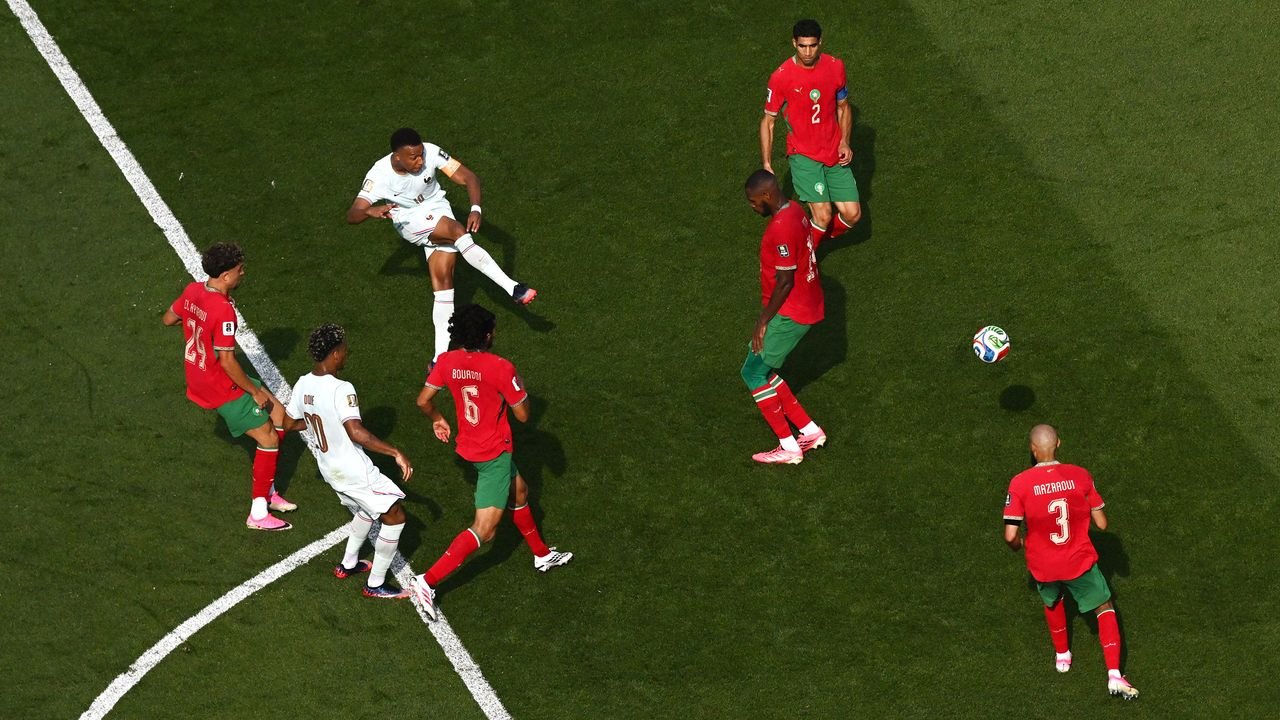
A few minutes after that, in some loose clearing at the top of Morocco’s box, the ball landed at Mbappé’s feet. Morocco’s burly defender Issa Diop was nearly on top of him, but Mbappé didn’t give him time to challenge. Instead, he struck a quick, ferocious shot that swung around Diop and curved into the corner of the goal. It was the twenty-seven-year-old Mbappé’s seventh goal of the tournament—and the twentieth time he’d scored at a World Cup, in twenty World Cup matches.
It was also a 1–0 lead for France, and the match felt, somehow, already, like a romp. Morocco looked demoralized. Six minutes later, Mbappé redirected a pass from Olise to Ousmane Dembélé, who carried the ball up—and then kept carrying it. Mbappé’s hard charge past him drew the defenders. Dembélé saw his opening and hammered a shot into the goal. We have seen comebacks from two goals down in this tournament, but Deschamps felt comfortable enough with the lead to pull several starters well before the game was over—including Mbappé, who appeared to have tweaked his ankle. The outcome was beyond doubt.
After the final whistle, Mbappé, ignoring his injury, started to dance about. And why not? He has been preparing for these moments, France’s moments, his moments, since he was a child. For weeks, a meme has circulated of Mbappé as a warlord, dictating his teammates’ roles. The image became so pervasive that Deschamps, the French coach, felt compelled to declare that Mbappé is actually a lovely teammate, not a despot. But Mbappé’s teammates seemed to be in on the joke, calling him Mobut—as in, Mobutu. It’s funny not because it’s true, but because it’s so absurd. Mbappé is sometimes criticized for arrogance, but whenever he speaks, it’s with a humane je ne sais quoi.
Earlier in the week, after France’s bruising win over Paraguay, a Paraguayan senator launched into a series of vile and racist attacks against Mbappé, questioning his intelligence, his manners, and even his Frenchness. He was, she wrote, “a colonized Cameroonian.” Mbappé responded without hesitation: “Through your recklessness and your brazen racism, the entire world has already forgotten the journey and the historic effort that your players accomplished during this World Cup, making way for an incompetent woman who gives the worst possible image of her country.” He added, “I will never allow people like her the freedom to spread their hatred and racism across the world.”
There are reasons a man might want to wear a nation’s jersey and embody a place, and reasons a man might want to leave it. Mbappé is not perfect, of course, but there are times when he perfectly represents his country. And, if he had chosen to represent his father’s country, Cameroon, or his mother’s country, Algeria, he could have stood beautifully for them, too. Some stories can seem animated by opposition, by rivalry and conflict. But some land simply where they should. ♦



