
In Rome, however, Mendieta had space and light, and—with a studio perched over the academy’s lovely, pine-filled gardens atop the Janiculum Hill—immediate access to the natural world. She could also enjoy new urban pleasures: she screeched around the city in a Volkswagen while yelling through her rolled-down window in demotic Italian; as a native Spanish speaker, the language came easily to her. Friends observed that Mendieta—who had been born in Cuba but, at the age of twelve, was sent to live in exile in the United States—had found in Rome a warm, sociable culture that was reassuringly familiar. Mendieta was vivacious, fast-talking, intense; she got into arguments and very loudly held her ground. In Italy, she could be like this without being stereotyped as a hotheaded Latina, as she often had been in America.
Her experience in Rome was so liberating that her artistic practice opened up, too. Mendieta enlisted a gardener at the academy to help her haul a fallen plane tree into her studio. She obtained other trees, then stripped their bark and burned abstracted silhouettes of human figures into the exposed grain, using gunpowder that she kept stashed in a cookie tin. Ida Panicelli, a curator who got to know Mendieta in Rome, and who would go on to serve as the editor of Artforum in the late eighties and early nineties, recalled recently, “She could finally produce things. Her work was so ephemeral before.”
Four forms that Mendieta made from those tree trunks in Rome make up a freestanding work that’s catalogued as “La Jungla (Totem Grove).” The series will be on display, starting this summer, at the Tate Modern, in London, as part of a wide-ranging exhibition of the artist’s work. The show, one of several recent and forthcoming exhibitions dedicated to Mendieta’s œuvre, will also include some of the works for which she is best known, from her years-long “Silueta Series.” In these pieces, made between 1973 and 1980, Mendieta used the measurements or the outline of her body to mark the ground, or placed herself in juxtaposition with trees, flowers, and other aspects of the natural world. These “earth-body” works, as she often called them, were documented in photographs or on film. Among them is perhaps Mendieta’s most recognizable work, “Imágen de Yágul,” a color photograph that she made in Oaxaca, Mexico, in 1973. In the image, she poses nude within the rocky interior of an ancient Mesoamerican tomb, with sprays of white blossoms rising from between her legs and sandwiched between her arms and her torso, her face hidden by the flowers. The vitality of her body is apparent even as she lies still in a space built for burial; her hands are poised on her hips, and her feet appear to be raised, hovering slightly above the dark shadow of the earth.
Mendieta’s name recognition, at least to the broad museumgoing public, is not comparable to that of, say, Frida Kahlo or Tracey Emin, both of whom have also been celebrated with Tate shows this year. But Mendieta’s art has been increasingly embraced in recent years, especially by young women, who recognize her as a kind of contemporary, even if her work was made half a century ago. Katy Hessel, the author of “The Story of Art Without Men,” a female-centered survey, calls Mendieta “one of the most important artists of the twentieth century.” The essayist and critic Olivia Laing, in her book “Everybody,” from 2021, places Mendieta in the context of the second-wave feminism of Andrea Dworkin, who wrote with incendiary fury about the violence of men toward women, and of Angela Carter, whose novels and short stories vividly reinterpreted myths and fairy tales with a feminine awareness of erotic danger. Mendieta’s work, Laing writes, suggests “the certainty of destruction, and the certainty too of abiding, resisting.” Laing also observed that Mendieta “used violent material in ways that feel full of liberating possibility, but that doesn’t mean she herself was out of harm’s way.”
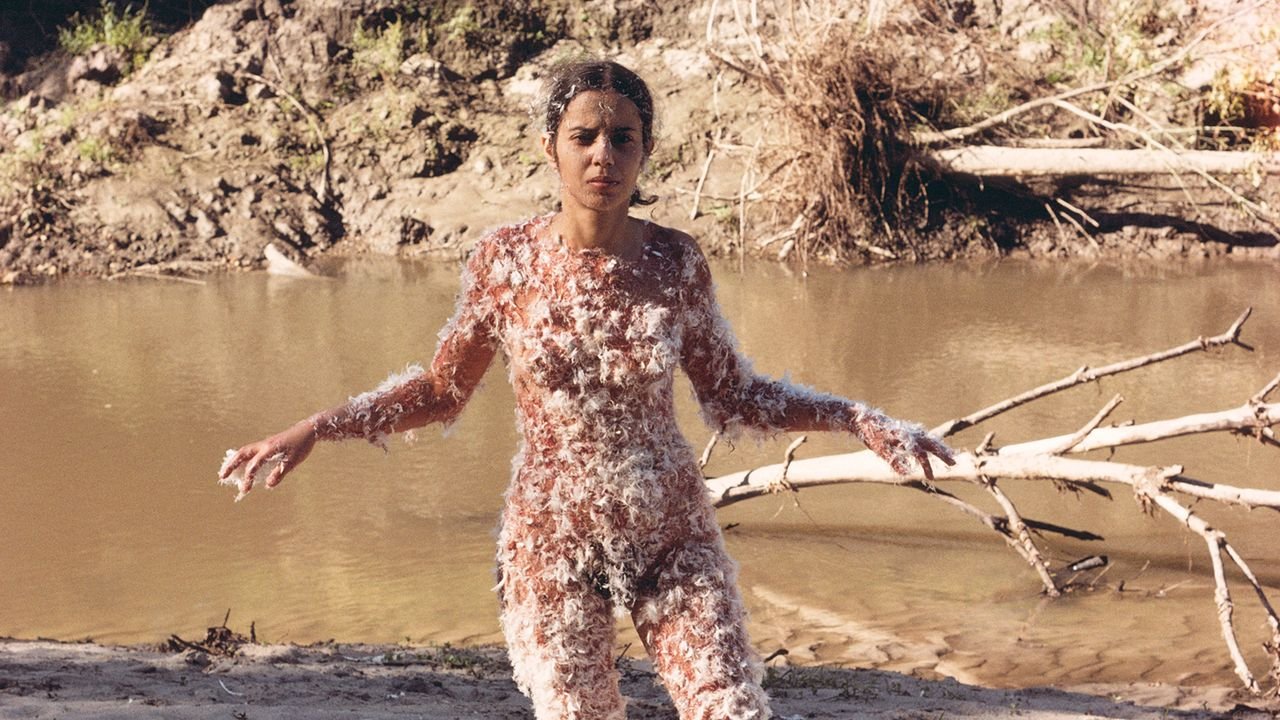
The certainty of destruction was an essential dimension of Mendieta’s art. The outline of a body that Mendieta stamped into river mud would inevitably be eroded by weather and water; the feathers that she stuck to her skin could disperse as she ran naked along a beach. Like all art that incorporates elements of performance and temporality, Mendieta’s is not always easy to access or appreciate, and the films she made documenting her work—the digitization of which has been painstakingly overseen by her niece Raquel Cecilia Mendieta, who now heads the Ana Mendieta estate—can’t fully capture the moments of execution. There are few artists whose pieces more keenly make a viewer wish that aroma could be conveyed by digital reproduction: the vegetal scent of mud, the heady perfume of flowers, the iron reek of blood. Much of Mendieta’s work has a striking visual effect at its core: in “Untitled (Glass on Body Imprints),” a series from the early seventies, photographs capture her through a sheet of glass onto which she has pressed her face and body, smearing her nose or cheek or mouth into a distorted fleshy mass—a gesture that the British artist Jenny Saville would echo some twenty years later, in her collaborations with the photographer Glen Luchford. Other Mendieta works are more private, even secretive, including the “Rupestrian Sculptures,” made in the early eighties, in which Mendieta carved figures into the walls of limestone grottoes in Cuba. Mendieta was active at a time when female artists, especially female artists of color, had so much less currency than their male counterparts that being overlooked, however much it was resented, offered its own kind of freedom. It’s impossible to view Mendieta’s output and not think about the physical stamina and cultural daring that she must have had—not only to make art from her exposed body but also to hide herself away and make work that might only ever please or satisfy herself.



