
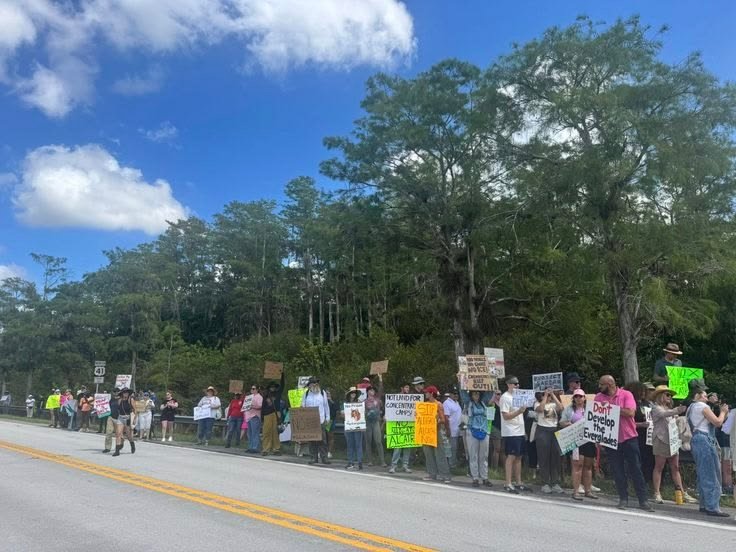
An environmental group seeking to punish state operators of the “Alligator Alcatraz” immigration lockup for alleged pollution of the Florida Everglades has withdrawn its case, the Center for Biological Diversity announced Monday.
Because the nation’s first state-run migrant detention center is fully closed, the environmental nonprofit says, its goal has been accomplished and there’s no need to continue its federal lawsuit.
“We achieved the desired result with our Clean Air Act lawsuit. This detestable facility’s air pollution will not continue,” Ryan Maher, a staff attorney at the center, said in a written statement.
The center filed the case two months ago in the federal Southern District of Florida, alleging the detention center was emitting hundreds of tons of toxic gases into the atmosphere without a permit, flouting the Clean Air Act, and demanded more than $120,000 per environmental violation per day.
It alleged the site’s 100 diesel-powered lighting towers and up to 200 diesel-powered generators — employed without a special air quality permit — consumed nearly 8 million gallons of fuel on an annualized basis and emitted hundreds of tons of carbon monoxide and nitrogen oxides.
But the June closure of the facility, officially cleared out last weekend, has brought an end to any potential air pollution. Gov. Ron DeSantis confirmed last month that the center had been emptied of detainees and was being torn down. This came on the heels of persistent, weeks-long rumors that officials were quietly planning to end the temporary facility — which saw more than 22,000 detainees in its 11-month lifespan — despite federal and state authorities denying any “official” closure talks were taking place.
Despite this, the center vowed that its legal battles with the state are far from over.
“The fight continues to ensure that the site is fully remediated and the Trump and DeSantis administrations are held accountable,” Maher said.
He referred to another suit against the state brought by the center and environmental groups including Friends of the Everglades, the Miccosukee Tribe, and Earthjustice. That case alleged that Florida violated the National Environmental Policy Act in constructing the facility because they failed to complete a federal environmental study ahead of building.
First filed in June 2025, mere days after work began on the Everglades site, the case has ping-ponged across the state — with vastly different results. At first, a federal trial judge in Miami sided with the advocates and ordered the facility quickly torn down and deactivated.
But a federal appellate court in April found that the facility didn’t have to comply with federal environmental law because it was entirely state-run and — at the time — lacked federal funding. That three-judge panel kicked the case back to the lower court, which is expected to reexamine the matter sometime this summer.
The federal dollars referred to in the court decision involves a $608 million reimbursement long promised to Florida for operating the facility. At the time of the ruling, the state had received nothing but vague assurances that the money would come. In May, officials received the first $58 million tranche.
“We and our partners will not stop until every piece of infrastructure tied to this facility is gone for good, the damage is assessed, and Big Cypress is restored,” Maher added.



