
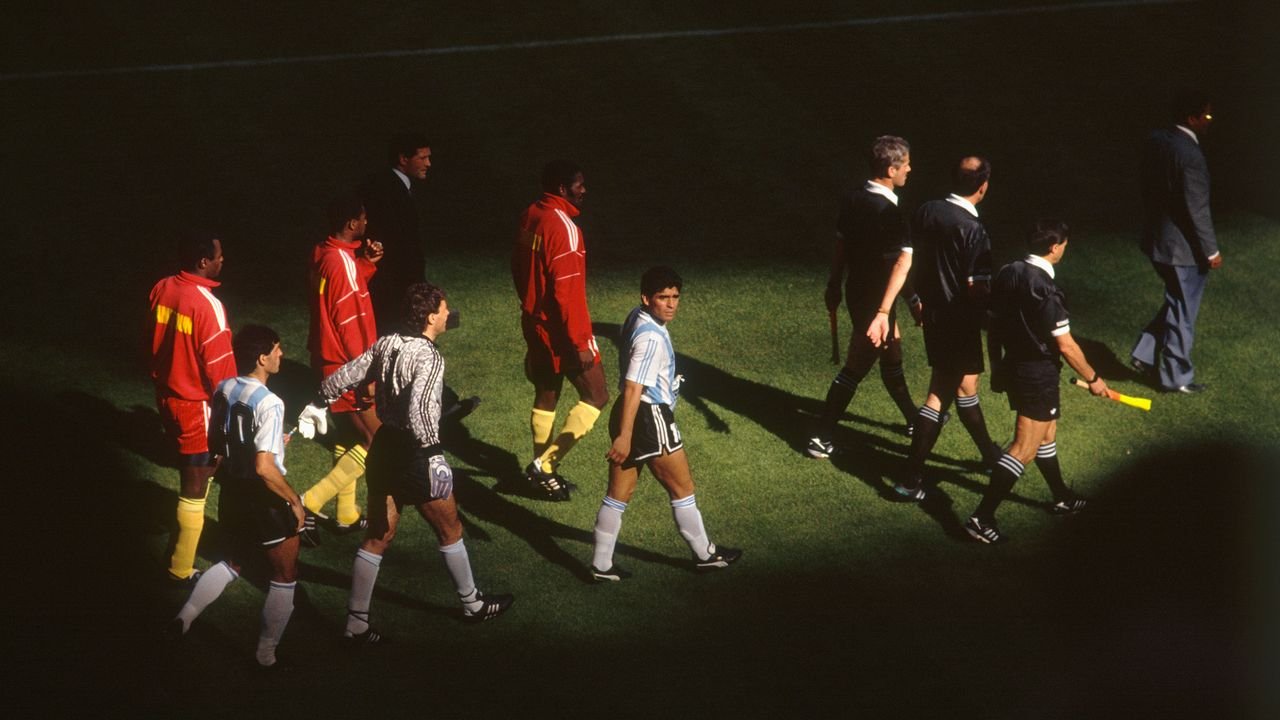
The first time I watched Argentina play live, I cried. It was the opening match of the 1990 World Cup, in Italy. I was six years old, sitting with my twin brother in our grandparents’ living room, thousands of miles away, in Kolkata, India. Our anticipation had been building for months. We were enamored of the Argentinean team and its talismanic star, Diego Maradona, whose exploits, which had led Argentina to victory in the previous World Cup, we watched repeatedly on VHS cassette. We would thunder around our family garden emulating the diminutive, mop-haired forward, our limbs flailing as we zipped past phantom opponents, tumbling into the grass like Maradona did when brought down, as he often was, by exasperated defenders. At bath time, we snapped our towels in the air, aping the footage we had seen of a victorious, bare-chested Maradona jumping in his team’s locker room and singing “¡Vamos, vamos, Argentina!” But, during the opening match, in Milan, against Cameroon, there was no triumph: the unlikely African side achieved one of the most famous upsets in World Cup history, grinding out a 1–0 victory against the lacklustre Argentineans. While relatives looked on in bemusement, my brother and I burst into tears, inconsolable. (We ended up crying again when Argentina lost to West Germany in that World Cup’s final.)
For much of the decades since, I’ve carried that strange grief for, and devotion to, a country that’s not my own. So have many others: a vast portion of humanity, numbering in the billions, finds itself stateless at the World Cup. I spent my childhood and much of my adult life as a citizen of India, which has never qualified for the tournament. Argentina filled a void. Embodied by Maradona, successive Argentinean national teams played with flair and toughness and an element of chaos, often on the edge of nervous breakdown. The team’s dramas coincided with years of wider chaos in the country, as cycles of hyperinflation and bailouts bedevilled its economy. As I grew older, I felt a sort of kinship with Argentina’s people, and an admiration for their fanaticism; I also just loved the swagger of multiple generations of attackers, from Maradona to the superstar who surpassed him, Lionel Messi, and many lesser-known, but hardly less dashing, talents who played in their shadows. Argentina fans, meanwhile, are unique in all sports—other countries have fan bases that get loud, but a stadium full of Argentineans activates something primordial. Their songs crescendo in waves, surging like radio static, echoing like a drum. You could spend hours on YouTube listening to the chants of various Buenos Aires club teams, marvelling at the atmosphere, which pulls in legions of tourists.
The albiceleste, as the Argentinean national team is known, are beloved all over South Asia, but especially among Bengalis, who are soccer crazy. Every four years, slums in Kolkata and in Dhaka, the capital of Bangladesh, get painted over in the respective colors of Argentina and Brazil, soccer powerhouses that have been embraced with astonishing fervor across the Global South. Maradona and Messi have paraded through Kolkata on multiple summer tours, mobbed by thousands at the airport and on the streets, hailed as gods coming down to earth. Huge statues of both players were erected there. (Last month, the seventy-foot fibreglass-and-iron replica of Messi was deemed unsafe and taken down.) When Maradona died, in 2020, after a lifetime of substance abuse and other poor choices, candlelight vigils and shrines sprung up across the city; the state government in Kerala, another soccer hotbed, in southwest India, declared a two-day period of official mourning. In 2011, my brother and I were among more than seventy thousand people who went to see Messi’s Argentina play a friendly against Venezuela inside Kolkata’s cavernous Salt Lake Stadium. The stands were a sea of blue and white, with no Venezuela shirts in sight. Everyone, it seemed, was there for Argentina, for Messi, for a crumb of the communion they otherwise never got to taste.



