
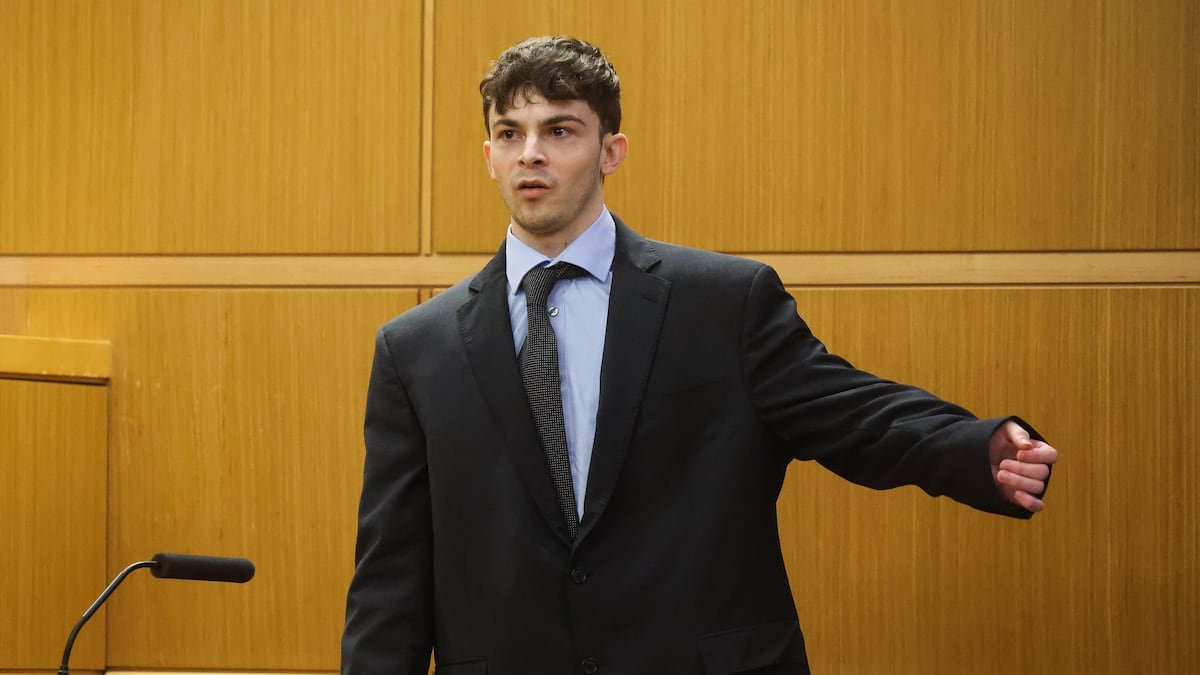
When Stuart Beck took the witness stand at his murder trial Thursday, he told the jury he meant to shoot Michael Conrad inside a Clearwater apartment in 2022.
“I didn’t mean to kill him, but I meant for the gun to go off,” he said.
By that point, Beck had been sitting in front of the microphone for over an hour. Assistant State Attorney Nash Licona was pressing him about why he said the shooting was self-defense when he previously told police it was an accident.
Beck, 25, faces a charge of first-degree murder in Conrad’s killing. Prosecutors say the shooting was committed in a jealous rage because Conrad was sleeping with Beck’s ex-girlfriend.
On the stand, Beck told attorneys multiple times that he was nervous. He spoke in short sentences as his brown eyes darted between the jury box and his family seated in the gallery.
The 2½-hour testimony, at times contradictory, shed light on how Beck’s recollection of the shooting has changed in the four years he’s been incarcerated.
Accidental shooting, justifiable use of force or murder?
When Kaitlyn Nash-Koehler testified Tuesday, the 24-year-old said she and Beck broke up in February 2022.
Although Beck’s name was still on the lease at Bay Cove Apartments, where she still lived, she said all of his belongings were gone except for his TV and a smoking tray.
She said she began spending time with Conrad but still hung out with Beck on a casual basis. She was with Beck on the Fourth of July, but with Conrad the following night.
That’s not how Beck remembers it, he said from the stand.
Beck contends that he and Nash-Koehler got back together around May, and he had moved back into the apartment. They had talked about buying a house together and raising kids, he said.
On July 6, 2022, Beck thought Nash-Koehler was staying at her mother’s house, he said. He showed up to the apartment around 2 a.m. and saw her car in the parking lot.
He unlocked the door with his key, he said, but the security latch barred his entry.
He called Nash-Koehler and told her to unlock the latch and let him in.
“She was just like, ‘No, just leave,’” Beck said. “I told her, ‘Come unlatch the door or I’m going to break it.’ She didn’t come unlock the door, so I kicked it. I had my pistol in my pocket.”
Beck said it was dark in the apartment, and he couldn’t see. Before he reached the light switch in the bedroom, he said, Nash-Koehler jumped on him and grabbed his backpack, pulling him backward.
Beck said that’s when he saw Conrad, whom he had encountered at the apartment a few months earlier, when he and Nash-Koehler were separated. Beck said Conrad and two of his friends beat him up that day.
When Beck saw Conrad in the bedroom, he said, he felt “in fear for my life.” Conrad started approaching him, he said, while Nash-Koehler continued pulling him from behind.
Beck had the gun at his side but started raising it to get it out of Conrad’s reach, he said.
“We were basically wrestling for the gun and moving around the general area,” he said. “I had tried to raise my hand to get him to let go, and at that time he had his other hand on the gun, and I started losing grip, and I tried to hit him with the gun to get him to let go, and he didn’t let go.”
That’s when Beck pulled the trigger. “I felt it was in my best interest to shoot him at that time otherwise he would get the gun.”
During cross-examination, Licona asked Beck to clarify that his testimony was that he showed up to the apartment with no intention of hurting anybody. Beck said yes.
Licona also pressed him on the fact that Nash-Koehler said Beck told her on the phone that he saw Conrad’s truck in the parking lot.
Beck denied that he knew Conrad was there before he barged in.
“You’re telling us that you walk into your apartment with your girlfriend, and you find her cheating on you, and you want us to believe you’re so scared for your life you pull out this gun?” Licona asked, holding up the .40-caliber pistol.
Beck said he always carried the loaded gun with him.
At the most climactic point of the cross-examination, Licona asked Beck if he shot Conrad on purpose.
“I shot him on purpose,” Beck responded.
“You killed Michael Conrad on purpose?” Licona asked.
“Yes.”
“And you want us to believe it was an accident?”
“That’s correct.”
When Licona asked why he didn’t call 911 or bring the gun right to police, Beck said he panicked.
“It was just too much for me,” he said. “I’ve been through a lot, previous encounters with death and stuff. I know Kaitlyn’s there, so I know she’s going to call the police. I didn’t know if what I did was justifiable.”
Beck went to Hernando County and hid the gun in a plaid purse he found a few hundred feet into the woods, he said. After he was arrested two days later, he led police to recover the weapon.

2 deaths shaped his life as a teenager
Suzanne Beck told the jury her son’s demeanor changed at age 15 after he experienced two deaths in close succession.
First, Beck found his grandfather dead at his home when he and his brother went to check on the man, Suzanne Beck said. He called his mother hysterically crying.
A few months later, Beck listed a dirt bike for sale on Craigslist, and he and his father drove to East Tampa for the exchange. When the buyer tried to rob them, Beck’s dad was shot 10 times.
“He was just crying and saying that he tried CPR and called 911 and did everything he could,” Suzanne Beck said. “He was covered in his father’s blood.”
Beck was diagnosed with post-traumatic stress disorder and suffered from anxiety and nightmares, she said.
Michael Collins, a neuropsychologist who evaluated Beck ahead of the trial, testified that post-traumatic stress disorder can emotionally stunt an individual.
Before jurors entered the courtroom Thursday, prosecutors argued that testimony about the father and Beck’s mental health are not relevant to Conrad’s killing, citing case law.
Pinellas-Pasco Judge Philippe Matthey agreed to prohibit Beck from testifying directly about his father’s death, but he allowed the defense to present the neuropsychologist as long as he did not speak to the validity of a self-defense claim.
Last year, Matthey ruled that the shooting was not justifiable under Florida’s stand your ground law.
If convicted as charged, Beck faces a mandatory life sentence. His attorneys are asking the jury to consider lesser charges of second-degree murder or manslaughter.
“This is a heat-of-passion shooting; this is a love triangle,” defense attorney Scott Tremblay said before Beck testified. “This is a manslaughter case at best.”
The jury will deliberate Friday after hearing closing arguments.



