
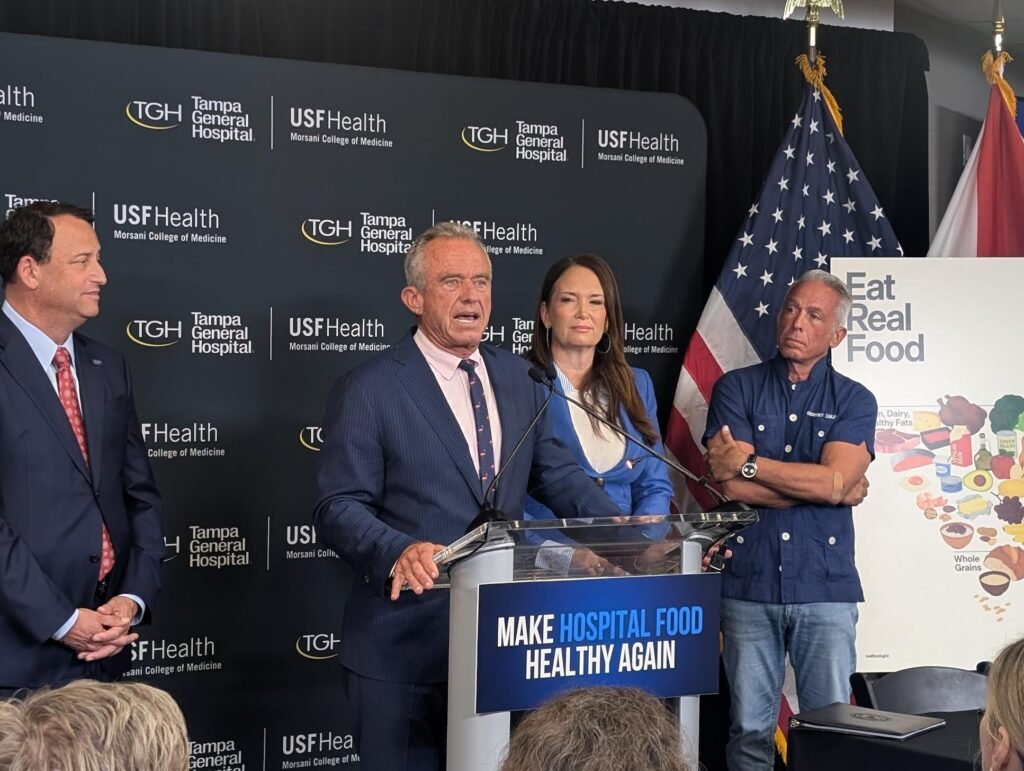
Tampa General Hospital CEO John Couris, HHS Secretary Robert F. Kennedy Jr., USDA Secretary Brooke Rollins, and chef Geoffrey Zakarian at a press conference at Tampa General Hospital on July 16, 2026. (Photo by Mitch Perry/Florida Phoenix)/
TAMPA — U.S. Department of Health & Human Services Secretary Robert F. Kennedy Jr. and U.S. Department of Agriculture Secretary Brooke Rollins came to Tampa General Hospital Thursday to celebrate hospital officials signing on to the Trump administration’s new dietary initiative, the ‘Make Hospital Food Healthier’ pledge, designed to improve hospital food.
“It’s really incredible that we’ve been feeding patients this pudding and Jello with sugar drinks when 50% of them are pre-diabetic or diabetic and, for a long time, we’ve understood the relationship between food and health and recovery and recidivism and all of these issues, and it’s good to see the leadership from John Couris and this extraordinary hospital,” Kennedy said, referring to Tampa General’s president and general manager.
While Kennedy, Rollins, and the Trump administration have been rolling out their plan to provide healthier food to patients, Tampa General under Couris’ leadership and with celebrity chef Geoffrey Zakarian have had a head start, deciding about two-and-a-half years ago it was time to redesign their menus, rebuild their kitchens, train their staff, and collaborate with physicians at the University of South Florida on building a menu designed to raise the quality of food they serve their patients.
Hospital officials said Thursday that since the new menu was completed in October, patients have reported a 53% increase in food quality.
Kennedy’s nomination as HHS secretary was controversial because of his long track record of questioning vaccine safety. His “Make America Healthy Again” (MAHA) platform has earned more popular support.
He said Thursday that one of the first things he and Rollins worked on after the Trump administration 2.0 began was to invert the traditional food pyramid by prioritizing proteins, dairy, fruits and vegetables, whole grains, and healthy fats and reducing highly processed foods. HHS and the USDA released that document in January.
“When Brooke and I came in, we were handed the dietary guidelines that had been worked for four years during the Biden administration,” he said. “They were 453 pages long. They were incompressible, and it reflected the mercantile impulses because they were written by food industry lobbyists.
“And the same impulse had driven Fruit Loops at the top of the old food pyramid. Which isn’t even a food, it’s like a foodlike substance. And we brought together the best scientists and nutritionists in the country from the biggest universities in this country, and we basically locked them in a room for a year, and we said we want something under 10 pages that everybody can understand.”
In March, the Centers for Medicare and Medicaid Services sent a notice telling hospitals they would be required to follow the new Dietary Guidelines for Americans to continue to receive Medicaid and Medicare payments.
Healthy template
That memo said that hospital leadership and nutrition departments must evaluate:
- Elimination of refined grains, replacing them with 100% whole grains.
- Prioritizing minimally processed protein sources, including plant-based options.
- Emphasizing vegetables, fruits, legumes, nuts, seeds, seafood, and healthy fats.
- Making sure vegetables and proteins are baked, broiled, roasted, stir-fried, or grilled rather than deep-fried.
- Eliminating processed meats and foods that are high in added sugars, sodium, and artificial additives.
- Making sure meals contain less than 10 grams of added sugar, unless clinically appropriate.
Kennedy said “a template” for serving healthy foods in hospitals had been created at Tampa General, and that as one of the largest hospitals in the country (with 1,000 beds, soon to go up to 1,200 beds), “we can say that, ‘If they did it, you can do it.’”
Kennedy said that the concept of providing healthier meals will spread across government departments.
“Pete Hegseth is cooperating with us and doing it on all of the military bases,” he said. “Two-thirds of the military meals were thrown out because the only metric they used in purchasing food commodities is shelf life. Nobody was looking at nutrition. And the troops weren’t eating it.”
He added that healthier foods would also be introduced in schools, prisons, and military bases.



