
On May 1, the Academy of Motion Picture Arts and Sciences announced a major change to the eligibility rules for the best international feature film. No longer would a film have to be nominated by the country of origin; henceforth, it could land in the pool of nominees by winning an award from a list of high-profile international film festivals. Moreover, in recognition of the fact that a person not a nation actually directs the film, the director’s name and not the country’s will be engraved for posterity on the statuette plaque.
The new protocols for the best international film category, née best foreign language film, are the latest rejiggering in what has historically been one of the more contentious and confusing Oscar categories. Of course, under whatever rules, Oscar validation can mean the difference between multi-platform distribution and oblivion in the American marketplace.
So, despite the provincialism of allotting a mere five slots to the output of the rest of the planet, foreign filmmakers have been eager to perform due obeisance before the Academy, which since 1957 has granted offshore films a regular seat at the festivities. (The first winner was Federico Fellini’s La Strada.) Before that, the Academy doled out an Honorary Oscar when the impact and excellence of a foreign film became too conspicuous to ignore, as with Italy’s The Bicycle Thief in 1949 or Japan’s Rashomon in 1952. The honor was voted on by the Board of Governors, to save the full Academy membership from reading subtitles. (Today the nominees are chosen by an Academy-approved Select Committee). Costa-Gavras’s Z (1969), nominated for best picture and best foreign language Film (it won the latter), was a landmark border crossing and, in 2020, Bong Joon Ho’s Parasite broke the language barrier by becoming the first non-English language film to win best picture.
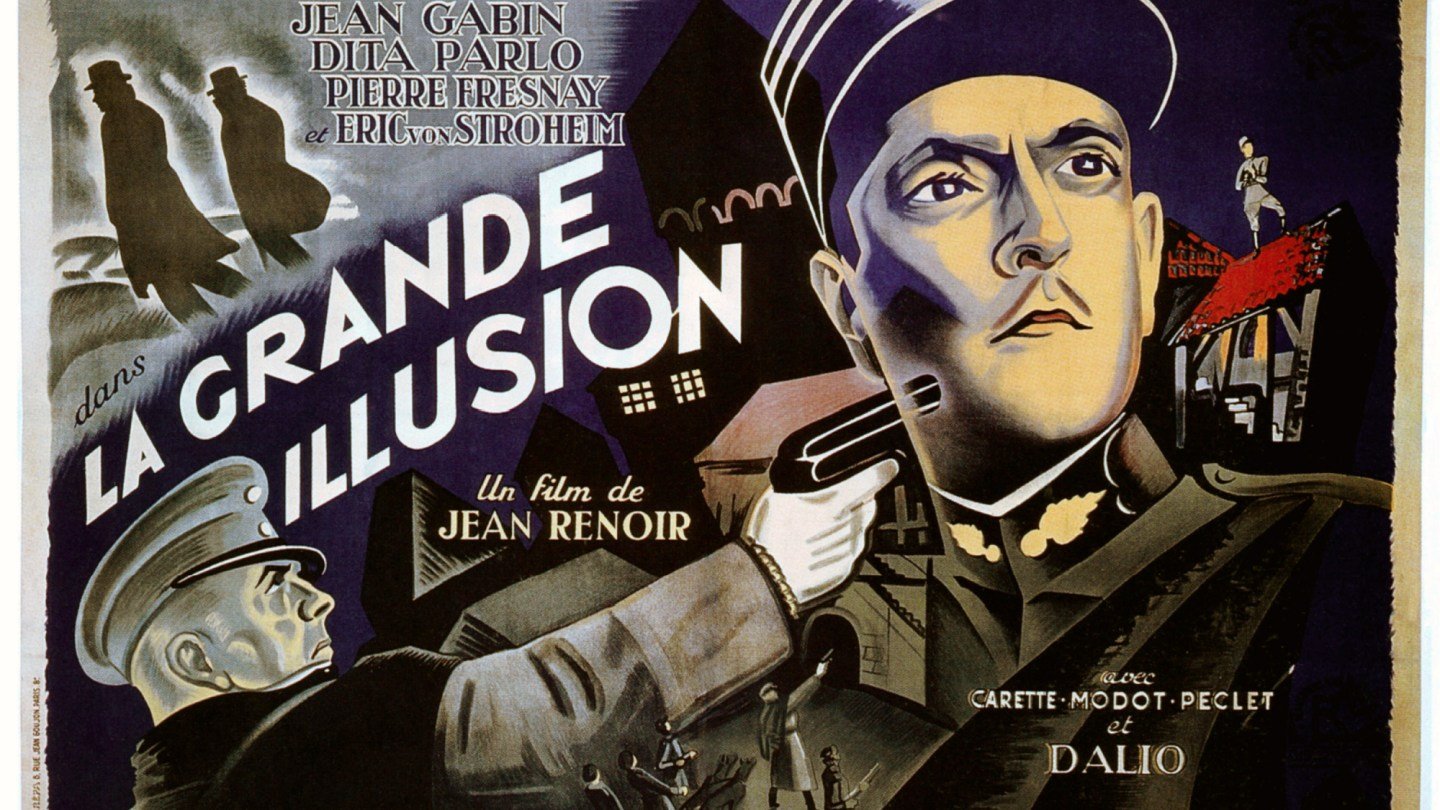
However, of all the foreign-born incursions into top-tier Oscar territory, the first breakthrough is the most curious. At a time when subtitled films were a species of exotica, and with no major studio backing, Jean Renoir’s antiwar classic La Grande Illusion (1937) — easily translated as Grand Illusion — landed a nomination in the best picture slot, which was then called outstanding production and included ten candidates. (The other nominees were Boys Town, The Citadel, Pygmalion, Test Pilot [all MGM], Four Daughters, The Adventures of Robin Hood, Jezebel [Warner Bros.], Alexander’s Ragtime Band [20th Century-Fox] and You Can’t Take It with You [Columbia]. The last, directed by Frank Capra, won.) To be sure, in 1949 a British invader, Laurence Olivier’s Hamlet, won best picture, but it was at least in English and credited to an A-list screenwriter. But how did Grand Illusion manage to crash the exclusive party?
Poster art for ‘La Grande Illusion’ circa 1937.
In 1938, Jean Renoir was not a known name in the US, much less a world-famous auteur. It seems unbelievable that two of his early masterpieces — Boudu Saved from Drowning (1932) and The Crime of Monsieur Lange (1936) were not released in the US until 1967 and 1964 respectively. Renoir’s version of Maxim Gorky’s The Lower Depths (1936) and his Popular Front documentary The People of France (1936) got only modest arthouse circulation and critical attention, with reviewers sure to identify the director as “the son of the famous French impressionist Auguste Renoir.” Only after Grand Illusion was Renoir acknowledged in his own right as a French master in another medium.
Made in Paris by Les Realisation d’Art Cinematographyque, Grand Illusion was distributed stateside by World Pictures Corp., operated by the legendary foreign film magnate Irvin Shapiro, who began his career importing The Cabinet of Dr. Caligari (1920) and capped it by exporting The Evil Dead (1985). Like almost all films about the Great War made in its aftermath but before its sequel, it is somber in tone and pacificist in sentiment. There are no scenes of thrilling aerial combat or over-the-top attacks in no man’s land. “A War Story without War Scenes!” warned the advertising. Renoir knew the material first hand, having served as both a cavalry officer and a pilot in the Great War and been wounded twice.
Two French pilots — Captain de Boeldieu (Pierre Fresnay), a white-gloved aristocrat, and Lieutenant Maréchal (Jean Gabin), a gruff former machinist — are shot down over German lines by the ramrod-straight Prussian aviator Captain von Rauffenstein (Erich von Stroheim). A chivalric knight of the air, von Rauffenstein plays the gracious host to his prisoner-guests before they must depart for a prison camp. The accommodations in the German POW camp are not half bad and the company is great. De Boeldieu and Marechal encounter a diverse crew of colorful countrymen — a comedian, a literary scholar, and the son of a wealthy Jewish family, Lieutenant Rosenthal (Marcel Dalio), a stalwart solider who generously shares his bountiful food parcels. (The affirmative portrait of Rosenthal was certainly by way of apology for the treatment of the most famous Jew in French military history, Captain Alfred Dreyfus, who had just died in 1935.)
Of course, the prisoners are digging a tunnel to escape. “A golf course is for golf, a tennis court for tennis, a prison camp for escape,” observes de Boeldieu. When not excavating and eating Rosenthal’s bread and cheese, the men rehearse for a musical comedy performance featuring a chorus line of men in drag. The shenanigans are interrupted by news that the French have retaken Fort Douaumont, marking the end of the carnage at Verdun. In an outburst of patriotism, the prisoners rise to sing “La Marseillaise,” a scene that ranks as the second most stirring rendition of the French National anthem in motion picture history.
As recidivist would-be escapees, de Boeldieu, Marechal, and Rosenthal are transferred to an impregnable medieval fortress, commanded by Captain von Rauffenstein, now burnt, broken in body, and wearing a neck brace. Knowing their days of bloodline privilege are numbered, the German and the French aristocrat bond, their class affinities binding them more tightly than the uniforms that separate them. Renoir told film historian Arthur Knight that if a French farmer and a French financier dined together, they would sit in uncomfortable silence, but if a French farmer and a Chinese farmer dined together, they would find plenty to talk about.
Still, a French prisoner must do his duty: de Boeldieu gallantly stages a diversion so Maréchal and Rosenthal can escape, during which a reluctant von Rauffenstein is forced to shoot his class comrade. On his death bed, de Boeldieu accepts the fortunes of war as Von Ruffenstein grieves.
The third act finds Maréchal and Rosenthal scurrying through the woods and fields, squabbling and miserable, until they come upon a farmhouse run by a fetching German war widow (Dita Parlo) with an adorable daughter. She takes them in, gives them shelter and food, and falls hard for Marechal, 1937 being the year of peak Jean Gabin. In too short a time, though, the pair must leave the idyll. Against odds, they escape into Switzerland. The guards on the German side see no point in firing as, in the distance, the men plod through the snow to freedom. In Great War territory, this counts as a happy ending.

Marcel Dalio, Jean Gabin and Pierre Fresnay in ‘La Grande Illusion.’
Everett
On June 8, 1937, La Grande Illusion premiered at the 1250-seat Marivaux Theater in Paris, to a packed house made up of “members of Paris society, Paris cinema and theater circles, writers and press representatives” who, at the end, “gave long and loud applause.” The French critics, then as now a surly and hard-to-please lot, were unanimous in praise: “an important and extremely happy event in French cinema history” (Le Temps); “a masterpiece of cinema”; (Mariane); and “a very fine film, a beautiful human work” (Oeuvre). In the theater that night was Pierre Autre, Motion Picture Herald’s man in Paris, who first sent word back to American readers, a rave that has stood the test of time. “La Grande Illusion is, by far, the best French film of the year, up to date — in fact, it is one of the best French films ever made.” The Hollywood Reporter also predicted that “the smash hit” should “go well in the States.”
It did better than well. In America, Grand Illusion became the most widely circulated and highly praised foreign film of the 1930s.
On Sept. 12, 1938, Grand Illusion opened at the newly refurbished Filmarte Theater in New York with columnist Dorothy Thompson, novelist Fannie Hurst, playwright Clifford Odets, and actress Aline MacMahon in attendance. The Filmarte was run by a pioneering importer of foreign film, Jean H. Lenauer, whose arthouse was emblematic of what were called “sure seaters” in the trade because a small but devoted clientele was sure to buy a ticket to whatever foreign film happened to be booked. Grand Illusion played the Filmarte for a record-breaking 27 weeks. The lobby was decorated with reproductions of Impressionist paintings by Auguste Renoir.
Meanwhile, the word on Grand Illusion was getting out beyond the insular arthouse crowd. Samuel Goldwyn called it “the most brilliantly directed film I have seen in years — a challenge to Hollywood.” Producer Walter Wanger, director Mervyn LeRoy, and the actresses Lillian Gish and Helen Hayes also offered endorsements. The New York Film Critics named Grand Illusion the year’s best foreign film. The National Board of Review dispensed with qualifiers and named it “the best film of the year from any country.” The Film Daily ran out of superlatives and finally just said, “you owe it to yourself to see this picture — it will send you out thinking.”
Some of the best notices went to von Stroheim, basically radioactive in Hollywood since Joseph P. Kennedy booted him off the set of Queen Kelly in 1929. In The New York Times, Frank Nugent chided Hollywood for its “folly in permitting so fine an actor to remain idle and unwanted.” Von Stroheim responded in character. “You can’t expect a director to enjoy acting when directing is the nearest thing to being God,” he said. “I have enjoyed acting in pictures directed by a director called Eric von Stroheim, and written by a writer called Eric von Stroheim.”
To break out of the arthouse ghetto, however, Grand Illusion needed a transit visa into the mainstream exhibition market, namely a Production Code seal. On July 29, 1938, Irvin Shapiro duly applied for the imprimatur from Hollywood’s censorship regime. Unsurprisingly, the Code guardians asked for a few “slight deletions” — a shot of a prisoner rubbing a pair of silk underwear, the use of the word “damn,” and a reference to a prisoner who tries to escape dressed as a woman (“Quite amusing,” comments a friend. ”Not so amusing when a sergeant mistook me for one,” he replies.). Also concerning was “the racial angle in reference to Rosenthal” — that is, an antisemitic insult aimed at him once in anger, once in jest, by Maréchal. But this was a matter left “solely for [Shapiro] to decide.” Shapiro decided to keep the insults. On Nov. 23, 1938, after the requested cuts were made, the PCA issued Grand Illusion a Code seal. The Roman Catholic Legion of Decency also gave it clean bill of health, rating it “AI: unobjectionable for adults.”
With the Code imprimatur, Grand Illusion spread out beyond the arthouses and played the RKO, Warner, and Publix circuits. Reviews and ads were careful to explain to the first-time foreign filmgoers that “English titles translate the dialogue.” The box office thrived on word of mouth, repeat business, and high school French teachers dragging their classes to screenings.
Grand Illusion was also fortunate to hit the crest of an antiwar zeitgeist. Another great war, with less chivalric Germans, was looming on the horizon: in March 1938, the Nazis annexed Austria; October saw the invasion of the Sudetenland, and on Nov. 9-10 the Reich-wide pogrom now known as Kristallnacht was launched. For many Americans, a film about what Variety called “the futility of mankind’s armed conflict” had ominous relevance.
Not that the antiwar message was universally embraced. Though Grand Illusion won “the most artistic ensemble” award at the Venice Film Festival in 1937, it was banned by the Italians under pressure from Nazi Germany on the grounds that the film “has an anti-German tendency and offends Germany’s honor.” Actually, what offended the Nazis was the sympathetic portrayal of Rosenthal. The Nazis also took more active measures to suppress the film. In 1938, film historian Herman G. Weinberg reported that on the very day that the Nazis moved in to Vienna [March 13, 1938], “Grand Illusion was taken off the screen in the middle of a reel by the storm troopers.” Renoir regarded the shut-down “as a signal honor — and a decoration.”

Jean Gabin, (left), Pierre Fresnay, (center), Marcel Dalio, (right) in ‘La Grande Illusion.’
In America, the reception of Grand Illusion was less violent but still passionate: isolationists and anti-Nazis alike adopted the film for their cause. On Jan. 12, 1939, a special “Congressional Night” screening of Grand Illusion at the Belasco Theater in Washington, DC was arranged for senators and congressmen because, said the management, “the picture’s indictment of warfare will be a message of interest to not only the Committees of Foreign Affairs and Foreign Relations, but to legislators generally.” The ardent isolationist Congressman Hamilton Fish (R-NY) blurbed the film as “an antidote to war hysteria.” From the other side of the ideological spectrum, anti-Nazis interpreted the tolerant and pacifist spirit of the film as a rebuke to Nazi eugenics and militarism. “It will give you hope for humanity and patience and inspiration in the fight against the Nazi syphilis,” said Mike Gold in the Daily Worker. In Los Angeles, the Hollywood Anti-Nazi League sponsored screenings of Grand Illusion.
Ultimately, the critical buzz and cultural impact of Grand Illusion reached into the ranks of the Academy voting pool. The timing was fortuitous. In accord with newly agreed to protocols adopted by the Academy Rules Committee on Dec. 20, 1937, selection of the nominees for Outstanding Production was now open to all eligible voters (whereas only directors selected the best director nominees and actors the Best Actor and Actress nominees and so on).
On Jan. 23, 1939, the nomination ballots were sent out to 4,000 Academy members; they had to be returned by February 3. By then Grand Illusion had been playing in New York since its premiere in July and in Los Angeles since November 1938. When the voting went down, every savvy person in the motion picture industry had certainly seen it. Its resonant timeliness and manifest excellence (everyone knew it was a work of genius on sight) catapulted Grand Illusion into the top ten. For Jean Renoir and Irvin Shapiro, the cliché was true: it was an honor just to be nominated.

Jean Gabin and Marcel Dalio in ‘La Grande Illusion.’
The recognition from the Academy kept Grand Illusion circulating. In New York, after ending its run at the Filmarte, it moved over to the 68th Street Playhouse, another landmark arthouse.
In September 1939, upon the outbreak of the war in Europe, World Pictures Corp. re-released Grand Illusion with a new publicity campaign tailored to the moment. “Never so timely!” exclaimed the ads. “They said the Europe of 1914-1918 would never happen again—but!” Renoir’s response — you can picture him giving a resigned Gallic shrug — was laconic. “In 1936, I made a picture in which I tried to express all my deep feelings for the cause of peace. It was very successful. Three years later the war broke out.”
By then, von Stroheim had offered his services to the French army, which thanked him politely but declined. Back in Hollywood, he played sinister Nazis in Five Graves to Cairo (1943) and The North Star (1944). In 1941, Renoir also came to Hollywood. Darryl F. Zanuck, a great admirer of Grand Illusion, signed him to a deal at 20th Century-Fox, but after an unhappy experience with the Tobacco Road-ish Swamp Water (1942), Renoir moved to RKO for This Land Is Mine (1943), about French resistance under the Nazi occupation, and United Artists for The Southerner (1945), a social realist drama about sharecroppers that was a genuine hit. After The Woman on the Beach (RKO, 1947), a moody noir with Joan Bennett as the woman, he returned to Europe for a postwar blossoming in Technicolor that included The Golden Couch (1952), which exposed Americans to the Commedia dell Arte, and French Can Can (1955), set during the Belle Epoque. He later made his home in Los Angeles, where he died in 1979, still tormented by a leg wound from the Great War.
The story of Grand Illusion has a coda that Captain de Boeldieu and Captain Von Ruffenstein might have appreciated.
In June 1940, when the Nazis barreled in to Paris, Henri Langlois, the archivist-programmer of the Cinematheque Francaise, was desperate to protect his collection of French cinema — including the original 35mm negative of Grand Illusion which Nazi Propaganda Minister Joseph Goebbels ordered seized and destroyed. Before the war, however, at the first meeting of the International Federation of Film Archives, held at the Museum of Modern Art in 1939, Langlois had made friends with Franz Hensel, head archivist for the Reichsfilmkammer, the motion picture branch of Goebbels’s propaganda ministry.
Hensel was now a Nazi major stationed in Paris during the Occupation. Going seriously rogue, he collaborated with Langlois to safeguard the treasures of the Cinémathèque Française, which Langlois had hidden in the basement of the Palais de Chaillot Hotel. Described by The Hollywood Reporter as “a Nazi who apparently cared more for cinema than party allegiance,” Hensel rescued the negative of Grand Illusion despite the film being deemed “cinematic public enemy No. 1” by Goebbels. When the Nazis confiscated the negative and shipped it back to Berlin, Hensel safeguarded it in the Reichsfilmarchiv vaults in Berlin until the Allied victory.
Berlin was in the Soviet sector. In 1945, according to an account by Stuart Klawans in The Nation, the Russians transported the negative back to Moscow and deposited it at Gosfilmofund, the Soviet film archive, unaware of its value. Eventually, Soviet and French film archivists realized what they had. In 1999, a clean print of Grand Illusion was struck from the original negative and released by Rialto Pictures. This is the definitive version currently in circulation.
It probably never happened but I like to think it is just possible that in 1939 Langlois and Hensel cut out from the film conference at MoMA and wandered up to the 68th Street Playhouse to catch a screening of Grand Illusion.

***
Author’s note: I want to thank the indispensable Louise Hilton, archivist at the Margaret Herrick Library, for facilitating access to the Production Code files on Grand Illusion.



