
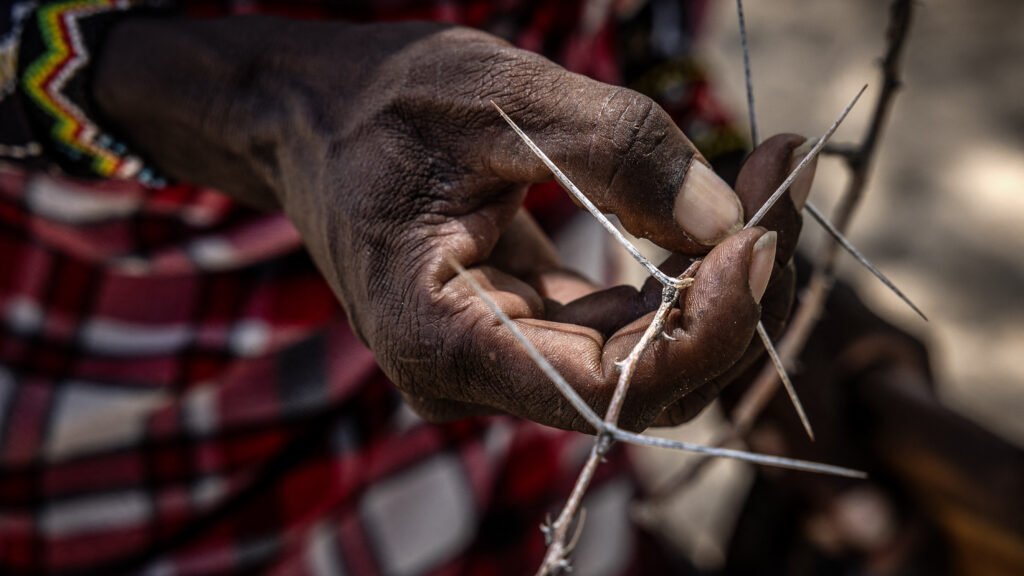
When I met Tesfaye at Boru Meda General Hospital, he vaguely remembered the thorn. He was 15 when it pricked his foot, out in the fields somewhere in Mekdela, in north-central Ethiopia. He had noticed it in passing, then forgot about it.
Seventeen years later, that prick had severely damaged his foot, destroying its bones.
The thorn infected him with mycetoma, a neglected disease that enters the body through even the smallest opening in the skin and slowly eats away surrounding tissue and bone. Caused by fungi or bacteria, it often leads to disability, amputation, and severe social stigma. If left untreated, it can cause death. Though it’s been reported in more than 100 countries across Africa, Asia, and Latin America, the debilitating, stigmatizing, and deadly disease is still largely ignored.
What surprise me as I examined Tesfaye were the scars: faint jagged cuts and deep, overlapping burn marks ran across his foot. These were the result of years of attempts by traditional healers, who likely recognized the disease but had no treatment to offer.
At Boru Meda General Hospital, one of the few referral centers in Ethiopia where mycetoma patients arrive each year, he was prescribed a combination of generic antibacterials and antifungals. But the medicines that are truly effective against mycetoma are not available here.
For decades, mycetoma remained scientifically invisible. Only a handful of medical research institutions, most notably the Mycetoma Research Center in Khartoum, Sudan, established in 1991, kept the field alive, treating hundreds of patients who traveled across borders to reach the only place that knew their disease.
My organization, Drugs for Neglected Diseases initiative (DNDi), first got involved with mycetoma after our team saw the way it impacts communities. We knew that the first and very important step was to get global recognition for the disease. That’s why we joined partners to advocate for its addition to the WHO list.
On May 28, 2016, the World Health Organization added mycetoma to its official list of neglected tropical diseases after interventions were made in the World Health Assembly. I was not in the room, but colleagues who had spent decades advocating for this recognition described the enthusiasm and optimism they felt: At last, the world would pay attention, donors would invest, ministries of health would act, and researchers working in near-total isolation would finally have the backing they needed.
That vision has not totally materialized. There has been progress on mycetoma, but it remains fragile and insufficient. This is mainly a failure of prioritization, brought about by underfunding and general neglect toward the vulnerable communities that this disease affects.
First, the good news: In 2017, DNDi, working with the Mycetoma Research Center and Japanese pharmaceutical company Eisai, launched the world’s first randomized, double-blind clinical trial for mycetoma in Sudan. The trial showed that fosravuconazole, a once-weekly oral drug, is as effective as itraconazole, the current standard, which requires daily dosing for up to a year, is expensive, and is out of reach to most patients.
In 2018, another step forward came when an open-source drug discovery initiative, MycetOS, was established to bring volunteer scientists from across the world to search for new treatments, sharing all data openly with no patents. More than 2,000 compounds have been screened so far, with several promising leads now identified.
Recent advancements in molecular diagnostics, such as PCR-based testing, now allow clinicians to differentiate between fungal and bacterial mycetoma. This ensures that health care workers can place patients on the correct treatment pathways faster.
Because mycetoma has been so deeply understudied, we still do not know how many people it affects. Encouragingly, burden-of-disease studies are now underway in Ethiopia, Senegal, India, and Kenya — the first attempts to count the neglected patients living with mycetoma.
Finally, the disease’s inclusion on the WHO list of neglected diseases acted as a catalyst for global collaboration. The Global Mycetoma Working Group was formed in January 2018. Today, it has over 200 members from 36 countries, creating a platform to share data, diagnostic advancements, and novel treatment strategies.
Despite this progress, setbacks continue.
Caught up in the conflict in Sudan, the Mycetoma Research Center — the world’s only specialized center for the disease — was destroyed in recent years.
Watching the footage, I saw collapsed ceilings, open laboratory freezers, and decades of microbial samples scattered across the floor.
But the greatest loss was not scientific. Hundreds of patients receiving care at the center were cut off overnight. Against extraordinary odds, center founder Ahmed Hassan Fahal and his team are now rebuilding and have resumed services, including through a new satellite facility.
But the lesson of the past 10 years is not only how much we have progressed or what we have lost. It is how much more we must build.
First, we must build the strong, distributed research and clinical partnerships that have transformed treatment for other neglected diseases. For sleeping sickness, the HAT Platform brought together institutions across five endemic countries to coordinate clinical trials and ensure new treatments reached patients. Mycetoma needs the same architecture. The foundations are forming, but these are early steps that need long-term structures.
Second, endemic countries must fully integrate mycetoma care into their health systems. This includes making it a notifiable disease and ensuring that frontline health workers can recognize and treat it early. If Tesfaye’s condition had been identified when that thorn first pierced his skin 17 years ago, his treatment would have begun then. Instead, he was left to navigate years of uncertainty and irreversible damage.
Thirdly, we must confront the conditions that sustain the disease. Mycetoma is a disease of poverty. It affects those who work the land, often barefoot, exposed daily to the soil where the infection lives. Prevention through protective footwear, wound care, and early reporting is possible and inexpensive. This depends on community awareness, functioning primary health care systems that can respond early, and the political will to invest in both.
The next 10 years of mycetoma care will determine whether it remains a story of neglect or becomes one of collective action. Ultimately, the only measure of real progress is whether patients like Tesfaye are identified, diagnosed, treated, and cured before it is too late.
Borna Nyaoke-Anoke is a physician and the head of mycetoma disease at Drugs for Neglected Diseases initiative.
Source: www.statnews.com



