
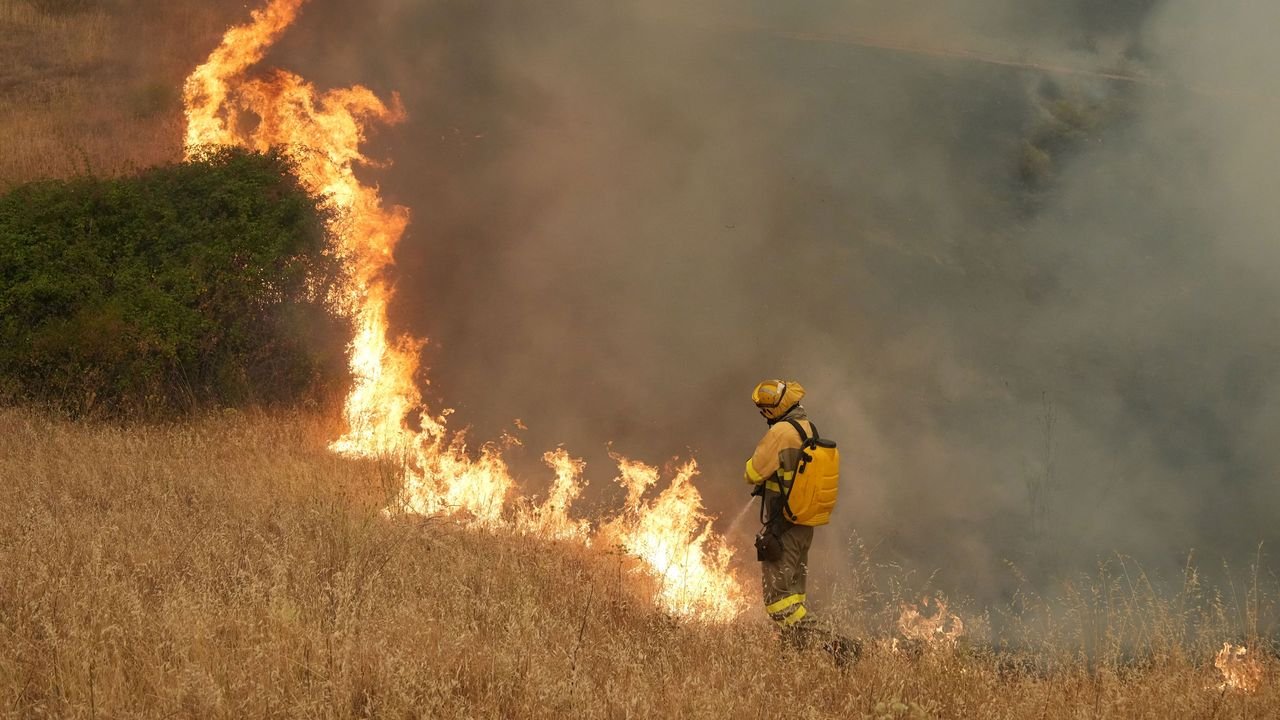
Pyne argues that Mediterranean Europe, much like California, is naturally predisposed to burn because of an annual cycle of wetting and drying. He writes in “Undying Fire” that, for eons, Europeans used fire to cultivate pastures, farms, woodlands, gardens, and orchards; burning liberated nutrients, cleared space, and promoted desired plants. He calls this practice “pyric horticulture.” And many modern Europeans understand themselves as part of this history. A researcher examining attitudes about wildfire policy once interviewed a resident of the Occitanie region of southern France, which borders Spain. “We often forget that we are in a region, regardless of climate change, which experiences hot and dry summers, with fires which are very, very predominantly of anthropogenic origin,” the resident said. “And it doesn’t come from today, it comes from the time of the Romans and the Greeks.”
By creating mosaic landscapes of interlocking fields, pastures, and orchards, Europeans broke up and thinned out trees and brush, making devastating fires less likely. But, in recent generations, Europe’s rural landscapes have rapidly transformed. Agriculture has industrialized and scaled up; fast-growing tree plantations have spread. Some of the most dramatic footage on social media appears to show the blackened remains of plantation forests: row after row of trees, spaced as evenly as Iowa corn, charred by fire.
The planting of trees is often celebrated, but the details matter. Pyne argues that Europe’s “broken-up biomes” have been “transfigured into monocultures of biomass fuel.” In Spain alone, some four million hectares have been afforested—establishing forest where, historically, there was none—since the nineteen-forties, mostly with flammable species like pine and eucalyptus. Between 1990 and 2015, the portion of Europe that was wooded increased by ninety thousand square kilometres—an area around the size of Portugal. The European Union has committed to planting three billion trees by 2030, in an effort to capture and store carbon. This movement has ecological and social consequences, and flammability is one of them.
The most important way that European landscapes are changing is that unprecedented numbers of people are leaving rural areas, a phenomenon that has accelerated in the last fifty years. “Families leave the forests for the cities,” Mena, the firefighter in southern Spain, said. Jobs are scarce in rural areas, he added, and the government doesn’t value the natural resources found there. Since the nineties alone, nearly three hundred million acres of agricultural land across Europe have been abandoned. The trend is most pronounced in Mediterranean, Scandinavian, and Baltic countries, and it has several knock-on effects. Landscapes become more homogeneous, and vegetation gives way to shrubland. As traditional farming wanes, biodiversity tends to decrease—and wildfires tend to intensify. “The problem is that the fuel load has grown significantly over recent decades, mainly as a result of the exodus from rural areas,” Jesús Santiago Notario del Pino, a Spanish soil scientist and agricultural chemist, recently told the Spanish Science Media Center. “Something like this cannot be easily resolved in the short term.”
In the coming years, climate change and globalization are predicted to be the biggest drivers of continued land abandonment. Another risk factor, ironically, is rewilding—a conservation approach that aims to restore ecosystems to good health by reducing human interference. The long-term impacts of rewilding have not been well studied, and some scholars worry about it. A recent paper in the journal Ambio pointed out that, if a landscape has already been shaped by humans, an ideal of “wilderness” doesn’t necessarily make sense there. “Several ecosystems of high biodiversity value, often misclassified as ‘pristine,’ have been shaped over millennia of human use, a context rarely acknowledged by re-wilding approaches,” the paper argued. When it comes to fire management, the problem is that rewilding and land abandonment often resemble one another—shrubs encroach on open areas and forests grow denser. (In Ireland, more than half of land affected by wildfires over the past decade overlapped with Natura 2000 sites—protected nature areas created by the E.U.)
“Rewilding is seen by many people in a romantic way,” Alexander Held, a senior expert in fire management at the European Forest Institute, told me. Recent E.U. legislation mandates that twenty per cent of degraded land and sea areas be restored to a natural state by 2030, and that all ecosystems in need of repair be restored by 2050. Rewilding is a primary tool in this effort; some three hundred million acres in Europe have been identified as potential rewilding sites. But, if land is truly allowed to return to wilderness, a natural cycle of burning will also return—one that modern society may not be willing to tolerate.



