
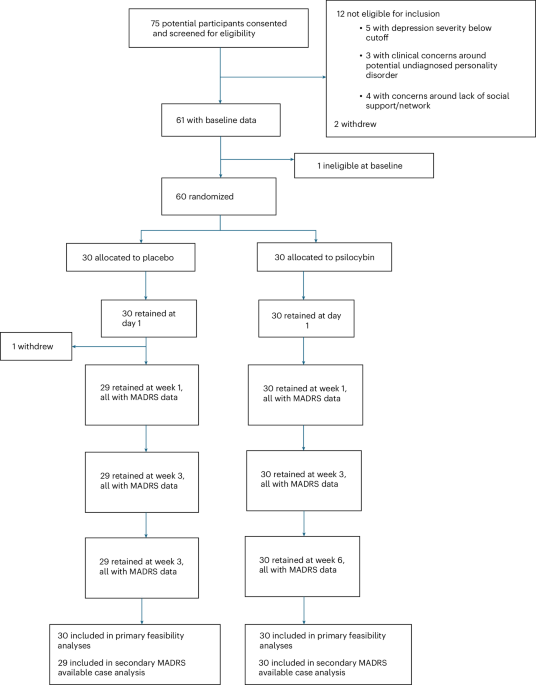
This study of psilocybin assisted-therapy for TRD—to our knowledge, the first RCT in this population to assess feasibility in an NHS setting in England—found significantly greater improvements in depressive symptoms in the active treatment arm compared to placebo, maintained at 3-week and 6-week follow-up. Psilocybin administration was well tolerated: AEs were mostly mild in severity and resolved by the end of the trial, and clinical safety scales measuring suicidality and mania did not show substantial changes across time. SAEs in all cases where a participant received psilocybin were deemed unrelated to the treatment. Recruitment, retention and measure completion metrics supported the feasibility of the trial design.
We noted a very large effect size at week 3, which was sustained at week 6 for both clinician-rated and patient-rated depressive symptoms. However, a part of this effect is likely attributable to a lack of response or remission in the placebo arm, with total MADRS and QIDS-SR scores not showing meaningful reductions across time. Blinding was not upheld, with 100% of participants who received psilocybin and 70% of participants who received placebo correctly guessing their allocation. Thus, expectancy effects in both groups likely account for some of the between-group difference observed.
These findings complement two previous RCTs of psilocybin versus placebo or immediate versus delayed treatment in MDD and TRD, respectively, both of which found very large between-group effect sizes at week 2 on the MADRS13,16. Together, these results suggest that a single dose of psilocybin may reduce depressive symptoms in MDD and TRD, although larger, and longer, scale studies are required to confirm the nature and durability of these effects.
On average, patients in this trial had been ill for 20 years and showed moderate levels of treatment resistance. Unlike commercial trials in this population15, we did not set an upper limit on the degree of treatment resistance, thus including some participants with severe and chronic illness who had not responded to a wide range of interventions. This may be more representative of a real-world implementation of psilocybin therapy, particularly in healthcare settings such as the NHS, where novel interventions are usually reserved for those unresponsive to multiple established treatments.
This trial was delivered initially in an NHS clinical research facility. Halfway through recruitment, we moved to a refurbished community mental health team setting in a residential area, close to the local hospital. Although this move was dictated by circumstance rather than intention, it introduced a natural test of the deliverability of psilocybin therapy in a less regulated, outpatient community setting. Indeed, such a setting is generally thought to be preferable for treatments involving drugs such as psilocybin, where overtly medical or inpatient hospital settings can invoke unhelpful health anxiety and are probably unnecessary given the benign physiological toxicity profile of the drug itself. Our own observations underlined this: we noted no new logistical or safety concerns because of the move; however, we present this as informal commentary only.
An inactive placebo control allows for a better characterization of safety signals in psychedelic trials and does not adversely affect feasibility aims; hence, it was chosen for this trial17. However, other trial designs (that is, active placebos or subperceptual doses of the study drug) may be more appropriate for efficacy trials and will be considered in the design of a future trial17. Indeed, in the largest RCT of psilocybin for TRD to date, Goodwin et al.15 found more modest effect sizes comparing 1-mg to 25-mg psilocybin at week 3 than in the present trial.
In the present study, the proportion of patients reporting suicidal ideation on the Columbia−Suicide Severity Rating Scale (C−SSRS) was similar at baseline and at week 3 and week 6 follow-up, after an initial reduction at day 1 and week 1. Proportions also appeared similar across arms. Conversely, suicidality as measured by the M3VAS appeared to improve in the psilocybin arm at each follow-up point (by approximately 15 points on average at week 3 and week 6) and remained relatively stable or worsened slightly in the placebo arm (by approximately −2 to −6 points on average). The M3VAS may provide a more nuanced measurement of change over time compared to the C−SSRS rating. High suicidal risk as measured by the C−SSRS was an exclusion in this trial (as is a usual requirement for ethical authorizations of experimental drug treatments in psychiatry), and, thus, the potential for observable change was attenuated.
Concerns have been raised over suicidality in previous psilocybin trials, with suicidal ideation and behavior AEs and SAEs appearing more common in the 10-mg or 25-mg arms than in the 1-mg arm in the trial reported by Goodwin et al.15, although statistical significance was not assessed15. On the other hand, a review including three RCTs of psilocybin-assisted therapy that included suicidal ideation as an outcome or safety measure reported significant reductions in suicidal ideation with psilocybin18. A 2-year follow-up of participants in this trial is currently underway and will be reported in due course.
Limitations
This trial has several strengths and limitations. Given that this trial was implemented within a public mental healthcare setting in the NHS in the UK, it helps inform how psilocybin therapy may be implemented within this healthcare context, if licensing is achieved and funding models are agreed. The recruitment target was reached, and almost all participants were retained to week 6, indicating that the inclusion criteria were appropriate and study procedures were acceptable to the population. These aspects of study design may be used in future efficacy trials in this setting.
Additional strengths include the use of a true placebo design that allows a baseline rate of AEs to be collected (to our knowledge, only one previous RCT in MDD has used a true placebo13); the inclusion of an optional open-label extension for all participants, which may have contributed to the high rates of participant retention; and the wide inclusion criteria (lack of an upper limit for treatment resistance as well as including psychological therapy trials), which allowed for a more ‘real-world’ group of patients to be recruited than the usual narrow criteria seen in commercially funded trials.
Ethnic diversity has been reported to be poor in clinical trials of psychedelics, with 85% of participants across studies being white19. Although results of trials testing psilocybin for various conditions have been promising, limited participation of ethnic minorities in these trials limits generalizability of the results. Furthermore, best practices in delivering complex interventions such as these may differ across individuals with different cultural backgrounds. We largely met our recruitment targets in all ethnic groups, apart from in Black, African, Caribbean or Black British participants. This is an important limitation that we aim to address in the follow-on trial; this could involve increased recruitment of individuals from Black ethnic groups as researchers or clinicians to increase cultural competency as well as inclusion of relevant cultural centers in participant recruitment efforts20.
In a similar way, we also aimed to recruit a diverse sample with regard to sexual orientation, surpassing our target for recruiting gay or lesbian participants but underrecruiting bisexual or other orientations. We did not create targets for recruitment for educational level or employment; this is another important limitation that could be addressed in future trials using similar methodology used for ethnicity and sexual orientation. We note that our sample population is highly educated, with much higher proportions of participants with university degrees than in the general population.
Functional unblinding due to the subjective effects of psilocybin is an obvious limitation of this trial, as it is with all trials of drugs that have noticeable effects, as well as many psychological and behavioral interventions. However, we used raters who were independent of the trial team to measure the primary outcome in this trial, and participants were asked not to discuss their beliefs about their allocation with the raters. Despite this, the limited assessment of blinding is a weakness of this trial. However, it is important to note that expectancies and functional unblinding in psychedelic trials are not solely a source of bias. The therapeutic model of psilocybin-assisted therapy relies on the subjective drug effects and their integration; therefore, expectancies, subjective effects and pharmacological effects likely work synergistically and thus may be intrinsic to the treatment21. Although placebo-controlled RCTs continue to be considered ‘gold standard’ to the extent that they are demanded for regulatory approval, they have obvious limitations when applied to psychoactive drugs delivered within a supportive context. A more detailed understanding of psilocybin therapy will necessarily emerge from a confluence of controlled and observational studies; statistical approaches that incorporate prior knowledge (for example, Bayesian); and, perhaps most critically, the sort of nuanced insights that arise from extensive clinical experience and careful attention to patient feedback.
The results of this trial suggest that administering a single dose of psilocybin versus placebo to participants with TRD, with psychological support, in a randomized, double-blind trial design is feasible. The treatment was well tolerated, and secondary endpoints suggest improvements in other important outcomes, such as anxiety. Efficacy and duration of antidepressant effects were observed up to 6 weeks in this trial using the preregistered, independently collected primary outcome. Feasibility parameters support the development of larger efficacy trials in public mental health settings in this population. However, the placebo control design alongside the obvious functional unblinding that occurs with psilocybin introduces complexity into the interpretation of results. Designs that are better able to disambiguate between the differential expectancy effects between groups and the interactional effect of psychological support given alongside a drug intervention are required, although such disambiguation is unlikely to be definitive in any clinically meaningful sense. Future trials should also examine long-term effects of psilocybin on functional outcomes. Furthermore, the cost-effectiveness of psilocybin therapy should be adequately characterized if it is to be assessed for provision in a public healthcare setting.
If found to be clinically effective and cost-effective in larger trials, psilocybin could offer a new treatment for TRD—a common and chronic condition with a high burden of disability and disproportionate risk of completed suicide, with few licensed or effective treatments available. In the longer term, this could lead to substantial improvements in functional recovery and reductions in societal and healthcare costs.



