
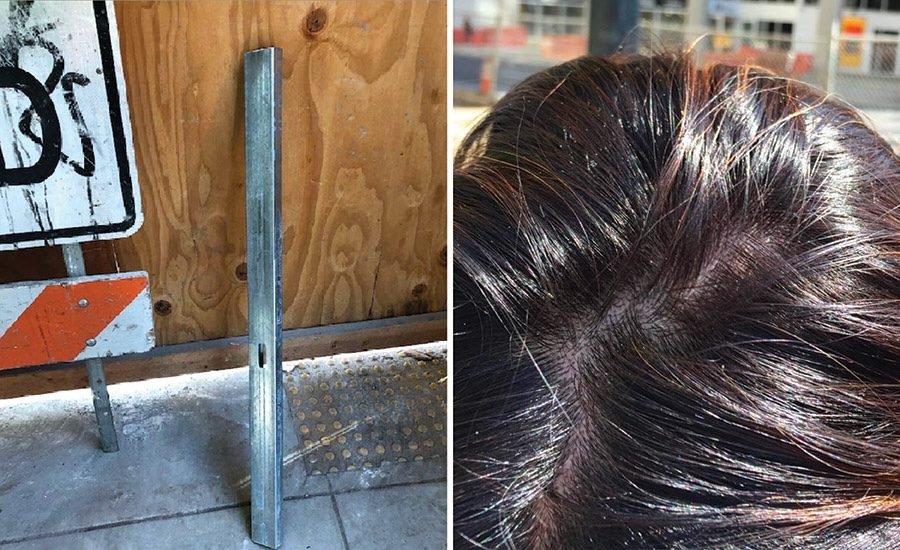
The wall stud that fell and hit Vanessa Oliveira’s head, as she waited for an Uber pickup outside a downtown San Francisco hotel renovation, at first appeared to cause only shock and a bump.
But over the months in 2019, in consultation with doctors, Oliveira’s symptoms multiplied until some physicians diagnosed a traumatic brain injury with potential lifelong effects. On July 22, a 12-person state superior court jury decided that three companies, Scaffold Solutions, Skanska USA Building and DMS Drywall & Interior Systems, were responsible for what the jury determined should be a $20.7-million damage award to her—most of it for lifetime medical care.
Only one of the three companies, Scaffold Solutions, had been a defendant in Oliveira’s negligence lawsuit, and the jury determined its damages should be about $2.7 million.
The other two had reached a last-minute settlement with Oliveira before trial, approved just as jurors were to be selected.
Under its terms, the two companies would pay her a total of $3 million and because its contract with DMS required DMS to insure Skanska, the big construction manager seems to have avoided any out-of-pocket damages.
Contacted for a response, Skanska said in a statement that while the company could not comment on the details of the legal outcome, “Skanska was no longer a party to the case at the time of the trial.”
The firm added: “Safety continues to be a core value of our company, and we remain committed to protecting the communities where we work.”
A Prior Mistrial as Defendants Split
The settlement and jury verdict came after seven years of litigation that included a mistrial last year when Skanska and DMS split with Scaffold Solutions, which had, up to that point, been represented by the same law firm.
Looking for quick answers on construction and engineering topics?
Try Ask ENR, our new smart AI search tool.
Ask ENR →
The wall stud that struck Oliveira, a physician’s assistant, fell from the second level of the building. A major issue in pretrial legal maneuvering was why and how a toeboard and webbing on the scaffold fall protection guardrail had not been installed.
Another major issue concerned the injury severity, with defendants’ experts differing with Oliveira’s medical experts on whether traumatic brain injury was actually present and lifelong costs for care and potential lost earnings were justified. The original injury did not require stitches or produce bleeding and Oliveira was discharged from a hospital emergency room in less than an hour, court records showed.
Arguments For and Against Settlement
Over Scaffold Solutions’s objections, Judge Victor Hwang approved the 11th-hour settlement between Oliveira and Skanska and DMS. Settlements just prior to or during civil court cases are common.
Skanska and DMS had cards to play at trial that may have swayed Oliveira’s attorneys to settle. In asking the judge to ratify the settlement, both companies admitted to breakdowns in coordination and partial fault for what occurred. But they also disputed Oliveira’s claims for large damages for headaches, foggy thinking and a worsened social life and diminished ability to travel.
The companies cited Oliveira’s social media posts, showing her hiking and on a cruise and with friends at a Beyonce concert. Also, some symptoms she claimed showed traumatic brain injury predated the accident, the companies argued, as indicated by her medical records. Also, despite her alleged cognitive issues, she continued to work and treat patients, they argued.
The settlement provides a lump sum payment to Oliveira of $3 million, which would come out of DMS’s $6 million insurance limit. Skanska appears not to have to pay out any funds.
Scaffold Solutions argued strenuously against the settlement, which it characterized as a second attempt by Skanska and DMS “to avoid trial at the last second” despite being central participants in the events at issue. Allowing the settlement, Scaffold Solutions argued, left it as the only defendant at trial and “could shift to the company a disproportionate amount of any damages assessed by a jury.”
In comments to Judge Hwang, Scaffold Solutions said: “Even assuming an equal three-way split of liability, based on Plaintiff’s evaluation, Skanska and DMS face liability of about $13.3 million.”
The at-that-time still-unapproved $3-million settlement payment “represents only 15% of the rough total recovery and only 22.5% of Skanska’s and DMS’s combined equal-share exposure. No ordinary settlement discount justifies that gap.”
But Hwang approved the pact and only Scaffold Solutions headed to trial.
Source: www.enr.com



