
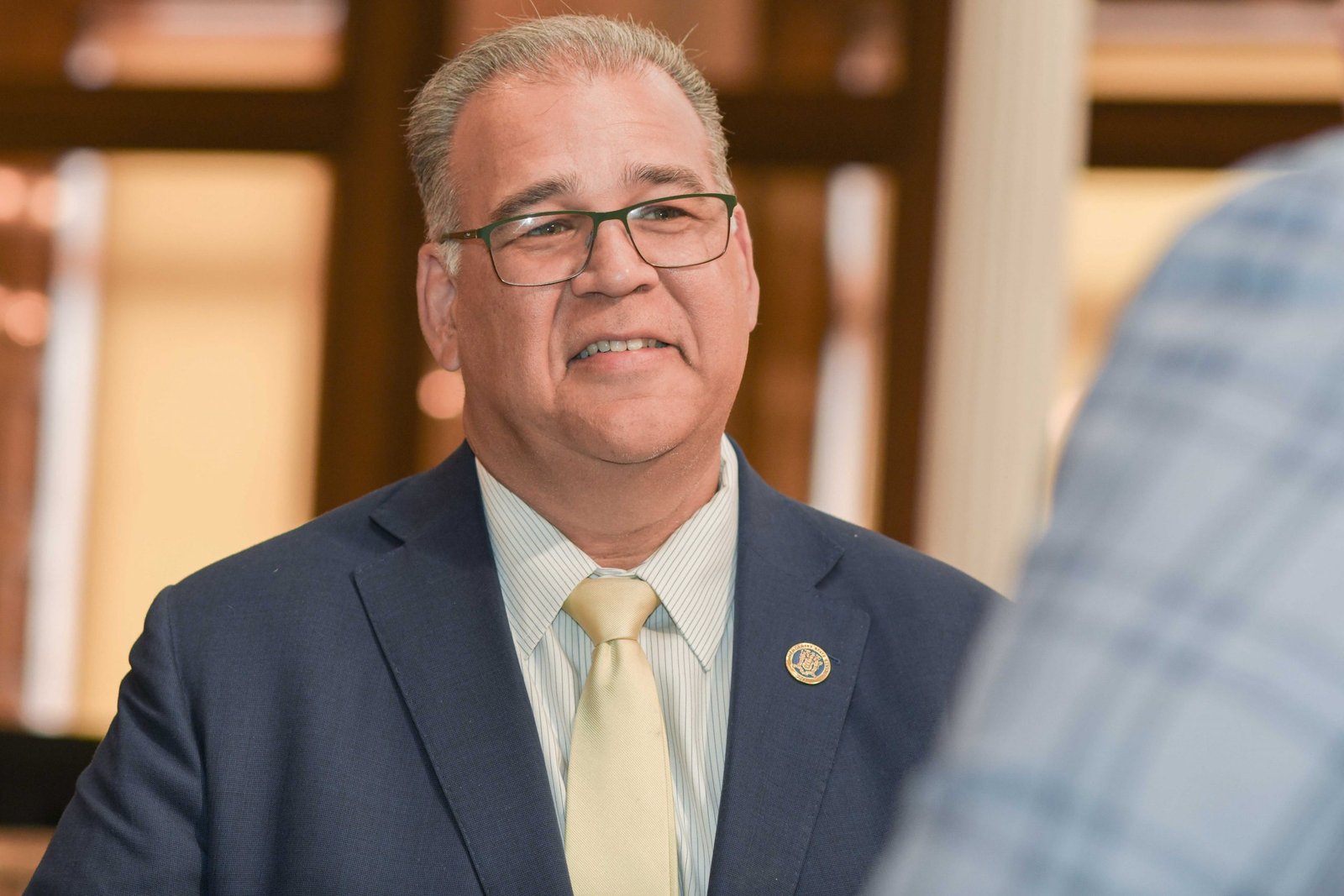
The New Jersey Globe is continuing a weekly interview series with state legislators. It began last month with Luanne Peterpaul and continued last week with Dave Bailey Jr. This week, Doug Steinhardt took the call.
Steinhardt served as mayor of Lopatcong from 2000 to 2015 and has chaired the Warren County Republican Party since 2004. He was also chairman of the state GOP from November 2017 to December 2020. He is an attorney at Florio Perrucci Steinhardt Cappelli Tipton & Taylor, a firm founded by the late Gov. James Florio.
Steinhardt joined the Senate in 2022, when a special convention picked him to replace Michael J. Doherty, who had resigned from his 23rd legislative district seat to become Warren County’s surrogate. Steinhardt secured a four-year term in 2023, defeating Democrat Denise King 31,066-22,790.
Last year, President Donald Trump tapped Steinhardt for an interim appointment as U.S. Attorney for New Jersey, but Steinhardt declined, opting to stay in his state Senate seat and law firm partnership. Steinhardt serves on the Budget and Appropriations Committee and the Labor Committee.
Last year, Steinhardt introduced legislation that would create a new crime of political violence and more harshly penalize crimes found to be politically motivated. The bill cleared committee, but did not clear the whole Senate or Assembly.
A list of Steinhardt’s floor and committee votes this session can be found by clicking here.
Click here to view a list of bills that Steinhardt has sponsored.
The following phone interview has been edited for clarity and length.
New Jersey Globe: When you go to the Senate on a daily basis, what are you hoping to get done?
Doug Steinhardt: In a microcosm, do the best work I can for my constituents, but in the macro, make the best decisions I can that affect the greatest group of people in the state.
You’re a conservative Republican, and —
I don’t know what that means. It’s a label that I think is ascribed to people; it’s easy to repeat. I don’t know whether that’s true or not true. I’m sure I am in some respects, and I probably am not in others, and you might be surprised.
I’ll broaden that just to say that you’re a Republican in a state government that doesn’t have a ton of them. Do you feel effective in a state government where you’re in the minority?
I think if I didn’t feel effective, it would be difficult to be motivated to go and do my work every day. Do I occasionally feel frustrated? I do. I think Trenton is sometimes an echo chamber for the majority party. But I think legislators can have an intellectual exchange of ideas and disagreements professionally and still try to work towards some sort of consensus that helps the most people. So I don’t want to say I feel ineffective. I think that I’ve been able to be effective where I’ve needed to be, though I feel frustrated sometimes.
Am I frustrated more than some of my Democratic counterparts are? Probably. But I bet if you ask some of them, they sometimes feel frustrated too, with the political environment and government generally.
A bill that caught my eye last year was one that you co-sponsored with Senator Brian Stack, the political violence bill. What is your goal there, and do you think it could get passed this year?
Yeah, I am optimistic that it will. I have a lot of respect for Senator Stack, and I think he and I have worked well together. We have a lot of common interests, public safety among them. The assassination of Charlie Kirk was sort of the last straw, but the vitriol and rhetoric in politics has been increasingly combative and violent, and the bill proposal was in recognition of that and an effort to try to ratchet that back through awareness, and where that was unsuccessful, then through legal consequence.
Do you think that we’re in a spot right now where awareness or legal consequences can fix political violence?
No. I mean, I think it takes all sides. And I think that, like anything else, I can only take responsibility for the shoes that I fill. So, for me, that means leading by example and not engaging in that type of behavior myself. And I don’t think that I do that, you know. I think it means that when I am exposed to that type of behavior, I am conscious of trying to de-escalate rather than inflame.
It’s a two-way street. The public with whom we engage needs to do the same. But I think if we hold ourselves to a standard where we conduct ourselves and engage with each other and the folks that we represent professionally, then hopefully we all can.
On the Budget Committee, you’ve seen the ins and outs of the budget for a few years. Are you confident in the state’s current fiscal standing, and what do you think of Mikie Sherrill’s plans to address the deficit?
I think she deserves credit for trying to bring some energy and a willingness to tackle some of the state’s big challenges, but a $60.7 billion budget raises real questions about long-term sustainability. I don’t think people, employers, or residents are looking for ideology. They’re looking for predictability, for cost discipline, not the state spending above its means. And right now, I don’t think that that’s entirely clear. To her credit, she was openly critical of the Christmas tree spending that the Budget Committee and the Democratic majority are notoriously famous for at the last minute.
But I think the real test is going to be whether she’s willing to take on her own party in the legislature to rein that in. I think if she wants to position New Jersey as being more resident-friendly, more business-friendly, then those kinds of fights matter. And I don’t know yet whether she has the appetite to win it, but we’ll continue to keep highlighting places where we think the state has a responsibility to do better, and I’m quite sure our colleagues across the aisle [will] keep spending more money.
Turning to politics, you were the chair of the state GOP for a few years, and right now, there’s a debate within the party about how to move on from last year’s elections. Do you see a path forward for Republicans to be competitive statewide in the near future?
Yeah, absolutely. The extremes on both parties tend to be on the louder side now, and I think that’s as much on the Democratic side as it is on the Republican side. So a lot of the solutions lie someplace in between. But with a lot more Democrats and a lot more progressives, and a lack of a [county] line and weakening of the organizations, we’re going to have to find alternatives soon, and I’d like to think that those will come from my colleagues and me.
My focus has always continued to be on things like public safety, affordability, and opportunity. And opportunity has a bunch of subcategories, whether it’s education or employment or things that I’m passionate about, like mental health. But I think there have to be opportunities for contrary points of view, and a path for elected officials to share those mindsets to be elected, and not just in the 23rd legislative district, but in other places around the state.
You mentioned mental health, and I asked Assemblyman Dave Bailey a version of this question last week: Do you think the state is well-suited to support vulnerable people struggling with mental health issues? And what do you want to see done in that arena?
One thing I learned sitting on the Budget Committee — one thing that was on full display [last] Monday when we were down at NJIT — is that there are a lot of groups looking for help. Mental health advocates are one of them. I lost a cousin to suicide when I was in law school, and he was growing up dealing with mental health issues his whole life and self-medicating, hence my involvement in addiction awareness issues, too.
We are in a state with dwindling resources, and we need to be strategic about where we put them. But I bet if you were at a party with somebody or at a family reunion, you couldn’t network your way through your group of family or friends and not talk to somebody who knows somebody — or somebody in the family — that has dealt with depression or mental illness or drug or alcohol addiction. And I think that we as a state need to be mindful of that and the effects that it has on everybody in that circle.
It’s been more than a year since you turned down an interim appointment for the U.S. Attorney job. How do you feel about that decision a year later?
I’ve had to make a lot of difficult decisions in my 57 years, and I think the healthiest path forward is not to spend a lot of time looking back at them, but rather to learn from them and figure out how I can harness that knowledge and turn it into energy moving ahead. I’m grateful for the opportunity to represent almost 250,000 folks who live in the 23rd legislative district. Not taking a U.S. Attorney’s position has enabled me to continue to do that, and it’s a job that I am not only honored to have, but one that I enjoy doing. So you close one door yourself, but another door, I like to think, always opens, and if I had made a different decision, I wouldn’t still be with my law office partners that I like to work with, and I wouldn’t still be representing my constituents in the Senate. So I’m in a good spot.
I saw that both you and your mother have been inducted into the Warren County Hall of Fame. What is that like? Does that come with a plaque?
Let’s start with the fact that I’m in a county of 100,000 people, right? So there’s slim pickings, I guess.
You made it, still.
I think the world of my mom. She’s dedicated her whole life to helping other people as a nurse and a nurse educator, and she is a great example to my sister and me and my kids, on what a compassionate professional looks like. I hope that I’ve been able to follow the same path.
The plaque sits on the wall with a handful of other things that I’ve been fortunate enough to collect over the years. But I think the more important thing is the fact that I’m third-generation in my county here, and we’re all proud to still have roots in the place where we grew up. And it’s certainly far less the recognition that matters than all the things that we’ve done along the way. I’m happy to still be in the same community that I grew up in.



