
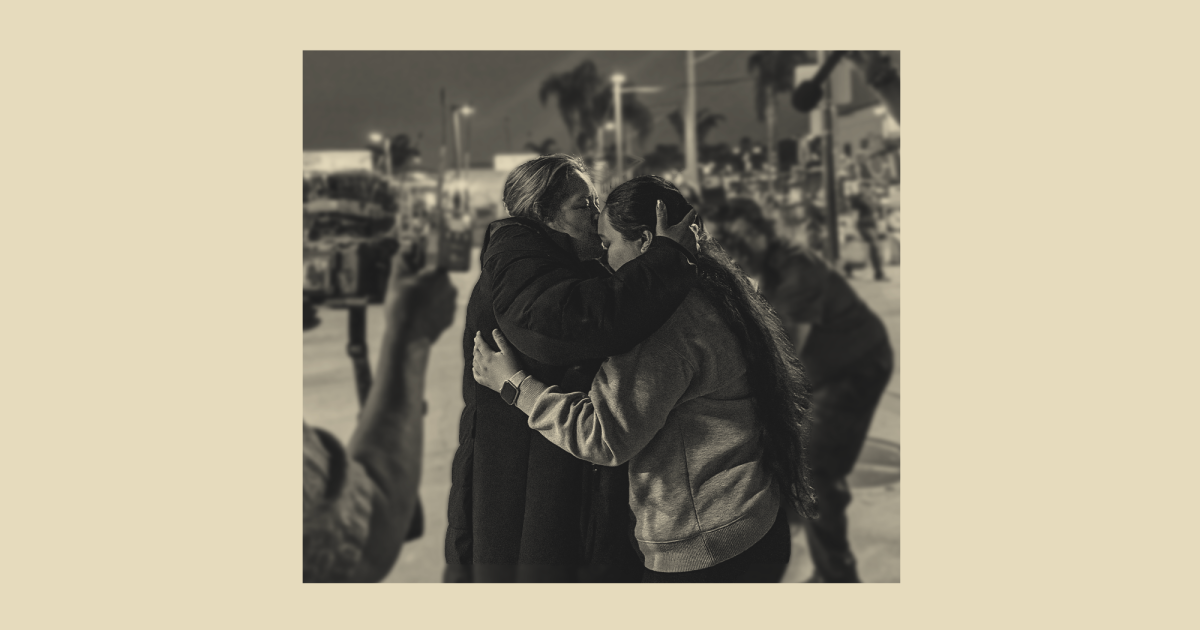
Maria de Jesus Estrada Juarez, left, kisses her daughter Damaris Bello after being reunited.Mother Jones illustration; Courtesy Courtesy Damaris Bello
Maria de Jesús Estrada Juárez recalls the 40 days she spent in Mexico as a dark time. After more than 27 years in the United States, her country of birth no longer felt like home. At 42, Estrada Juárez found herself needing help with the smallest things, grocery shopping, for instance, or riding the bus. Worst of all, she was missing the most important person in her life: her US citizen daughter Damaris Bello.
“There were some moments where it was even hard for me to breathe,” Estrada Juárez said during a video call last week. “We’ve never been apart so much; we’ve always been together.”
In February, Estrada Juárez was wrongfully deported to Mexico despite having protection under the Deferred Action for Childhood Arrivals (DACA) program that shields undocumented immigrants brought to the United States as children from deportation. She’s now back in Sacramento after a California federal judge ordered the Trump administration to return her to the United States. But readjusting to life post-deportation hasn’t been easy, and mother and daughter are still reeling from the forced separation.
“I think a lot of people assume that the story ends when your loved one comes back,” 22-year-old Bello said. “But that’s just the beginning of when the healing process starts.”
Their nightmare started on the morning of February 18 when Estrada Juárez appeared for an interview as part of the process of adjusting her immigration status to that of a permanent legal resident, which she was eligible for as the relative of a US citizen. Estrada Juárez was excited about the prospect of no longer being required to renew her DACA status, something she has had to do every two years since 2013. “We thought of it as the next step forward,” Bello said. “But obviously there were different plans in store, and things changed overnight.”
Estrada Juárez went to the appointment accompanied by Bello and prepared with years’ worth of tax filings, her work permit, proof of DACA renewals, and a copy of the advance parole authorization she had received in 2014 to go on a short trip to Mexico and lawfully return. The interview appeared to be going fine until the US Citizenship and Immigration Services (USCIS) officer told Estrada Juárez she had an outstanding order of removal from when she first entered the United States in 1998 at the age of 15. He said he would have to consult his supervisor.
Estrada Juárez, who had never known about a removal order, turned to her daughter and said, “I’m getting deported.” Bello reassured her that there was no reason to worry; after all, she had followed the rules and done everything right. But then they heard a knock on the door, and immigration agents told Estrada Juárez to stand up and put her hands behind her back. She was indeed getting deported to Mexico. All Estrada Juárez could think about in that moment was what would happen to her daughter, her only child. She felt helpless. When Estrada Juárez looked at Bello, she was pale and shaking.
“When it was happening, I was just looking around the room and seeing who was able to help me,” Bello said. “And then you step back, and you realize that there is no one there to help you. Everyone there is against you.” Estrada Juárez protested, saying she had valid DACA status through at least April 2026. But her pleas fell on deaf ears. “The feeling I got was they just wanted me out as soon as possible,” she said, adding that she never received a copy of the alleged 1998 expedited removal order.
“I think a lot of people assume that the story ends when your loved one comes back, but that’s just the beginning of when the healing process starts.”
The next several hours were filled with agony. After Estrada Juárez was taken away, Bello started checking the US Immigration and Customs Enforcement (ICE) online system, looking for her location. Estrada Juárez recalled that her whereabouts kept shifting—she was moved to Stockton, Bakersfield, Los Angeles, and finally San Ysidro on the border. She described the experience as humiliating. “They refer to us, the people getting picked up and dropped off, as ‘We’re taking these,’ Are we dropping these off?’ How many of these are we taking?’ Like we’re not people, we’re things.”
At some point, Estrada Juárez said she was given a heated frozen burrito wrapped in what she thought was toilet paper, which made her feel even worse. When she requested her medication for diabetes, they turned her down. During the long car rides, Estrada Juárez said she had asked to be buckled to the seat and was told she should do it herself, even though she was handcuffed. Within less than 24 hours, Estrada Juárez was deported to Mexico, a country she had visited only once in decades. Her hometown of Atlixco in Puebla felt like a new place after all that time, Estrada Juárez said. Most days, she passed the time helping her mother around the house with cooking and cleaning.
When we first spoke, Bello said she felt as if she was “grieving” Estrada Juárez, who was the breadwinner of the household. She started packing their home because, as a nursing school student, she couldn’t afford the rent and utility bills. She went to Washington, DC, to attend a congressional oversight hearing where now-former Homeland Security Secretary Kristi Noem testified about the department’s immigration enforcement actions and gave media interviews advocating for Estrada Juárez.
“It’s a little difficult to keep repeating the story and having those same feelings come up,” Bello said. “Even talking about it now, I still feel the anxiety and the trauma that I went through. But I would do it all over again if I had to in order to bring her back.”
Estrada Juárez is not an isolated case. At least 86 DACA recipients have been deported in the first year of President Donald Trump’s second term. Many more have been arrested and detained in direct betrayal of the program’s intent. On March 10, Estrada Juárez and her legal team filed a case against the federal government in the district court for the Eastern District of California, claiming her deportation was unlawful under DACA and asking that she be returned to the United States.
The petition stated that Estrada Juárez never received a copy of the alleged decades-old removal order, which was the basis for her green card application denial. Instead, Estrada Juárez was given a document saying she was barred from returning to the United States as a result of an order from an immigration judge, even though Estrada Juárez never appeared before a judge, according to the court document. Her lawyer, Stacy Tolchin, further argued that Estrada Juárez’s 1998 expedited removal order didn’t constitute a final order because it hadn’t been approved by a supervising officer at the time. It also couldn’t be reinstated to deport Estrada Juárez, she said, because her client had last entered the country lawfully in 2014.
A couple of weeks later, on March 23, Judge Dena Coggins ruled that Estrada Juárez had been removed in “flagrant violation” of her DACA protections. “The court finds, clearly and unequivocally, that each day Petitioner remains unlawfully separated from her daughter, they both suffer unimaginable irreparable harm,” the judge wrote, mandating that the government facilitate Estrada Juárez’s return within seven days of the court order. Moreover, she ordered that Estrada Juárez’s benefits under DACA should be restored as if her deportation had “never occurred.”
“The court finds, clearly and unequivocally, that each day Petitioner remains unlawfully separated from her daughter, they both suffer unimaginable irreparable harm.”
Estrada Juárez received the good news with a mix of relief and apprehension. “They failed me once, they made a mistake once, what makes you think it’s not going to happen again?” she said. “The trust is not there anymore.” Estrada Juárez went from Puebla to Mexico City to pray at the Basilica of Our Lady of Guadalupe before flying to Tijuana, where she waited. As she strolled by the ocean in nearby Rosarito on March 29, Estrada Juárez realized that it was the first time she had walked on a beach without Bello since her daughter had been born.
“The fear of a system failure again took over,” she said. “I got very overwhelmed.”
At the US-Mexico border port of entry in San Ysidro the next day, Estrada Juárez said she was held for about five hours even though her parole authorization to re-enter the country had already been approved, and the government’s court-ordered deadline to bring her back to the United States was approaching. She said the border patrol officers repeatedly asked her what she was doing in Mexico. She explained she had been wrongfully deported and pointed them to the judge’s order mandating her return.
As Estrada Juárez watched some border crossers be turned away, she said she felt as if the officers were holding her just to assert their power over her. She couldn’t help but notice how long the government was now taking to allow her back, compared to how expeditiously it had sent her away. Finally, after more than a month in Mexico, Estrada Juárez was let into the United States and reunited with Bello. They embraced for a long time. “I feel like I got my life back,” she said.
But the life she returned to was not the same as the one she had left. Estrada Juárez has nightmares about being back in her mother’s house in Mexico. Bello is also struggling with anxiety. On a recent evening, they were expecting guests for dinner, but when Bello heard a knock on the door, she froze and was too afraid to open it. “I felt like I was right back in that moment again when they were taking my mom away from me,” Bello said. “And I think that’s when I realized that the trauma doesn’t just end there, it doesn’t just go away.”
The mother and daughter are now waiting for Estrada Juárez’s DACA to be renewed while they are appealing the denial of her green card application. They worry about what the next appointment might bring. Estrada Juárez said she has always been a confident person who doesn’t like to live in fear. “I don’t think I’m the same person,” she said. These days, a lingering dread of leaving the house always creeps in. “This feeling is the worst feeling I’ve ever felt in my life, trying to go outside and not having that little fear of ‘what if?’ I think it’s going to take some time for me to be able to get rid of that.”
Estrada Juárez added, “I think also it’s going to take some time for Damaris not to feel afraid of me going outside and having the certainty that I’m going to come back home for her.”



