
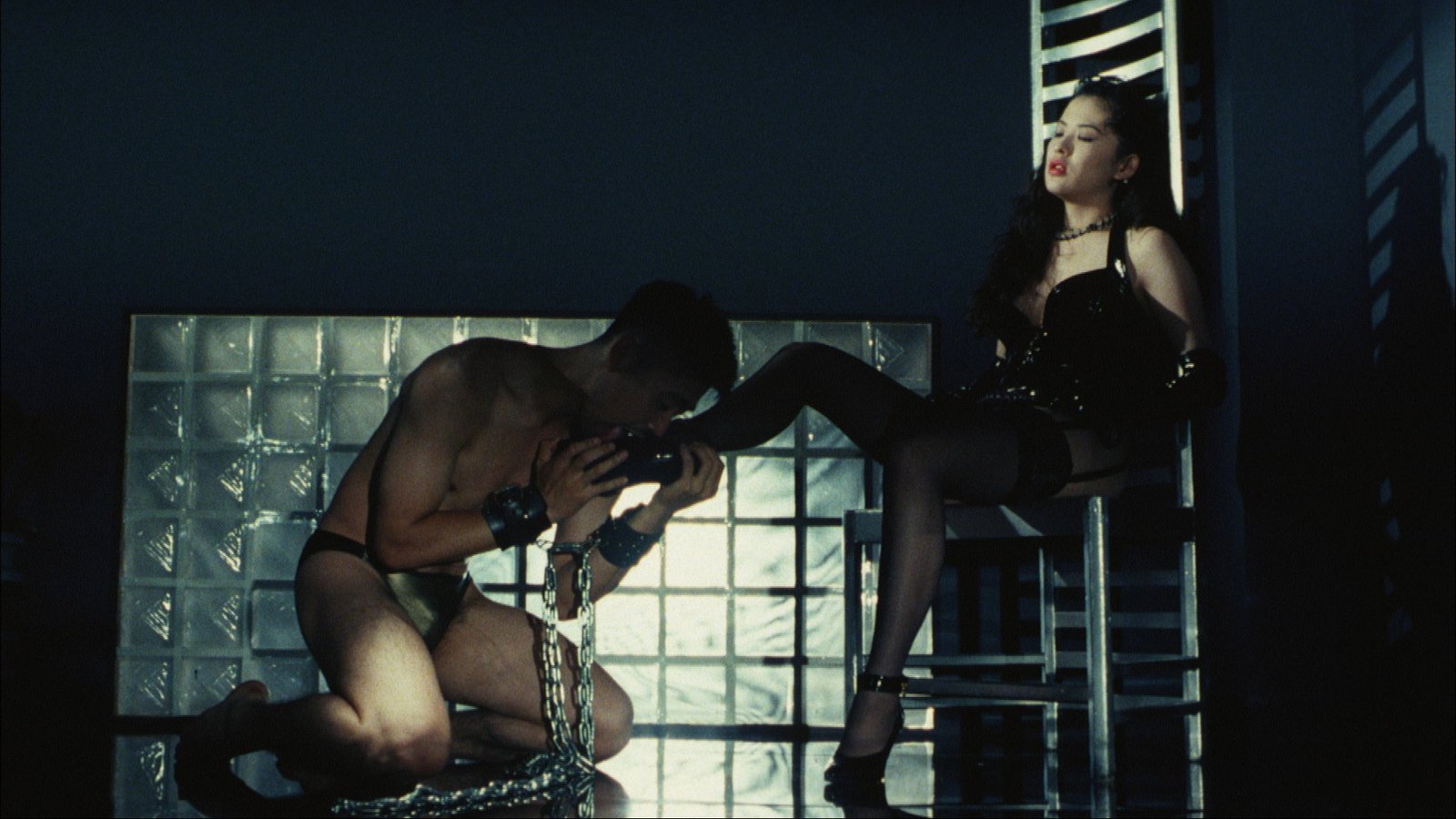
Are you a true connoisseur of S&M practices? I cannot claim to be, but after the long introduction of “A New Love in Tokyo”, you should definitely be more knowledgeable. Indeed, sex is central to the movie, but it would be a mistake to simply catalogue it as a modern take (as per the 1990s!) on Pinku Eiga. On the contrary, the film does not intentionally steer the viewer toward voyeuristic or erotic territory. Instead, the very detailed and possibly rough depictions of several peculiar practices – some of which may be shocking to certain audiences – lean more toward US educational exploitation cinema, almost documentary-like, as the brief introductory journalist interview scene may imply. Putting aside its special background, the film is objectively narrating the touching and striking connection between two soulmates in a form that feels more like a freewheeling indie attempt, part art-house, part amateur than another Roman Porno variation.
A New Love in Tokyo is screening at Metrograph
Rei (Sawa Suzuki) is a belated aspiring actress who has found a peculiar way to pay the bills: working as a dominatrix in an S&M dungeon. Her life seems metronomically organized among her troupe of immature young actors, whom she uses without passion as sex toys, her persistent follower, whom she mostly despises, and a far-suburban life where she finds refuge in growing sunflowers and feeding birds.
Working apparently in the same building, she meets in the lift Ayumi (Reiko Kataoka), a call girl posing as underage, who prostitutes herself to indulge her apathetic law-student boyfriend, trying to convince him that her family is wealthy enough for them to marry. Rei quickly becomes a sort of mentor to Ayumi as the two girls realize they share more than their love of karaoke and their compulsion for partying across the Shinjuku/Shibuya nightlife: a certain post-punk nihilistic disillusionment, like some Thelma and Louise cut from Hollywood dramaturgic glamour.
Let’s cut it short: “A New Love in Tokyo” is definitely not a great movie, but is definitely an interesting piece of cinema. Obviously, the patronage of the cult underground photographer Nobuyoshi Araki – already gaining recognition internationally in the 90s – gives a certain credibility to its artistic dimension.Thus, the film is regularly punctuated by black-and-white stills from sessions he shot with Sawa Suzuki (a photobook, also subtitled in French, Sawa – Le Nouveau Monde Amoureux, accompanied the release of the movie) but the narrative is somehow deserved by this contribution. In fact, the main merit of the work lies elsewhere than its arty credibility, but in its capacity to depict sex workers’ daily lives in the simplest way possible, without pathos or judgment. Unapologetic could be the proper word. Overall it seems no point of view is adopted other than the general disenchantment with the bygone Tokyo of the 1980s. .
Unfortunately, by 2026, the movie looks slightly dated, like much of the indie cinema of the period, not yet vintage. The absence of stylistic research, which was on the contrary a hallmark of certain sexploitation movies during the Roman Porno era – obviously referring to Masumura or Kumashiro to name but two – is immediately noticeable. Likewise, how radical the content may be, it is devoid of any political subtext, which was nonetheless a classic pattern of underground Japanese cinema. In that sense, “Ai no Shinsekai” clearly looks more toward the contemporary Western scene, relying on a Sawa Suzuki,neither glamorously beautiful nor outrageously sexually appealing, yet astonishingly lifelike.
Indeed the real focus of the film seems to lie in its determination to show things as banal as they are. The camera never attempts to signify, for instance, the physical pain of whipping. No excessive zooms, no intrusive music here, apart from some not-very subtle experimentation with the light. Similarly, frontal sex scenes are presented plainly, without desire or dramatization, even if some prove quite convincing such as the long initiation to domination that appears in the second part of the film. Meanwhile, and this is worth noting, the film is threaded with a constant humor: sometimes sarcastic and disillusioned that aligns with Sawa’s traits, sometimes slapstick and prankish (blowing up a condom like a balloon, joking with STD, etc.), incarnated by the bunch of losers forming the theatrical troupe, with, as a side note, a flavour of what would later be seen in Sion Sono’s “Why Don’t You Play in Hell?.”
Taken together, beyond my objections, “A New Love in Tokyo” remains a film that must be seen, if only for the disenchanted freedom it exhales. This immersion, with no moral arc, into a segment of the city we usually prefer not to see is rich in small anecdotes and micro-intrigues, which give a real density to the work. To a certain extent, an edited version stripped of all sex scenes could probably stand just as well, making me think that it could take its place within a long tradition of Japanese cinema of prostitution, from Suzuki’s “Story of a Prostitute” to Toyoda’s “Twilight Story”.



