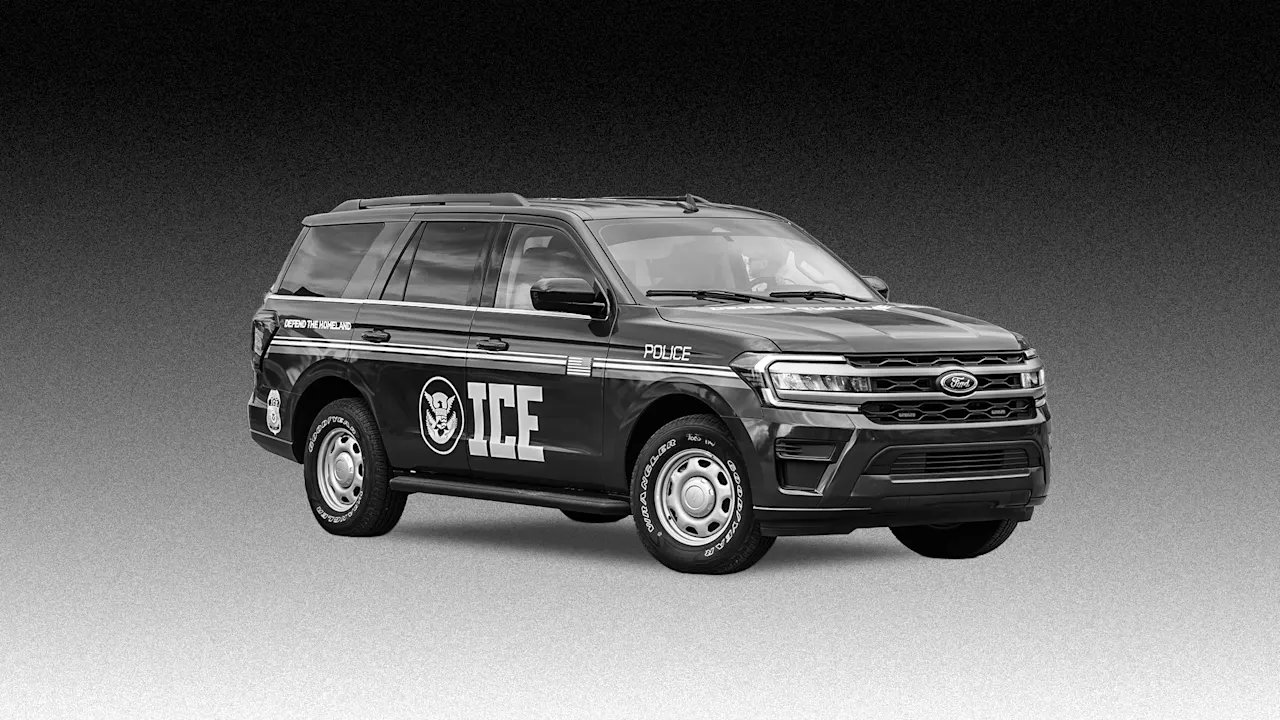
One week ago, a Savannah, Georgia, woman was killed during an Immigration and Customs Enforcement (ICE) pursuit.
It’s not the first time in recent weeks that a bystander has been killed by ICE. However, this story—one involving a Black bystander—hasn’t taken off with the same ferocity as the others that have flooded our feeds and torn at our collective heartstrings. In fact, many people haven’t even heard about this recent incident.
Linda Davis, a beloved 52-year-old mother of five, was struck by a truck driven by a man who was fleeing immigration officers. Davis taught kindergarten and first grade at Herman W. Hesse K-8 School in Savannah’s southside suburbs, less than a half mile from where she was killed.
The school’s principal, Alonna McMullen, mourned her death in a statement to PBS. “It was extremely difficult to tell 5- and 6-year-olds that the teacher they loved and cherished will not be returning to see them,” McMullen said. “To see the looks on their faces—it broke my heart.”
Davis’s family also released a statement about her tragic and untimely passing, but noted that they would not yet “speculate about the circumstances” that led to it.
Meanwhile, the Department of Homeland Security (DHS), was quick to blame Oscar Vasquez Lopez, the suspect who was fleeing ICE when his car collided with Davis’s. In a statement, DHS described Lopez as “a criminal illegal alien from Guatemala who was issued a final order of removal by a federal judge in 2024.”
Different circumstances, and a very different public response
Davis’s death is far from the only news story we’ve seen recently involving ICE-related deaths.
In January, Alex Pretti, a 37-year-old ICU nurse with the Minneapolis VA Health Care System, was shot and killed by Customs and Border Protection (CBP) agents. That shooting came just weeks after Renee Good, a 37-year-old mother of three, was killed by an ICE agent.
In both cases, there was instant outrage across the country, as many Americans started protesting to voice their concerns about ICE’s protocols. As the national reaction swept the country, the number of stories seemed to multiply accordingly.
For weeks, these stories dominated the news cycle and social media, as protests erupted nationwide. More than a month later, demonstrations honoring the two slain civilians have continued in some parts of the country.
Importantly, Davis’s death happened under a different set of circumstances than both Pretti’s and Good’s. For starters, the incident did not involve ICE gunfire.
However, the death did occur as a result of an ICE pursuit. And it comes at a time when many violent altercations with ICE are being documented, raising serious questions about the agency’s impact on public safety.
While the Chatham County Police Department has a “no-chase” policy for nonviolent felonies, the ICE agents seemed to fail to abide by it. In video footage from school zone cameras, three vehicles can be seen chasing Lopez through the school zone. Local police agencies have denied any involvement with the chase.
Chester Ellis, chairman of the Chatham County Board of Commissioners, spoke to WTOC shortly after the incident, noting that local law enforcement agencies in the area have restrictive policies in place that are specifically meant to guard against incidents like this one. “[Our] no-chase policy is to help protect our citizens more than it is anything else,” Ellis said.
Fast Company reached out to DHS for a comment on the footage but did not hear back by the time of publication.
All these recent ICE- and CBP-involved civilian deaths have been troubling. Still, while there have been vigils and a GoFundMe campaign for Davis, as well as some major news stories on the special education teacher, the incident is far from being as visible as those of Pretti or Good. That can be observed in the lack of coverage on major broadcasts, such as ABC World News.
Likewise, the traction gained on the GoFundMe pages for each of the families is notably different, in regard to race. Campaigns for Good and Pretti quickly raised well over $1 million in donations. (At present, they have $1.4 million and $1.8 million, respectively.) In the week since Davis’s passing, the GoFundMe campaign for her family has raised just over $16,000 as of Tuesday.
Davis isn’t the first Black person to be killed recently in relation to ICE. Keith Porter Jr., a 43-year-old father of two, was killed by an off-duty ICE officer in Los Angeles on New Year’s Eve after Porter reportedly fired a gun in the air.
According to an autopsy report, Porter was shot by the officer three times. The local community rallied for accountability from ICE, while DHS has denied any wrongdoing, echoing the organization’s persistent statements that blame the individuals killed by ICE for their own deaths. Porter’s fundraiser has amassed about $300,000 in donations so far.
Ingrained racial bias
It’s tough to miss that there has been far less coverage and, subsequently, less moral outrage involving the most recent ICE-related death. Some experts say that’s not due just to the different set of circumstances, but it instead reflects racial biases that allow some stories to get less circulation.
Brian C. Stewart is a trial attorney at Parker & McConkie who worked for the family of Gabby Petito, the young traveler who was killed by her fiancé in 2021. That story, which captured global attention, was the subject of countless headlines, dominating the news cycle for months. Eventually, it led to a three-part docuseries, along with other TV movies.
Stewart understands how racial bias impacts how stories travel well. He tells Fast Company that there’s even a name for it. It’s called “missing white woman syndrome,” and it “refers to the fact that when a white woman goes missing, her case is much more likely to receive widespread media coverage than when a woman of color goes missing,” he says.
Stewart continues: “The issue isn’t that those cases shouldn’t get attention; it’s that many others don’t.”
The Salt Lake City attorney says that cases involving women of color often don’t get the same kind of attention. However, he adds that it’s not just one system that allows for that bias to continue—it’s all of them.
“Media outlets, law enforcement, social media platforms, and even the public all play a role,” Stewart explains. “What gets shared, clicked on, and prioritized shapes which cases receive attention.”
Not only does the lack of attention lead to cases stalling, he adds, but it “leaves families feeling forgotten,” too.
Media studies research underscores coverage disparities
Surely, there are always arguments to be made about how different circumstances may lead to different reactions or may even detract from widespread national moral outrage.
However, given how many more Black Americans are killed by law enforcement than white Americans (about three times as many fatal shootings), equality—in terms of uproar—feels extraordinarily far off.
In part, that may be because Americans don’t see as many news stories on Black tragedies. According to a 2020 data analysis published in the journal Sociology of Race and Ethnicity, when victims are killed in “predominantly Black neighborhoods,” the stories aren’t covered as often as those that occur in non-Hispanic white neighborhoods.
Likewise, the way those stories are covered is often different. “Those killed in predominantly Black or Hispanic neighborhoods are also less likely to be discussed as multifaceted, complex people,” the report explains.
A 2021 report from the Equal Justice Initiative and Global Strategy Group on disparities in media coverage also found racial bias, with the bias showing up in 20 different areas of media coverage.
For example, mugshots were used in coverage of cases involving Black defendants 45% of the time, compared with just 8% of the time for white defendants. White defendants were called by their names 50% more than Black defendants.
Meanwhile, white victims were shown in photos with friends and family—aimed at drawing sympathetic responses—four times more than Black victims.
So far, it’s unclear as to whether ICE will be held accountable for any of the deaths that have occurred as a result of the organization’s pursuits. But, at a bare minimum, the public deserves to know about each and every one, regardless of circumstance or of skin color.