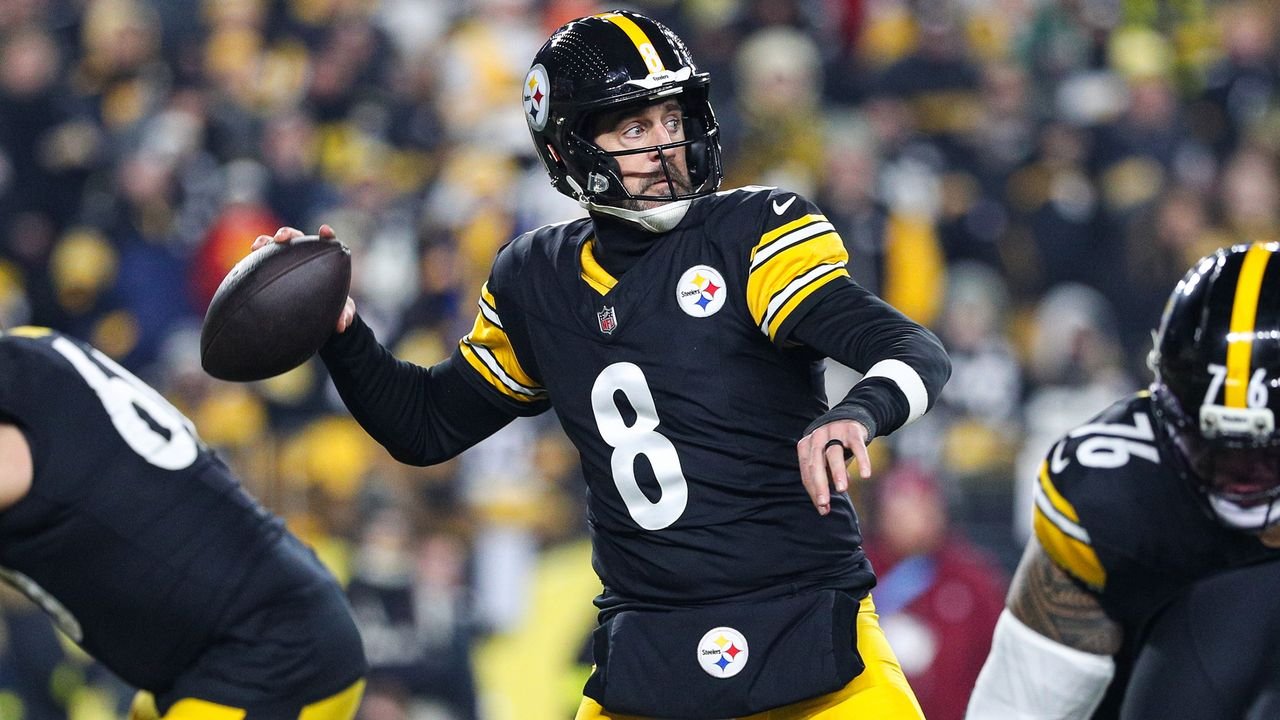
How much of his declining skills—or growing media presence—actually mattered to what he might contribute to the Steelers? Tomlin had previously demonstrated an inexplicable ability to lead teams to wins with terrible offenses. His Steelers had won games with Mason Rudolph and Duck Hodges at quarterback. They had made the playoffs with Kenny Pickett and Mitchell Trubisky as starters. Last season, Tomlin benched Justin Fields for Russell Wilson, who took the team off a cliff in the last four games of the regular season—and the Steelers still finished 10–7. But, coming into this year, the Steelers had lost six straight playoff games, and they haven’t won during the post-season since 2016. For years, people have whispered that Tomlin was near the end of his tenure. And it’s possible to see something a little desperate in the Steelers’ pursuit of Rodgers. But Rodgers is also a four-time M.V.P. award winner, a future Hall of Famer, a model for the modern quarterback. And he could still, on occasion, flick a long spiral up the seam and hit a receiver in stride, the kind of throw that seems to turn chaos into perfect, thrilling order. Rodgers had already declined the chance to be Robert F. Kennedy, Jr.,’s running mate during the 2024 Presidential campaign, he said, because he wanted to keep playing. And the whole Jets thing hadn’t worked out. He needed a job. And Tomlin needed a quarterback.
Perhaps the vision wasn’t the result of a bad burrito, or of taking ayahuasca with Rodgers on one of Rodgers’s spiritual quests. Perhaps there was something logical about it. It seemed that way for a while. The Steelers started the season 4–1. Rodgers began the season by laughing at his old team, the Jets, scoring four touchdowns. The Steelers beat the New England Patriots (one of only three teams to do so all season) and then went to Ireland to beat the Minnesota Vikings. They lost to the Cincinnati Bengals—who, with their star quarterback Joe Burrow injured, employed another fortysomething, Joe Flacco—but Rodgers put in a vintage performance, with four touchdowns and nearly a fifth, a Hail Mary attempt that flew sixty-eight yards through the air before it was batted down. He’s still got the arm, at least some of the time.
But not the legs, it seems. No one this season got rid of the ball faster than he did, whether the situation seemed to call for a quick pass or not. Only one wide receiver, DK Metcalf, had Rodgers’s obvious trust; his targets were often the Steelers’ running backs, closer to hand. That Hail Mary was an anomaly: no other quarterback’s completions travelled a shorter distance, on average, past the line of scrimmage. And when the pocket broke down, he usually crumbled with it. Yet there he was, in the final moments of the regular season, with his arms triumphantly raised.
Was he responsible for bailing his teammates out under pressure, or for putting them in trouble to begin with? Rodgers is football’s Rorschach test, one of the league’s most polarizing players. It’s a role he seems comfortable in; it fits with his contrariness, and provides an ongoing relevance. The Steelers finished the season with their usual 10–7 record. (Maybe Tomlin’s vision was actually for more of the same.) On Monday, in any case, he’ll get another chance to finally win a big game: the Steelers host the Houston Texans during the wild-card round of the playoffs, with the winner advancing. It will be Rodgers’s twenty-second playoff start; his first came when the Texans’ quarterback, C. J. Stroud, was eight years old.
The Texans are a flawed and beatable team, but they have one of the league’s best defenses, which means that it won’t be an easy night for Rodgers, most likely. But when has Rodgers ever made things easy? Before the start of the season, he said that he was “pretty sure” he’d retire after it was over. But after the Ravens game, he refused to close the door on his career. Who knows what visions may lie ahead? ♦